

Kotak
Stockshaala
Chapter 2 | 3 min read
Supertrend Flip Reversion Scalping
On a choppy, directionless day, a popular indicator kept flipping from green to red and back again. Every flip lured trend traders into a breakout that immediately failed. One scalper watched the same flips and did the opposite. Each time a flip failed to follow through, she faded it, taking small profits as price snapped back into its range. The chop that frustrated everyone else was her edge.
This is the Supertrend Flip Reversion Scalp. It is built for sideways sessions, and it turns the Supertrend's biggest weakness, its false flips in a range, into the actual signal.
The Setup
The Supertrend is a trend-following indicator that plots a line which flips from below price to above it as direction changes.
In a trending market it is helpful. In a sideways, choppy market it is a menace, flipping repeatedly and giving false signals in both directions.
The Swing Trading course covers the Supertrend fully; here we exploit its known weakness.
The key insight: in a range, a Supertrend flip usually fails. Price flips the indicator, then cannot follow through, and closes back inside the prior range. That failure is your trigger. You are not trading the flip, you are trading its failure.
Entry: wait for a flip to occur, then for price to fail to continue and close back inside the prior range. Enter against the flip on that retest failure. If the indicator flipped to bullish but price fell back into the range, you enter short.
Stop: at the flip extreme, the furthest point price reached during the false flip.
Exit: a quick snap back to the mean, the opposing EMA, or the opposite edge of the range.
The Analogy
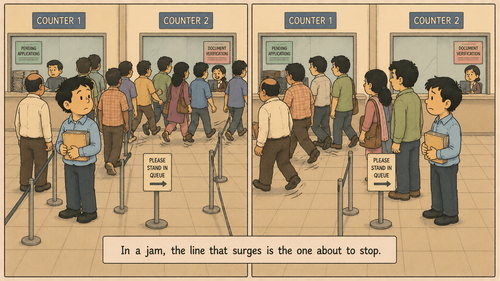
Picture a man standing in a long queue at a government counter, watching the queue beside him suddenly start moving. He switches. The moment he does, his new queue stops dead and the one he left begins to move again. Anyone who has stood in enough queues learns the pattern. A failed Supertrend flip is that surging queue. In choppy conditions, the line that looks like it is finally going somewhere is precisely the one about to stall.
A Worked Example
This example uses: entry ₹500, account capital ₹5,00,000, 1% risk per trade (₹5,000). The stop distance varies by setup.
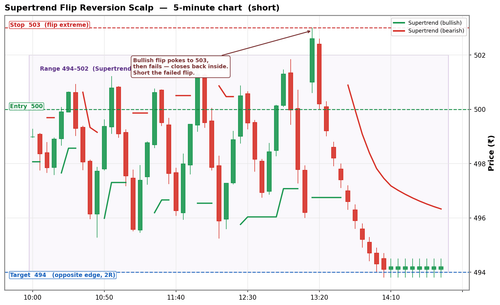
Note that this is a short trade. On a choppy session, the Supertrend flips bullish, but price fails to follow through and closes back inside its range.
Step | Level (₹) | Detail |
|---|---|---|
Session context | - | Sideways, choppy range; Supertrend flipping often |
Prior range | 494 to 502 | Price rotating inside this band |
Bullish flip attempt | up to 503 | Supertrend flips bullish, price pokes to ₹503 |
Failure (close back inside range) | 500 | Price closes back inside the range at ₹500 |
Entry (against the flip, short) | 500 | Enter short on the retest failure |
Stop (flip extreme) | 503 | Risk = ₹3 per share |
Position size | 1,666 shares | ₹5,000 / ₹3 |
Target (snap to mean / opposite edge) | 494 | Reward = ₹6 per share, R-multiple = 2.0R |
Common Mistakes
Mistake 1: Using this setup in a trending market
This is a range-only tool. In a genuine trend, a Supertrend flip is real and following through is the norm. Fading flips in a trend means fighting a moving market repeatedly. Confirm the session is choppy and range-bound first.
Mistake 2: Entering the moment the flip happens
The trigger is the failure of the flip, not the flip itself. You must wait for price to fail to continue and close back inside the prior range. Entering on the flip alone means you are just taking the false breakout you meant to fade.
Key Takeaways
- The Supertrend Flip Reversion Scalp is a range-only setup that fades failed Supertrend flips in choppy, sideways sessions.
- The trigger is a flip that fails to follow through and closes back inside the prior range. Enter against the flip; stop goes at the flip extreme.
- Target a quick snap back to the mean or the opposite edge of the range. Never use this setup in a trending market.
Assignment
- Find a recent choppy, range-bound session on a 5-minute chart and add the Supertrend.
- Count how many times it flipped. For each flip, note whether price followed through or failed and closed back inside the range.
- On the failures, measure how far price snapped back toward the opposite edge.
How many flips failed? This will show you why the chop is the opportunity here.
In the next chapter, we add a precise intraday framework for range days. The CPR Mean Reversion Scalp uses the Central Pivot Range to define exactly where a rotating market is likely to turn.
Disclaimer: This article is for informational purposes only and does not constitute financial advice. It is not produced by the desk of the Kotak Neo Research Team, nor is it a report published by the Kotak Neo Research Team. The information presented is compiled from several secondary sources available on the internet and may change over time. Investors should conduct their own research and consult with financial professionals before making any investment decisions. Read the full disclaimer here.
Investments in securities market are subject to market risks, read all the related documents carefully before investing. Brokerage will not exceed SEBI prescribed limit. The securities are quoted as an example and not as a recommendation. SEBI Registration No-INZ000200137 Member Id NSE-08081; BSE-673; MSE-1024, MCX-56285, NCDEX-1262.
Recommended Courses for you



















Learn, Invest, and Grow with Kotak Videos
Explore our comprehensive video library that blends expert market insights with Kotak's innovative financial solutions to support your goals.

Trading with collateral as margin with Kotak Neo

How India is Redefining Space Exploration