

Kotak
Stockshaala
Chapter 3 | 3 min read
CPR Mean Reversion Scalping
Some days a stock simply refuses to trend. It drifts up to a level, stalls, drifts back down to another, stalls again, and repeats this rotation all session. To an impatient trader it is maddening. To a scalper armed with the right map, each edge of that rotation is a high probability turn, marked in advance before the day even begins.
That map is the Central Pivot Range, and this is the CPR Mean Reversion Scalp. It trades the rotation of a range-bound day between levels calculated from the previous session.
The Setup
The Central Pivot Range, or CPR, is a set of three horizontal lines calculated from the previous day's high, low, and close: a central pivot with a top and bottom band around it.
Together they mark the levels the market is likely to treat as fair value for the day. Your charting platform plots them automatically before the open, so you know your zones in advance.
The setup works on a range-bound day, especially a wide-CPR day, where price rotates between the CPR top and bottom rather than trending away.
You treat the CPR top and bottom as mean reversion zones: price stretching to one band is likely to rotate back toward the pivot.
Entry: wait for price to test the CPR top or bottom and print a rejection candle, then enter on the break of that rejection candle, in the direction of the pivot. For a test of the CPR bottom, that means going long back toward the middle.
Stop: beyond the CPR band plus the last swing extreme, giving the level a little room.
First target: book at the CPR pivot.
Trail: if momentum carries through the pivot, trail toward the opposite band or the next key level.
The Analogy
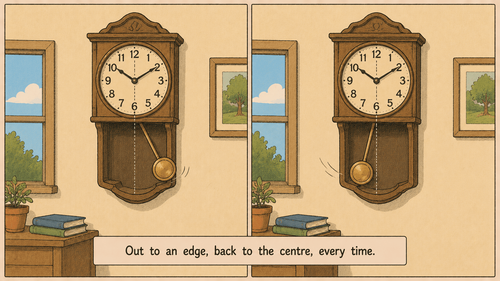
Think of the pendulum on an old wall clock. It travels out to one extreme, slows, and comes back through the centre, then out to the other extreme and back through the centre again. It never stays at an edge. The centre is where it spends its time and always returns. On a range day, price moves the same way, rotating out to a CPR band and back toward the central pivot.
A Worked Example
This example uses: entry ₹500, account capital ₹5,00,000, 1% risk per trade (₹5,000). The stop distance varies by setup.
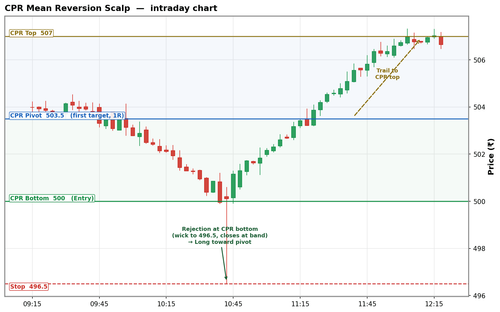
On a range-bound day, the CPR pivot sits near ₹503.5 with the bottom band around ₹500. Price rotates down to the bottom band and rejects it.
Step | Level (₹) | Detail |
|---|---|---|
CPR for the day | 500 / 503.5 / 507 | Bottom band / pivot / top band |
Test of CPR bottom | 500 | Price rotates down and tests the bottom band |
Rejection candle | 496.5 to 500 | Wick to ₹496.5, closes back at the band |
Entry (break of rejection high, long) | 500 | Enter long toward the pivot |
Stop (beyond band + swing extreme) | 496.5 | Risk = ₹3.5 per share |
Position size | 1,428 shares | ₹5,000 / ₹3.5 |
First target (CPR pivot) | 503.5 | Reward = ₹3.5 per share, R-multiple = 1.0R, book here |
Trail (if momentum continues) | 507 | Toward the opposite CPR band |
Booking the first target at the pivot is a 1R scalp. The trail toward the opposite band is what lifts the average result above 1R across many trades, but only when momentum genuinely carries through the pivot.
Common Mistakes
Mistake 1: Trading CPR reversion on a trending day
The CPR mean reversion setup needs rotation. On a strong trending day, price breaks a CPR band and runs, and fading it means standing in front of the move. A narrow CPR often warns of a trend day; a wide CPR favours rotation. Read the day type first.
Mistake 2: Holding past the pivot without booking
The first target is the pivot, and it should be booked. Letting a full position ride past it hoping for the opposite band gives back a certain 1R gain for an uncertain one. Book at the pivot, then trail only a portion if momentum is strong.
Key Takeaways
- The Central Pivot Range is three lines (pivot, top band, bottom band) from the prior day's high, low, and close, marking the day's fair-value zones.
- On a range-bound or wide-CPR day, fade the bands back toward the pivot: enter on a rejection candle break, stop beyond the band plus swing extreme.
- Book the first target at the pivot. Trail toward the opposite band or next key level only if momentum continues through the pivot.
Assignment
- Enable the CPR on your charting platform and note the three levels for a liquid stock before the open.
- During a range-bound session, watch how price behaves at the CPR top and bottom. Did rejection candles form? Did price rotate back to the pivot? Measure how often the pivot was reached after a band rejection.
Note whether the day was a rotation day or a trend day, and how the CPR width hinted at which it would be.
That completes the mean reversion module. Next we shift to the third style. In the Breakout and Expansion module, we trade the moment a coiled, quiet market finally bursts into motion, starting with the EMA Breakout Scalp.
Disclaimer: This article is for informational purposes only and does not constitute financial advice. It is not produced by the desk of the Kotak Neo Research Team, nor is it a report published by the Kotak Neo Research Team. The information presented is compiled from several secondary sources available on the internet and may change over time. Investors should conduct their own research and consult with financial professionals before making any investment decisions. Read the full disclaimer here.
Investments in securities market are subject to market risks, read all the related documents carefully before investing. Brokerage will not exceed SEBI prescribed limit. The securities are quoted as an example and not as a recommendation. SEBI Registration No-INZ000200137 Member Id NSE-08081; BSE-673; MSE-1024, MCX-56285, NCDEX-1262.
Recommended Courses for you



















Learn, Invest, and Grow with Kotak Videos
Explore our comprehensive video library that blends expert market insights with Kotak's innovative financial solutions to support your goals.

Trading with collateral as margin with Kotak Neo

How India is Redefining Space Exploration