West Asia War Hits ₹50,000 Crore Basmati Trade
 Add Preferred News Source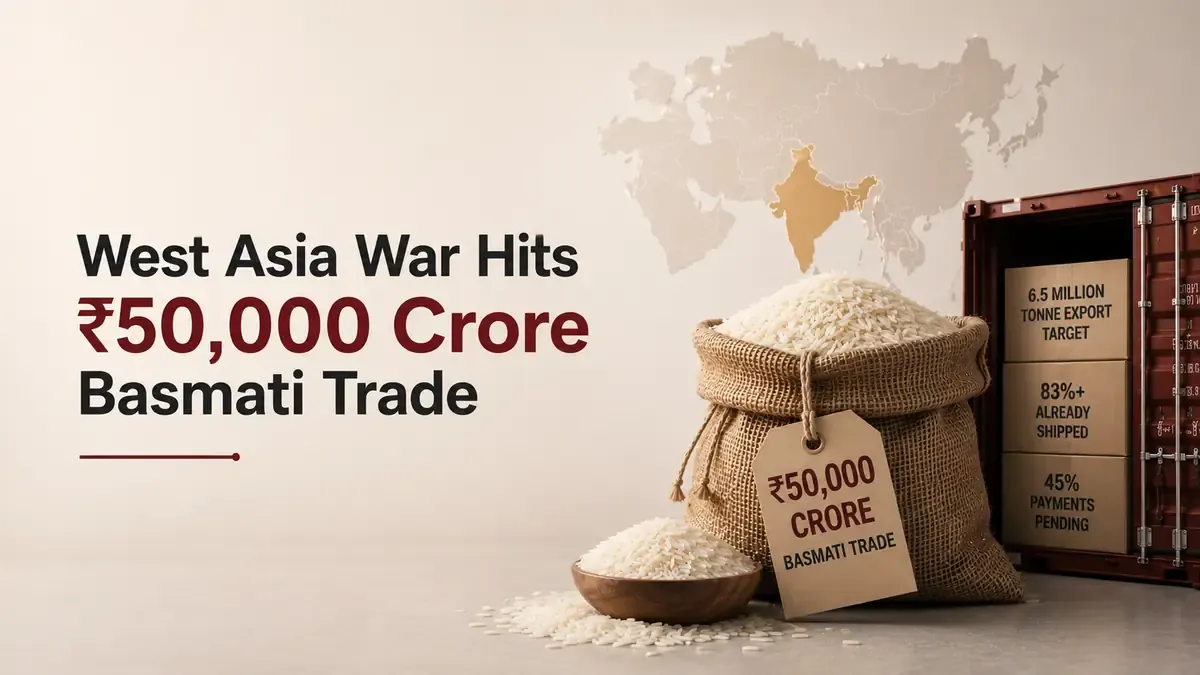
West Asia tensions threaten India’s ₹50,000 crore basmati trade, with 45% payments pending and over 83% of the 6.5 million tonne export target already shipped.
The war in West Asia is now affecting one of India’s biggest agricultural exports, basmati rice. The trade, valued at nearly ₹50,000 crore a year, is facing shipment delays, payment uncertainty and rising freight costs as tensions disrupt routes to Iran and Gulf countries.
Exporters in Punjab and Haryana are particularly exposed. Together, the two states account for around 75% of India’s premium basmati exports, with Punjab accounting for about 40% and Haryana roughly 35%.
After US-Israel strikes on Iran on February 28 and Iran’s retaliatory attacks, fears have grown about restrictions in the Strait of Hormuz, a key shipping route.
The Indian Rice Exporters Federation (IREF) has advised members not to enter new cost, insurance and freight (CIF) contracts with Iran and Gulf destinations. Under CIF deals, sellers bear shipping and insurance costs until goods reach the buyer’s port, a risk exporters are now reluctant to take.
Why Are Exporters Worried Despite Strong Shipments?
By January 31, about 5.4–5.5 million tonnes of basmati had already been shipped, over 83% of the 6.5 million tonne target for the financial year. Demand remained firm through December and January, especially ahead of Ramadan.
Nearly 45% of the export value is still pending. The basmati trade runs largely on credit, and payments often arrive months after delivery. With banking channels in parts of West Asia, especially Iran, facing disruption, exporters are unsure when funds will come in.
Some consignments heading to Iran or Afghanistan through Iran’s Bandar Abbas port have been delayed. Reports suggest shipping companies have paused vessels in transit. Containers are stuck at ports or at sea, increasing storage and demurrage costs.
Exporters are also wary because earlier US sanctions had already created trouble. In January, grain stocks worth nearly ₹2,000 crore were left stranded when Iran restricted food trade.
How Dependent Is India On West Asian Markets?
India produces more than 70% of the world’s basmati and ships close to 60 lakh tonnes every year. The Middle East and West Asia remain the biggest buyers.
Between April and December 2025, basmati exports to Middle Eastern countries were worth ₹27,197 crore. Iran alone imported rice valued at about ₹6,000 crore during this period. Around 7.8 lakh tonnes were shipped to Iran between April 2025 and January 2026.
Countries such as Saudi Arabia, Iran, Iraq, the UAE and Yemen together account for nearly half of India’s basmati exports. The wider region absorbs close to 70% of shipments.
Exporters say the current risks include:
-
Delayed payments due to banking disruptions
-
Longer credit cycles, especially in Iran
-
Higher freight and insurance costs
-
Containers stuck at ports or in transit
There are also concerns about maritime risks in the Red Sea. If tensions spread toward the Strait of Hormuz, shipping costs could rise further. Exporters have therefore been advised to prefer free-on-board (FOB) contracts, where buyers take responsibility for shipping.
Also Read - NHAI-Backed Raajmarg InvIT Targets ₹6,000 Crore IPO
What Is Being Done To Manage The Fallout?
The Centre has begun reviewing the situation. At a meeting held on March 2 at Vanijya Bhawan in New Delhi, officials from the Department of Commerce assessed the impact of the conflict on trade and logistics.
A coordination mechanism is being created to track freight rates, shipment delays and payment exposure. Weekly reviews have been proposed.
The Reserve Bank of India and the Department of Financial Services have been asked to examine export credit support for traders facing liquidity stress. Authorities are also working to improve coordination among ports, banks, insurers and shipping companies.
For now, exporters in the agriculture sector remain cautious. While volumes shipped have been strong, uncertainty over payments and rising logistics costs pose serious risks. If the conflict continues, falling basmati prices could hurt both traders and farmers in Punjab and Haryana.
The immediate threat is not demand. It is the disruption of trade routes, finance and insurance in a region that remains central to India’s ₹50,000 crore basmati business.
Sources:
HindustanTimes
Indian Express
This article is for informational purposes only and should not be considered investment advice from Kotak Neo. For compliance T&C and disclaimers, Visit https://www.kotakneo.com/disclaimer/
This article is for informational purposes only and should not be considered investment advice from Kotak Neo. For compliance T&C and disclaimers, Visit www.kotakneo.com/disclaimer
Right Tools, Rich Insights