US Revises India Trade Deal Terms; Pulses Protected, $500 Billion Clause Softened
 Add Preferred News Source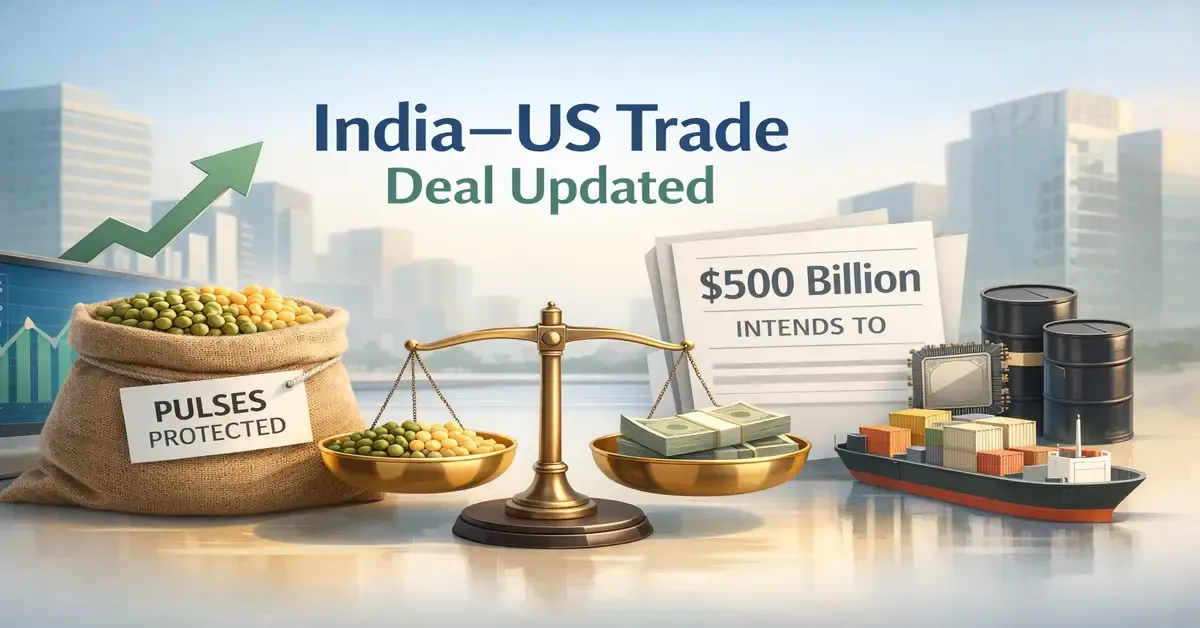
The United States has revised the official fact sheet accompanying its recently announced trade agreement with India, introducing subtle but important changes.
At first glance, the structure of the deal remains intact. Tariff reductions are still on the table. Market access remains a shared objective. But the updated language reveals a careful recalibration reflecting domestic sensitivities on both sides.
The agreement was announced separately by Prime Minister Narendra Modi and US President Donald Trump, followed by a joint statement outlining tariff measures and economic cooperation. The new version of the US fact sheet now aligns more closely with India’s publicly released agriculture chapter.
Why Were Pulses Removed From the Tariff List?
One of the most notable changes is the removal of “pulses” from the list of American products on which India would eliminate or reduce tariffs.
The revised document now states that India will cut tariffs on:
-
US industrial goods
-
Dried distillers’ grains (DDGs)
-
Red sorghum
-
Tree nuts
-
Fresh and processed fruits
-
Soybean oil
-
Wine and spirits
-
Additional specified products
Pulses are no longer mentioned. This revision mirrors India’s agriculture chapter, which places pulses under a highly sensitive Exemption category. In simple terms, they remain fully protected.
Commerce and Industry Minister Piyush Goyal has described the agreement as “farmers-first.” In parliamentary remarks and press briefings, he emphasised that agriculture, dairy, and other sensitive sectors have been safeguarded.
What Changed in the $500 Billion Purchase Language?
The second major change lies in the wording around India’s procurement commitments.
Earlier, the US fact sheet stated that India “will purchase over $500 billion” worth of American energy, information and communication technology (ICT) products, agricultural goods, coal, and other items.
That phrasing has now been revised. The document says India “intends” to purchase over $500 billion of:
-
Energy products
-
Information and communication technology goods
-
Coal
-
Other specified items
The joint statement had already used similar wording, referring to India’s intention to purchase US energy products, aircraft and aircraft parts, precious metals, technology products, and coking coal over the next five years.
The difference between “will” and “intends” is not minor.
“Will” signals a binding obligation. “Intends” leaves room for commercial viability, market pricing, and evolving negotiations. For sectors anticipating large export flows, this shift tempers expectations without reversing direction.
Alongside this, Trump reduced the 25% reciprocal tariff on India to 18% and removed an additional 25% levy that had been imposed over India’s purchases of Russian oil. That rollback offers immediate relief to certain Indian exporters.
Has the Digital Services Tax Commitment Been Dialled Back?
The earlier US version claimed that India “will remove its digital services taxes” and committed to negotiating strong bilateral digital trade rules.
The updated fact sheet removes the claim regarding tax removal.
What remains is a commitment to negotiate robust digital trade rules addressing discriminatory practices and barriers to digital trade as part of the broader Bilateral Trade Agreement (BTA).
This is a meaningful narrowing of language. It indicates that digital taxation remains under negotiation rather than a settled policy.
The joint statement also refers to an “interim agreement,” suggesting that discussions toward a comprehensive BTA are still underway. In other words, more adjustments could follow.
What Does the Agriculture Chapter Reveal?
Beyond pulses, the fine print of the agriculture chapter is structured around gradual adjustment.
India has committed to phasing out tariffs, over a period of up to ten years, on several intermediate agricultural inputs used by the food processing industry.
These include:
-
Albumins
-
Coconut oil, castor oil, and cottonseed oil
-
Hoofmeal
-
Lard and stearin
-
Modified starches
-
Peptones and plant derivatives
The long transition window provides domestic processors and farmers time to adapt. It also reflects the government’s attempt to balance trade liberalisation with economic cushioning.
From the American side, US Agriculture Secretary Brooke Rollins welcomed the agreement, stating that it would expand export opportunities for American farmers and boost rural incomes.
Source:
Economic Times
Kotak Neo News Desk is a team of enthusiastic market observers backed by Kotak’s 30+ years of legacy, working round the clock to bring the latest news about equities, IPOs, corporate developments, commodities, and economic trends from the financial world.
This article is for informational purposes only and should not be considered investment advice from Kotak Neo. For compliance T&C and disclaimers, Visit https://www.kotakneo.com/disclaimer/
This article is for informational purposes only and should not be considered investment advice from Kotak Neo. For compliance T&C and disclaimers, Visit www.kotakneo.com/disclaimer

Kotak News Desk brings you latest updates, expert insights, and market-ready ideas - helping you stay informed and invest smarter.
Connect on: Linkedin
0 people liked this article.