Is The ₹3,486 Cr. Loss A Temporary Roadblock For Tata?
- By Kotak News Desk
- 06 Feb 2026 at 2:31 PM IST
- Market News
- 4m
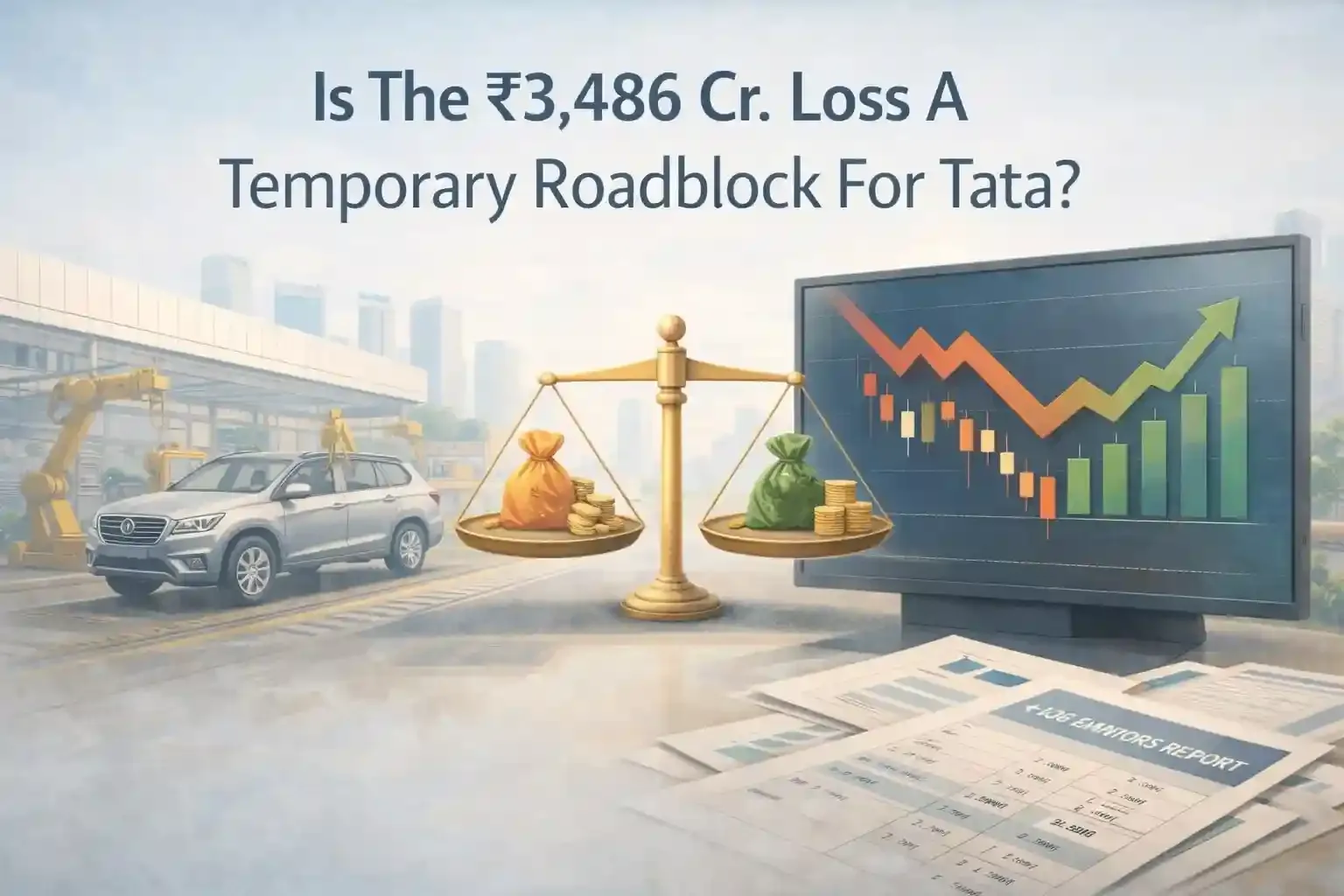
Tata Motors Passenger Vehicles reported a consolidated net loss of up to ₹3,486 Cr. for Q3 FY26, as a major cyber incident at Jaguar Land Rover weighed on global performance. Learn how, despite the consolidated drag, domestic sales hit record highs.
On 05 February 2026, Tata Motors Passenger Vehicles (PV) reported a consolidated net loss of up to ₹3,486 Cr for the third quarter. For the same period last year, the company had recorded a profit of ₹5,485 Cr.
This Q3 results downturn was largely due to a heavy revenue decline of 25.8% to ₹70,108 Cr. Total expenses too remained high at ₹74,880 Cr. The expenses were mainly increased due to exceptional items totalling ₹1,600 Cr., comprising:
-
₹800 Cr. related to a cyber incident at Jaguar Land Rover (JLR)
-
₹400 Cr. for new labour code provisions
-
₹400 Cr. in stamp duty
However, the Indian passenger vehicle segment witnessed its highest-ever quarterly wholesales at 1,71,000 units. Also, the retail sales surpassed the 2,00,000 units milestone for the first time. Now, an important question for the investors is: Can the domestic record-breaking sales lead to a turnaround for Tata Motors PV in the future?
Domestic Record-Breaking Sales Fuelling The Future
The domestic passenger vehicle business in India seems to be firing on all cylinders. The credit mainly would go to the implementation of Goods and Services Tax (GST) 2.0. The new GST norms seem to have increased the demand across various segments.
Tata Motors could have leveraged this momentum with:
-
The Nexon maintaining its crown as a top-selling model
-
The Punch witnessing a high volume expansion in its new avatar
-
The Sierra is making a strategic debut. Reportedly, the model gained an exceptional response from the premium customer base.
-
Diversifying its portfolio with petrol variants for the Sport Utility Vehicles (SUVs) Harrier and Safari
Thus, Tata Motors PV has managed to fill important gaps. They adopted a product-led strategy resulting in the domestic business achieving a healthy net cash position of ₹5,100 Cr.
The company's "highest-ever" milestones in wholesale and retail suggest that brand loyalty and product value propositions might be at an all-time high.
The success of the Sierra and the new petrol SUV variants can be the main indicators for retaining Tata Motors Passenger Vehicles market share in a highly competitive domestic market. But what were the exceptional items that led to a high increase in the company’s expenses?
Exceptional Items And JLR Disruption
The main downward pull on Tata Motors' consolidated earnings in Q3 was the "perfect storm" of international operational hurdles and regulatory adjustments. Here are the main reasons explained below.
-
The Cyber Incident - The luxury arm, Jaguar Land Rover (JLR), continued to navigate the after-effects of a major cyber incident that disrupted global logistics and delivery schedules. The inability to fully take advantage of the global demand for luxury SUVs during the high-margin winter quarter impacted the consolidated balance sheet.
-
The New Labour Code - The provision for the new labour code reflects a proactive approach to evolving employment laws. However, its immediate financial impact was a combination of significant stamp duty charges and additional layers of cost. The company’s revenue growth could not completely absorb these additional expenses.
-
Difference between Luxury and Mass Market Segments - Interestingly, the expenses were lower than the previous year due to globally reduced production volumes. The luxury segment was struggling globally. However, the mass-market or the cheaper vehicles were a success. Now, the market will be closely watching for a normalisation of Jaguar Land Rover (luxury) operations and the sustained impact of new launches like the Sierra (mass-market).
The repeating nature of "exceptional items" across multiple quarters seems to require a closer look at the company's cost-management approach. So, for traders and investors, the focus might now shift from the "shocks" of the past quarter to the "execution" of the next.
Moving Towards The Recovery Lane
With the Tata Motor Passenger Vehicles Q3 FY26 results, investors witnessed a classic "tale of two markets", the global luxury and the domestic market.
-
The heavy consolidated loss reflects the fragile nature of global luxury retail when faced with digital and regulatory hurdles.
-
The domestic performance confirms that the Indian consumer's appetite for premium, tech-enabled, and "Made in India" vehicles remains strong.
The divergence in Tata Motors PV Q3 results can be seen as a unique study in risk management. Here, the domestic business can be seen as profit-making with record volumes, and the JLR segment (luxury) as the high-risk and high-reward component.
Source:
Financial Express
Outlook Money
Livemint
MSN

Since its incorporation on 20 July 1994, Kotak Neo has grown into one of India’s most trusted brokerage houses - backed by over 30 years of expertise across stocks, funds, IPOs, and full-service investing.
With a pan-India footprint of 145+ branches, 1000+ franchises and presence across 310+ cities, Kotak Neo serves 5 million+ customers nationwide.
From equities and IPOs to mutual funds and derivatives, Kotak offers comprehensive, research-backed investment solutions - simplifying wealth management for retail and institutional clients alike.
Kotak News Desk brings you latest updates, expert insights, and market-ready ideas - helping you stay informed and invest smarter.
Connect on: Linkedin
0 people liked this article.