 Add Preferred News Source
1,010 Views| 23 Oct 2026
Will RBI’s UTI Mandate Clear The OTC Derivative Fog?
Summary
The RBI has mandated a ‘Unique Transaction Identifier’ for all OTC derivatives starting 01 January 2027. Read ahead about how this regulatory shift aims to align Indian markets with global standards, enhancing transparency and systemic risk monitoring.
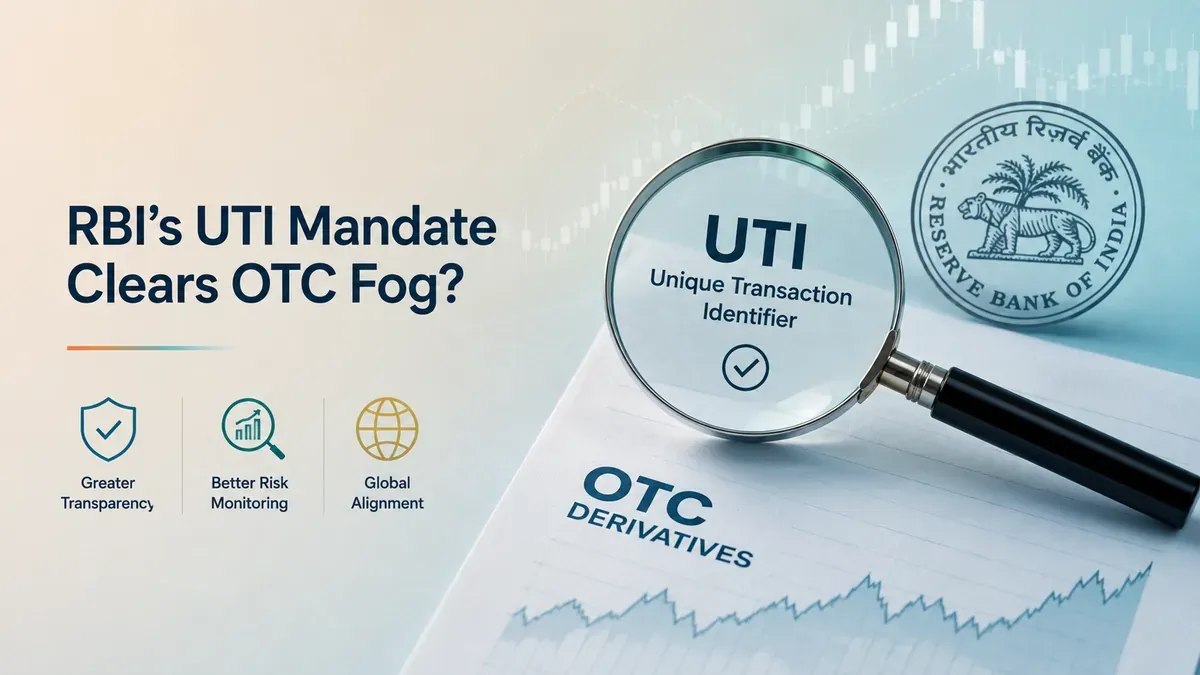
Over-the-counter (OTC) derivative trades in India will now need a Unique Transaction Identifier (UTI) from January 1, 2027. The Reserve Bank of India (RBI) has deferred the rollout by nine months, giving banks and other market participants additional time to upgrade their systems and reporting processes, according to the final guidelines issued on Wednesday.
The rule was earlier scheduled to take effect from April 1, but was pushed back after industry feedback. The extended timeline is meant to help participants put the required technology in place.
Under the new framework, every OTC derivative transaction must carry a UTI, functioning as a unique digital tag. At present, such trades are reported to the trade repository operated by the Clearing Corporation of India Limited.
The introduction of a standardised identifier can effectively stitch together fragmented reporting systems. It can complement the existing Legal Entity Identifier (LEI) system, which identifies ‘who’ is trading, by adding a specific tag for ‘what’ is being traded.
The question for investors is: as the regulatory landscape tightens, are our trading desks prepared for the era of the digital audit trail?
What Exactly Is UTI & How Does It De-Clutter The Market?
Let us understand the Unique Transaction Identifier (UTI) to learn the significance of the RBI move. You can think of it as a "global passport" for an individual trade. Here is how the UTI system works.
Regulatory Ease - Many trades do not happen on a public exchange (like the NSE or BSE); instead, they occur OTC. An "over-the-counter" derivative is a private financial contract that does not trade on an exchange. These trades are customised and private. So, they are harder to track than regular stocks. Because they are private, they can sometimes be like a black box for regulators. A UTI is a long alphanumeric code. It is assigned to every single one of these private contracts, making it easier for regulatory tracking.
Reduced Risk Of Double Counting - The UTI is the specific receipt number for the transaction itself. So, even if a trade is reported by both the buyer and the seller to different repositories globally, the regulator can use the UTI to see that it is actually the same single transaction. This system can prevent double counting and provide a crystal-clear image of how much money is actually at stake in the market.
Synchronised Digital Leadership - With this mandate, the RBI is moving away from fragmented, manual record-keeping towards a synchronised, digital ledger. Thus, every forward contract in government securities or foreign currency interest rate derivatives can be accounted for consistently with international best practices.
Why Does This Global Alignment Matter for Market Stability?
You might be wondering why a "serial number" for a trade requires such a long implementation phase. The answer is the management of ‘systemic risk.’ Here is how the RBI’s move can help bring market stability.
Data Aggregation - The UTI can act as the "financial forensic tool" to solve this. With this, the RBI can aggregate data across the entire market to see where the risks are piling up.
Aligning With Global Standards - The RBI is making a move to align with global data standards by implementing UTI. This move is also important for foreign institutional investors operating across multiple jurisdictions.
Harmonising With Reporting Requirements - As reporting requirements are harmonised, the "compliance friction" for global banks operating in India can be reduced.
Better Policy-Making - UTI can also enable better policy-making. Having a comprehensive view of the OTC derivatives market, the RBI can make more informed decisions about:
-
Interest rates
-
Liquidity management
-
Currency interventions
Therefore, UTI can be seen as a lighthouse helping regulators navigate the complex waters of modern finance without hitting hidden icebergs.
Also Read - RBI’s ECB Reform Could Spark $100B Borrowing
Investor Takeaway
As we move towards this new era of reporting, investors can expect a more robust, data-driven financial system. The "dark corners" of the derivative market are set to be lit up, one transaction at a time. The technical work is happening behind the scenes at major banks. But the end result could be a safer, more transparent playground for everyone involved in the Indian growth story.
Source:
The Hindu BL
CNBC TV18
Kotak Neo News Desk is a team of enthusiastic market observers backed by Kotak’s 30+ years of legacy, working round the clock to bring the latest news about equities, IPOs, corporate developments, commodities, and economic trends from the financial world.
This article is for informational purposes only and should not be considered investment advice from Kotak Neo. For compliance T&C and disclaimers, Visit https://www.kotakneo.com/disclaimer/
This article is for informational purposes only and should not be considered investment advice from Kotak Neo. For compliance T&C and disclaimers, Visit www.kotakneo.com/disclaimer
Right Tools, Rich Insights

Latest News
- 1,002 Views| 23 Oct 2026
- 1,093 Views| 23 Oct 2026
- 1,072 Views| 23 Oct 2026
- 1,013 Views| 23 Oct 2026
- 1,071 Views| 23 Oct 2026
- Paras Healthcare IPO Allotment Status: Check Online on MUFG Intime India, NSE & BSE for Live Updates
 1,010 Views| 23 Oct 2026
 - 1,030 Views| 23 Oct 2026
- 1,025 Views| 23 Oct 2026
- Tata Teleservices Q2 Results: Loss Narrows Sharply, But Shares Crash 11% After Earnings Announcement
 1,035 Views| 23 Oct 2026