XIRR In Mutual Funds – Meaning, Formula & How It Works
- 4 min read
- 1,003
- Published 27 Feb 2026

What is the one thing that most mutual fund investors track post their investment? It is the returns earned. However, have you ever thought about what the right metric is to do so? Especially when your mutual fund investment has multiple investments across different time frames.
In such a scenario, you can use the extended internal rate of return (XIRR). Read on to know all about XIRR in mutual funds, what it means, and its working methodology.
What Is XIRR In Mutual Funds?
XIRR in mutual funds measures your mutual fund returns at the end of your investment tenure. When you invest in mutual funds through systematic investment plans (SIPs), each SIP remains invested for a different period. The SIP amount invested at the beginning of your investment remains active for a longer period, while subsequent SIPs remain invested for a shorter period.
Mutual fund XIRR considers the time frame of every invested SIP installment to give you an accurate picture of the returns earned. If you make any redemptions in between, it also considers that while calculating returns.
How XIRR Works?
Here is how XIRR in mutual funds works:
-
Considers The Time And Cash Flow Value
XIRR considers the amount and timing of your investment for a particular period. It also includes redemptions, if any.
-
Annualises Returns
XIRR converts your gains into a percentage. This percentage is the return you earn on your mutual fund investment at the end of your investment tenure.
Let us understand its working with the help of an example. Suppose you invest ₹5000 via SIPs in a mutual fund. The investment tenure is from 20 January 2025 to 20 December 2025. Upon redemption, your investment value would have been ₹80,000. Check the images below to know the XIRR on your investment:
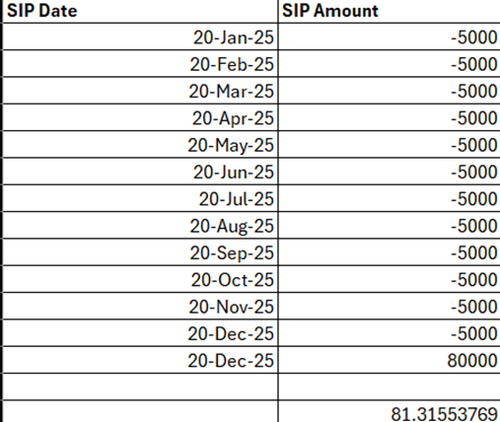
Here, the SIP investment of ₹5000 is taken as negative as money flows out of your bank account. The money you get upon redemption is positive as it flows into your account.
XIRR Formula
MS Excel has an XIRR formula that you can use to calculate returns on your mutual fund investment. The formula is:
=XIRR(Values, Dates, [guess]), where:
- Values reflect the total invested amount, including redemption
- Dates refer to the investment date
- Leave the guess part blank
When Should You Use XIRR?
You should XIRR in the following circumstances:
-
When Investments Are Staggered
Mutual fund XIRR takes into account the staggered nature of SIP investments. In other words, as you invest money every month, the SIP installment amount remains invested for a different period.
-
When You Make Redemptions
XIRR is also useful when you make partial redemptions from your mutual fund investment. In such cases, money flows into your account. XIRR considers and factors it in while calculating returns. Advantages Of XIRR Here are the advantages of XIRR in mutual funds:
-
Flexibility
XIRR adapts to your investment schedule. Irrespective of whether you invest monthly, fortnightly, quarterly, or at irregular intervals, it helps you calculate a consistent measure of your returns.
-
Easy To Use
You can easily use XIRR on MS Excel to calculate your mutual fund returns. Also, there are other online calculators that you can use to calculate XIRR. You need not have advanced mathematical skills to compute it.
-
Accurate Returns
When cash flow is not constant and spread across time periods, XIRR can help you get an accurate estimate of the returns earned. Through it, you can understand if the returns are positive or negative.
Limitations Of XIRR
Along with advantages, XIRR has certain limitations too. These include:
-
Does Not Capture Risk
XIRR does not capture the risk of your investment. Mutual fund investments are subject to market risks. However, XIRR does not factor in such risks in its calculation.
-
Does Not Adjust For Inflation
This is another drawback of XIRR. It does not factor in inflation, which can affect returns. Along with inflation, it also does not consider the taxation aspect while calculating returns. Both inflation and taxation can bring down actual returns earned.
-
Reinvestment Assumption
XIRR assumes interim returns to be reinvested at the same rate. This may not happen in reality. You may reinvest at a lower or higher rate depending on prevailing market conditions.
Conclusion
XIRR works best when you want an honest view of your mutual fund performance, not a simplified headline number. It reflects the timing of every investment and withdrawal, which makes it especially relevant for SIP investors. Still, it should not be read in isolation. Pair it with an understanding of risk, costs, inflation, and time horizon. Numbers inform decisions, but context gives them meaning.
Sources
Value Research
Moneycontrol
Frequently Asked Questions
0 people liked this article.