Absolute Returns vs XIRR: Understanding the Differences
- 5 min read
- 1,004
- Published 24 Feb 2026

You invest in a Mutual Fund (MF), and your MF investment generates 20% returns. You share the news with your friend, only to be asked follow-up questions like: are these returns based on the extended internal rate of return (XIRR) or absolute?
If you invest, or want to invest in mutual funds, it is essential to know whether the returns you see or quote are XIRR or absolute. Though they may look the same, they are not. Read on to know the difference between absolute return and XIRR and their various aspects.
What Is XIRR?
XIRR helps you analyse the performance of your investment when there are multiple cash flows. For instance, when you invest in a mutual fund via a Systematic Investment Plan (SIP), each instalment remains invested for a different duration.
For example, if you contribute monthly to an SIP for 5-years, the first SIP instalment is invested for 5 years, the second for 4 years, 11 months, and subsequent SIPs for lesser periods. So, essentially, each SIP compounds for a different period. XIRR factors in the compounded annual growth of each instalment, adds them together, and gives you the overall rate of growth.
XIRR Formula
You can easily calculate XIRR on MS Excel. The formula to calculate XIRR on Excel is:
=XIRR(Values, Dates, [guess]), where:
- Values is the total amount you have invested, including redemption
- Dates refer to the investment date
- Leave the guess part blank
How XIRR Works In Mutual Funds?
Let us see how XIRR works in the case of a mutual fund investment.
- Suppose you invested ₹10,000 in a mutual fund through SIP.
- The SIP period was from 15 January 2025 to 15 December 2025.
- The amount you get upon redemption is ₹1.3 lakhs.
In this case, the XIRR of your investment is 18.73% (see images).
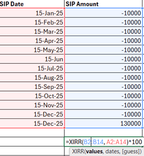
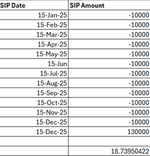
Here, each SIP amount invested is shown as negative, as money is flowing out. The amount upon redemption is positive as money flows in.
When XIRR Is Used?
You can use XIRR in the following scenarios:
-
Multiple Investments
If you make multiple investments over a period of time, such as SIPs in mutual funds, you can use XIRR to get an accurate picture of returns earned.
-
Make Partial Withdrawals
If you make partial withdrawals during your investment and keep the rest of the amount invested, you can use XIRR to accurately calculate returns by factoring in each withdrawal and the remaining investment period.
-
Irregular Cash Flows
If your investment amounts and dates are not fixed, you can use XIRR to get an accurate picture of your investment returns.
What Is Absolute Return?
Absolute return, on the other hand, shows how much your investment has gained or lost over a specific period. Unlike XIRR, it does not factor in the time taken to earn the return.
How Absolute Return Is Calculated?
Absolute Return Formula
The formula to calculate absolute return is as follows:
Absolute return = (Final value - Initial Value) / Initial Value X 100
Suppose you invest ₹1 lakh in a mutual fund and it grows to ₹1.3 lakhs after a year. In this case, absolute return stands at 30%. You can use absolute return in these scenarios:
-
Lumpsum Investments
You invest a large amount (lump sum) in one go and redeem all of it at once at the end. In such cases, absolute return can give you an accurate picture of your returns because there are no interim cash flows to annualise.
-
Short-Term Investments
If you hold on to your investment for a short period of time, say a few months or a year, you can use absolute return because it shows the actual gain without exaggerating it through annualisation.
-
Quick performance snapshot
If you want to know your returns in a quick glance, you can use this metric to track your total gains.
XIRR vs Absolute Return: Major Differences
Here are the differences between XIRR and absolute returns on various aspects:
Time Factor | XIRR considers the period of your investment. As highlighted above, it factors in the time during which your money has remained invested. | Absolute returns do not consider the time factor. It only factors in how much your money has grown at the end of your investment. |
Multiple Investment Impact | XIRR works well with multiple investments as it calculates returns based on when the investment was made. | Absolute returns may not provide an accurate picture of returns earned if you make multiple investments or if you invest your money at different times. |
Accuracy In SIP Investments | XIRR presents a more accurate picture in the case of SIP investments. This is because each SIP remains invested for a different period. | Absolute returns may not paint an accurate picture of SIP investments. This is because it does not factor in the investment period. |
One Time Vs Multiple Cash Flows | XIRR is more handy when there are multiple cash flows akin to SIPs in mutual funds. | For a one-time investment, you can use absolute returns. |
Frequently Asked Questions
0 people liked this article.