Dematerialisation Request Form (DRF): A Complete Guide
- Updated: 22 May 2026, 5:17 PM IST
- | 4 min read
- 1,931
 Add Preferred News Source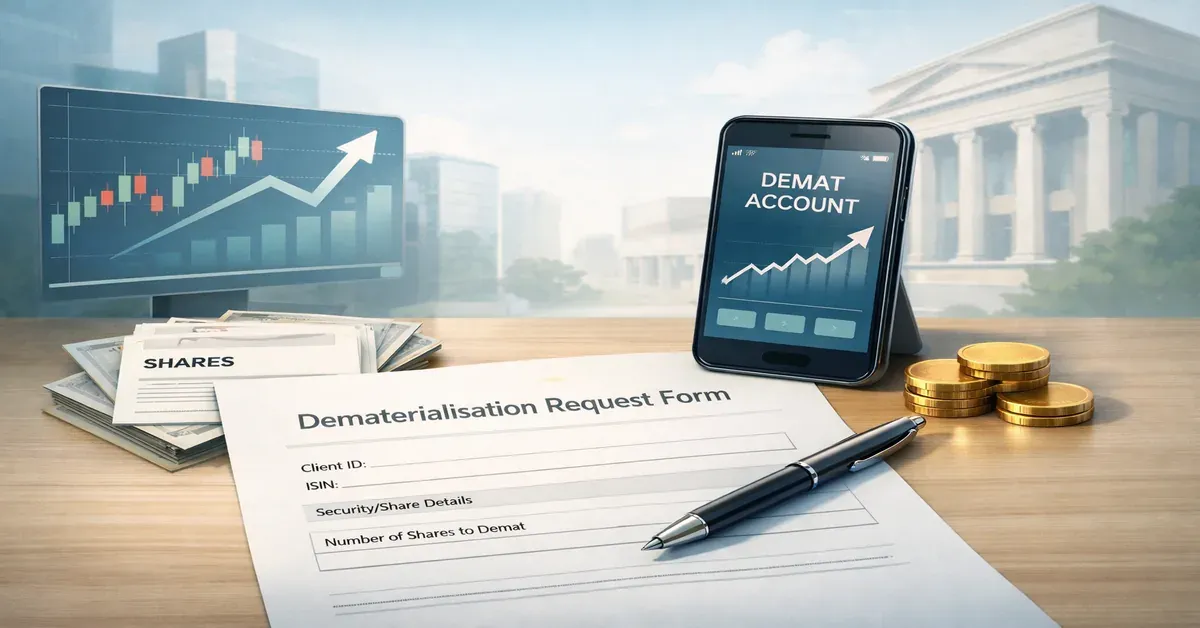
Think about the scenario where you come across a rather old and filthy trunk in the attic. Along with the vintage postcards, there is a pile of beautifully printed paper stocks of a blue-chip company that are still as good as new. It was pure gold in the 1990s. In today's scenario, where everything is digital, these papers are like a long-distance runner trying to participate in a Formula 1 race. To trade, sell or even swim with them, one would need to convert those physical papers into digital entries first.
There is a particular document, called Dematerialisation Request Form (DRF), that plays a major role in this transformation. However, what is this document and how can one avoid getting stuck in the jungle of documents when trying to follow the DRF process?
What is a Dematerialisation Request Form (DRF)?
Dematerialisation Request Form (DRF) is fundamentally a formal request that is an application of a Depository Participant (DP). It serves as a channel through which investors can change their physical share certificates into an electronic form.
By submitting a DRF, you are literally requesting your DP (for instance, Kotak Securities) to collect your physical certificates, confirm their validity with the registrar of the company, and then "credit" the same number of shares into your Demat account. This is the very first legal act of transferring your investment from a physical locker to a safe digital vault.
Process after Submitting the DRF
As soon as you present the signed DRF along with your physical certificates to your DP, a perfectly coordinated operation starts working unnoticed:
- Verification: The DP goes through your documents and certificates to check that everything is correct.
- Digital Request: The DP puts the request into the depository system (either NSDL or CDSL).
- Physical Dispatch: Your physical certificates are stamped (tagged "Surrendered for Dematerialisation") and then dispatched to the Company’s Registrar and Share Transfer Agent (RTA).
- Confirmation: The RTA checks the validity of the certificates. After being convinced, they will acknowledge the request.
- Credit: The depository subsequently transfers the electronic shares into your Demat account while the physical ones get incinerated.
Features of a Dematerialisation Request Form
A Document of Reference Form (DRF) is not merely an ordinary slip, it is a standard document that may take time to reach you owing to high security and accuracy requirements.
Standard Format for Submission to DP
The DRF observes a format that is strictly controlled by the depositories. Although the label of your broker may change, the basic layout is similar throughout the industry for the sake of processing and consistency.
Fields Typically Included
The form with the least likelihood of confusion demands certain particulars:
- Demat Account Details: Your personal Client ID and DP ID.
- Company Details: The name of the company, whose shares are in your possession.
- Share Certificate Details: The certificate numbers and corresponding "folio" numbers.
- Distinctive Numbers: Each physical share has a unique pair of starting and ending "distinctive numbers" that must be provided.
Signature Requirement and Verification
This aspect is the most important one. The validities on the DRF must be congruent with the validities that are kept with the company's RTA. If you were the one who signed those original documents twenty years ago and your handwriting has entirely changed, most delays would occur at this very stage.
How to Fill a Dematerialisation Request Form
Filling a DRF is not an easy task as it requires a steady hand and a sharp eye. Here is a straightforward guide in five steps:
- Step 1: Each company must have a separate DRF. No shares of 'Company A' and 'Company B' can be mixed in the same form.
- Step 2: Confirm that the name on the share certificate is identical to the name on your Demat account.
- Step 3: Write down the ISIN (International Securities Identification Number) of the security.
- Step 4: Hand in the form in three copies. Generally, one copy is for the RTA, one for the DP, and one is your acknowledged receipt.
Benefits of Using a DRF for Dematerialisation
Why put in so much effort? Transitioning to digital through a DRF guarantees multiple safeguards:
- Protection: Certificates are not liable to be burnt, stolen, or damaged.
- Complete prevention of counterfeiting: The process of sharing electronic shares is so secure that they cannot be forged thus making your holdings more secure.
- Instantaneous Transfers: The selling of digital shares almost happens immediately, unlike the physical shares which used to take weeks to sell.
- Integration: There is one single statement revealing your total portfolio.
Common Mistakes While Filling DRF
Even mistakes are made by experienced investors sometimes. These are the things you should be wary of:
- Mismatched Names: If the certificate mentions "Robert J. Smith" but your Demat says "Robert Smith," the transaction could be denied.
- Wrong ISIN: Typing the wrong code that identifies the company.
- Incomplete Folio Numbers: Make sure that you have all the digits from the physical certificate copied correctly.
- Overwriting: Do not over-write or use correction fluids on the form. If you make a mistake, it’s better to take a new form.
Fees and Charges
The DPs charge a nominal fee for the dematerialisation process even though the DRF itself is mostly free. The following are the costs related to dematerialisation:
- Dematerialisation Fee: Generally a flat fee per request or per certificate.
- Courier Charges: To deliver your original documents to the RTA.
- Statutory Levies: Any relevant tax.
- To keep yourself updated, always look at the schedule of charges of your DP.
References:
NSDL: Annexure D - Demat Request Form
Kotak Neo: Demat Account Rejection Reasons
FAQs
Usually, the starting point of the application can be online, but since surrendering the physical share certificates is a must, you will still be required to submit a signed DRF along with the actual certificates in a physical copy at your DP´s branch.
Generally, it takes around 15 to 21 days for the whole process, counting from the day the RTA gets the physical documents.
Shares of almost all listed public companies can be dematerialised. However, the RTA might deny the application if the company is delisted or is involved in a legal case.
In case of an error at the DP or RTA, a "rejection memo" will be issued to you. You will have to correct the error and present a new DRF.
As soon as the RTA has dealt with the request and the shares have been transferred to your Demat account, the physical certificates are cancelled and cannot be reverted to their original paper form.
The content in this blog is intended purely for educational purposes. Any securities or mutual funds referenced are illustrative in nature and do not constitute a recommendation or endorsement by Kotak Neo. Investors are encouraged to assess their own financial situation and seek professional advice before making any investment decisions. For compliance T&C and disclaimers, Visit https://www.kotakneo.com/disclaimer/
0 people liked this article.

Kotak Neo (Kotak Neo) is India's venerable stockbroking company with a rich legacy. It offers comprehensive investment services across asset classes, prioritising a technology-first approach for a seamless experience. Trusted by 5 million+ customers, it guides you toward financial success with ease of investment and speed of trade.
Note: The opinions expressed in this blog are personal viewpoints and should not be construed as recommendations.