From Yarn to 5G: The Rise of Reliance
- 4 min read
- 1,011
- Published 27 Feb 2026
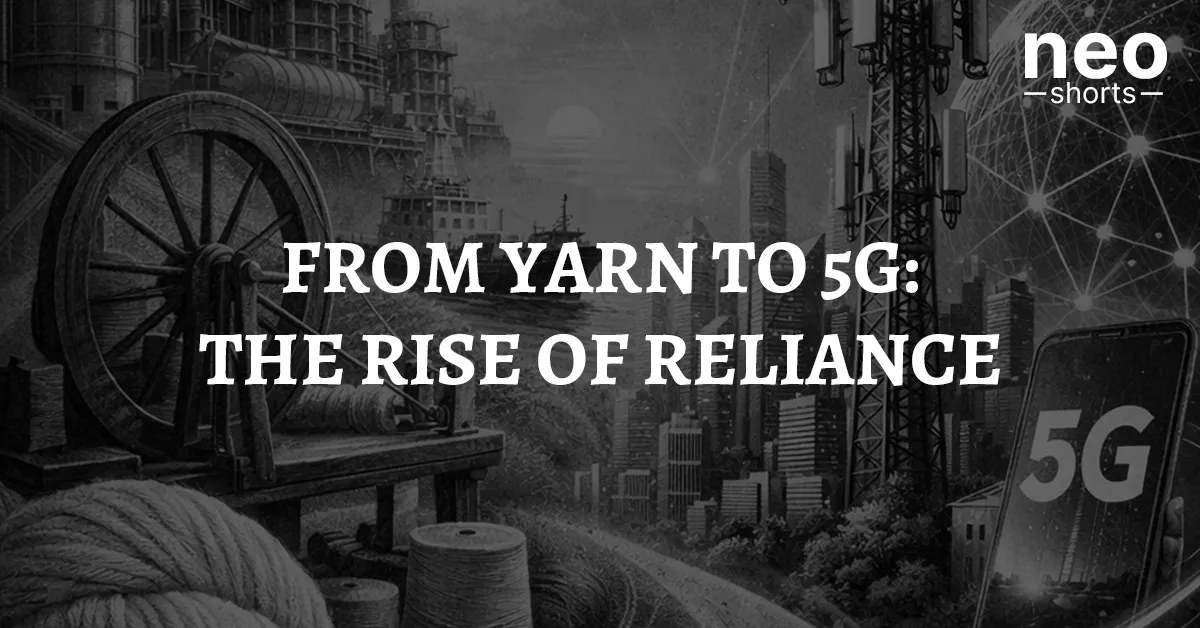
“Our dreams have to be bigger. Our ambitions higher. Our commitment deeper. And our efforts greater. This is my dream for Reliance and for India.” - Dhirubhai H. Ambani.
Fuel. Data. Retail. Energy. Different industries. One name.
What began as a small textile trading business in 1957 has quietly grown into India’s largest private sector enterprise.
This is not just the story of a company. It is the story of how modern India consumes, connects, and powers itself.
This is the Reliance Industries story.

Reliance was founded by Dhirubhai Ambani, a first-generation entrepreneur who believed that scale itself could be a competitive advantage.
Headquartered in Mumbai and now led by Mukesh Ambani, the group has evolved far beyond its original identity.
Today, Reliance does not operate as a single business. It operates as a system. At its foundation lies energy.
The Oil-to-Chemicals business spans refining, petrochemicals, and fuel marketing, anchored by the Jamnagar Refining Complex, the world’s largest integrated refinery with a crude processing capacity of 1.4 million barrels per day.
But the company’s most dramatic transformation came when it entered digital infrastructure.
Through Jio Platforms, Reliance reshaped India’s telecom and broadband landscape.
What started as a telecom launch became a nationwide digital backbone.
Today, Jio commands more than 65% of India’s 5G subscribers, serves over 515 million users, and connects 11.5 million homes through JioAirFiber.
In a country where data became a necessity rather than a luxury, Reliance ensured that connectivity scaled faster than demand.
Consumption followed.
Reliance Retail grew into India’s largest and most profitable retailer, spanning grocery, fashion, electronics, and omnichannel commerce.
With nearly 20,000 stores across the country, it sits closer to the Indian consumer than any other organised retailer.
Energy security remained another strategic pillar.
Reliance’s exploration and production assets supported domestic energy supply. Deep-water oil & gas fields like KG-D6 Block R, Satellite, and MJ clusters contribute around 30% of India’s domestic gas production.
Content completed the ecosystem.
Through Network18, Jio Studios, and JioStar, Reliance built scale in media and entertainment.
With around 450 million monthly active users, JioStar reflects how content, connectivity, and commerce increasingly blur into a single consumer experience.
The scale of this ecosystem shows up clearly in the numbers.
Revenue from operations rose from ₹2.44 lakh crore in December 2024 to ₹2.69 lakh crore in December 2025.
Profit after tax grew from ₹21,804 crore to ₹22,167 crore over the same period.
In Q3 FY26, nearly half of group revenue came from Oil-to-Chemicals, while retail and digital services together contributed over 43%, a sign that Reliance is no longer dependent on any single growth engine.
Across sectors, the company competes at the very top.
In the refining and fuel ecosystem, Reliance accounts for around 25% market share, second only to Indian Oil Corporation at 32%, and ahead of Bharat Petroleum and Hindustan Petroleum.
In telecom, Reliance Jio controls 50.87% of India’s wireless market, compared with 31.31% for Bharti Airtel and 12.73% for Vodafone Idea.
In online retail, its platform AJIO holds around 9.3% market share, competing with Flipkart at 22.4%, Myntra at 17.5%, and Amazon at 14%.
Yet Reliance is already looking beyond its current scale.
Jio Platforms is considering a 2026 IPO, potentially listing 2.5% of its equity.
In 2024, Reliance Industries and The Walt Disney Company completed an $8.5 billion merger, consolidating media and streaming scale under one structure.
On the consumption front, Reliance expanded its private labels with the launch of Waggies in science-backed pet nutrition and SIL in packaged foods during Q3 FY26.
The company also plans to commission a 10 GWp solar manufacturing giga factory, scalable to 20 GWp.
Reliance has reinvented itself repeatedly, textiles to energy, energy to digital, digital to consumer platforms, and now towards sustainability.
Together, these shifts have steadily broadened Reliance’s footprint in India.
Sources:
Reliance
BSE
Petroleum Planning and Analysis Cell
TRAI
LinkedIn
Reuters
RIL Media Release
RIL Financial Results Q3 FY26
0 people liked this article.