Supreme Court Criticises RERA, Says States Must Rethink Its Purpose
- By Kotak News Desk
- 13 Feb 2026 at 11:03 AM IST
- Market News
- 4m
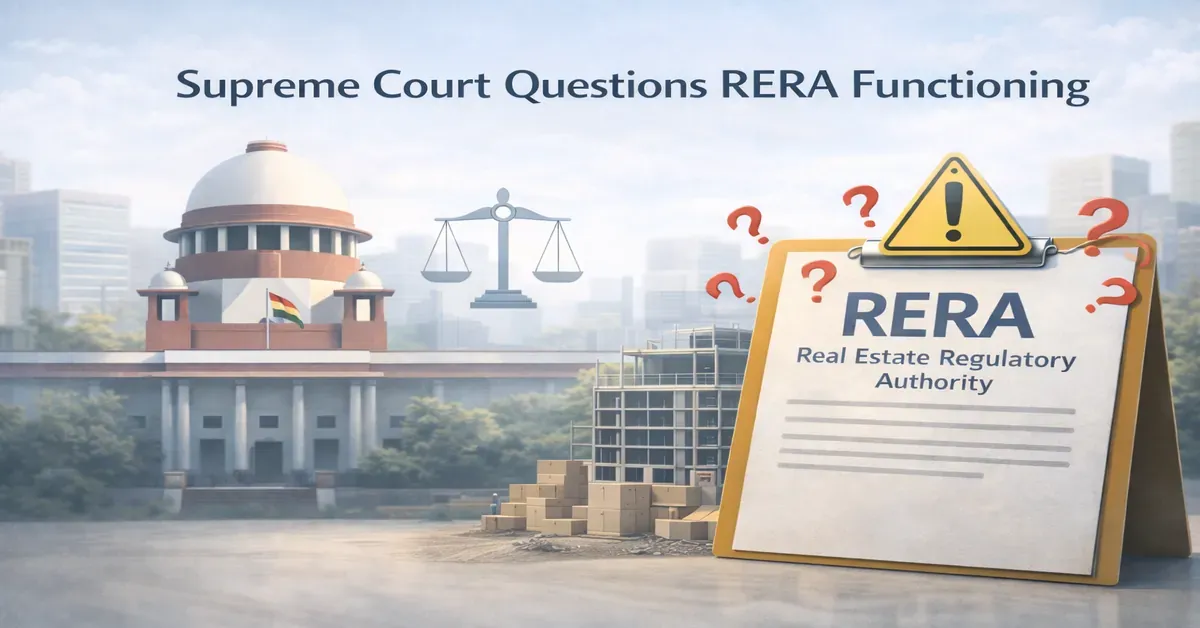
After RERA’s 2016 launch, the Supreme Court signalled deep dissatisfaction with its functioning, asking states to reassess the regulator’s purpose.
The Supreme Court has delivered a sharp oral critique of the Real Estate Regulatory Authority (RERA), questioning whether the institution is serving its original purpose.
During a hearing on Thursday, 12 Feb 2026, the Bench observed that the regulator appears to be benefiting defaulting builders rather than protecting homebuyers.
A Bench comprising Chief Justice of India Surya Kant and Justice Joymalya Bagchi made the remarks while hearing an appeal against a Himachal Pradesh High Court order. The High Court had stayed the state government’s decision to shift the RERA office from Shimla to Dharamshala.
“All States should now think of the people for whom the institution of RERA was created. Except for facilitating builders in default, it is not doing anything else. Better to just abolish this institution,” the Chief Justice said, according to court reports.
While the Court stopped short of ordering any structural change, the remarks signal dissatisfaction with how the regulatory framework is functioning nearly nine years after it was introduced.
What Was The Case Before The Supreme Court?
The immediate dispute concerned the Himachal Pradesh government’s notification to relocate the state’s RERA office from Shimla to Dharamshala. The High Court had stayed the move last year, observing that the decision was taken without identifying an alternative office location.
The High Court also noted that transferring 18 outsourced employees to other boards and corporations would render RERA’s functioning defunct.
However, the Supreme Court set aside the High Court’s order and permitted the relocation. The Bench directed that the principal appellate tribunal also be moved to Dharamshala to ensure that individuals affected by RERA orders are not inconvenienced.
The litigation stemmed from the State of Himachal Pradesh vs Naresh Sharma (SLP(C) No. 005835/2026), in which the state government challenged the High Court’s stay order.
Although the case centred on administrative relocation, the broader discussion in court moved toward the effectiveness of RERA itself.
RERA was enacted in 2016 to address chronic delays in real estate projects, improve transparency, and protect homebuyers from misrepresentation and stalled developments. Each state and union territory operates its own RERA authority.
In September 2025, the Ministry of Housing and Urban Affairs launched a unified national RERA portal aimed at consolidating data across jurisdictions. Despite these efforts, criticism from homebuyer groups has persisted.
Why Is the Court’s Remark Significant For Homebuyers And States?
Homebuyer advocacy groups have argued that RERA has not consistently delivered on its mandate. The Forum for People’s Collective Efforts (FPCE), which had supported the enactment of RERA, said the regulator has drifted from its original purpose.
According to FPCE, nine years after the law was passed, there remains no certainty that a RERA-registered project will be completed on schedule or that promises made to buyers will be fulfilled without dispute.
It is, however, important to note that the Court has not directed the abolition of RERA. The remark was made orally during proceedings and does not constitute a binding order dismantling the regulator.
The Ministry of Housing and Urban Affairs has, in recent months, pushed for stronger implementation of the unified portal and improved compliance, though there has been no official response so far to the Court’s latest comments.
What Could This Mean For The Real Estate Sector?
The Court's comments create further market uncertainty for real estate equities. The Nifty Realty index has already seen volatile swings in early 2026, and comments questioning the regulator's effectiveness give investors even more reason to be concerned.
The shares of developers such as DLF, Godrej Properties, Prestige Estates, Sobha, and Oberoi Realty may continue to be impacted by any additional policy signals. While larger firms with stronger balance sheets may be better equipped to manage changes in compliance, smaller businesses may react more forcefully if regulatory requirements shift.
For now, the sector appears to be in a wait-and-watch phase, with sentiment tied closely to how policymakers respond in the coming weeks. At this stage, the Supreme Court has not ordered structural changes.
Yet its strong language suggests that implementation, not just legislation, will remain under scrutiny in the months ahead.
Sources:
Business Standard
The Statesman
Hindustan Times

Since its incorporation on 20 July 1994, Kotak Neo has grown into one of India’s most trusted brokerage houses - backed by over 30 years of expertise across stocks, funds, IPOs, and full-service investing.
With a pan-India footprint of 145+ branches, 1000+ franchises and presence across 310+ cities, Kotak Neo serves 5 million+ customers nationwide.
From equities and IPOs to mutual funds and derivatives, Kotak offers comprehensive, research-backed investment solutions - simplifying wealth management for retail and institutional clients alike.
Kotak News Desk brings you latest updates, expert insights, and market-ready ideas - helping you stay informed and invest smarter.
Connect on: Linkedin
0 people liked this article.