Trades Stuck Since Tuesday Due To NSDL System Glitch
- By Kotak News Desk
- 06 Feb 2026 at 3:57 PM IST
- Market News
- 4 minutes read
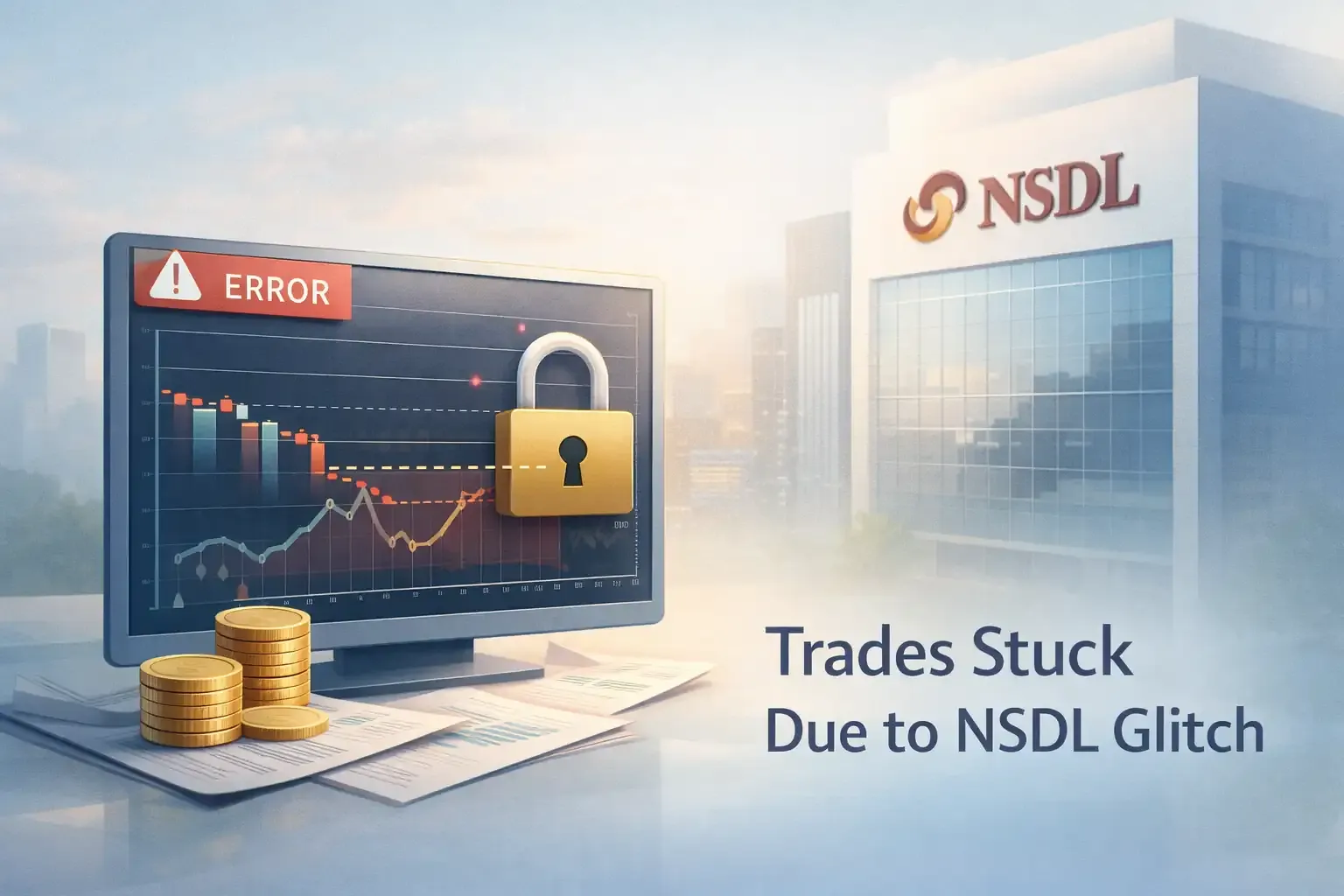
A technical glitch at National Securities Depository Ltd. (NSDL) recently disrupted India's settlement cycle, causing multi-day delays in crediting shares. Learn more as the depository has moved to resolve the network instability, but the event raises questions about the market infrastructure.
February 2026 has begun with an unexpected digital hurdle for the Indian capital markets. A technical snag (glitch) at the National Securities Depository Ltd. (NSDL) led to a huge disruption in the settlement of trades.
For three consecutive days starting 03 February 2026 (Tuesday), investors found that their purchased shares failed to reflect in their demat accounts. Thus, many investors/traders were unable to execute sell orders on their holdings. This glitch effectively froze investor portfolios during a volatile market period.
NSDL, a giant in the share market ecosystem, holds >80% of the market share in terms of the value of assets under custody as of February 2025. Its rival, Central Depository Services (India) Ltd. (CDSL), commands the retail space with ~15.5 Cr. active demat accounts as of FY24.
With the total Indian stock market valued at $5.2 trillion, even a minor network instability can ripple through crores of accounts. As the systems stabilise and the backlog of pending trades is being processed, an important question for investors is: what are the details of the glitch and its impact on investor portfolios?
What Exactly Happened?
Currently, there are two major depositories in India. These are the NSDL and the CDSL.
A depository is a digital vault that simply holds the wealth of the capital market investors. However, starting 03 February, the vault doors appeared to be jammed, invisibility vanishing investors’ wealth. Here are the details of the incidents:
-
No Sign of Executed Orders - Investors who had executed buy orders found their "Account Statement" stagnant. The routine process of the shares moving from the clearing corporation to the investor's demat account was interrupted. The "Pay-in" and "Pay-out" cycles were disrupted. As a result, brokers across the country reported an increase in customer queries.
-
A Functional Halt - In the modern T+1 (trades being finalised one business day after the transaction) settlement environment, speed is very important. A securities credit-related delay can lead to the entire chain of liquidity being compromised. Traders relying on rotating capital found their funds locked in "unsettled" securities. Thus, they were unable to shift to new opportunities.
-
Brokers’ Nightmare - Brokers act as the frontline for the depositories. Due to the glitch, they struggled to explain the depository friction to their anxious clients. Thus, the ownership of the shares was in a state of digital limbo (confusion).
Why Did The Systems Snap?
The reason behind the snap is the IDT system glitch. In the complex world of Indian markets, not all trades happen within a single instance. A large portion of daily transactions involves "Inter-Depository Transfers" (IDT).
IDT is the process where securities move between NSDL and CDSL. You can think of it as a high-speed digital bridge connecting two huge islands of data. Now, imagine this bridge experiencing a structural failure.
The connectivity between the two depositories was negatively affected or became too volatile to process the high-volume data packs required for settlement.
CDSL is dominant in retail, and NSDL has a stronghold in institutional custody. Any snag in the IDT routing can create a huge backlog. Now, the fragility of this link has been exposed to the investors.
The incident might mean that the underlying hardware and network protocols of the market system might not be robust enough to handle the weight of crores of simultaneous transactions.
So, should the investors treat depository connectivity as a strategic risk in the digital age?
What Is The Real Impact On Market Trust?
The impact of such a disruption goes beyond a few days of delayed securities’ credits. The Securities and Exchange Board of India (SEBI) has been vocal about its Cybersecurity and Cyber Resilience Framework (CSCRF).
An incident like the current glitch, even if resolved quickly, puts the securities markets functioning under the microscope. It forces a re-evaluation of how Market Infrastructure Institutions (MIIs) handle technical failures. Also, there is a scrutiny around whether their disaster recovery protocols are truly "instant" in a high-speed trading environment.
Furthermore, it is important to monitor the operational updates from both NSDL and CDSL during periods of high market activity. Such monitoring can provide early warning signs of systemic stress. The backlog may be cleared by tonight, but the conversation regarding the absolute reliability of our crucial financial systems has only just begun.
Source
Economic times
WhalesBook

Since its incorporation on 20 July 1994, Kotak Neo has grown into one of India’s most trusted brokerage houses - backed by over 30 years of expertise across stocks, funds, IPOs, and full-service investing.
With a pan-India footprint of 145+ branches, 1000+ franchises and presence across 310+ cities, Kotak Neo serves 5 million+ customers nationwide.
From equities and IPOs to mutual funds and derivatives, Kotak offers comprehensive, research-backed investment solutions - simplifying wealth management for retail and institutional clients alike.
Kotak News Desk brings you latest updates, expert insights, and market-ready ideas - helping you stay informed and invest smarter.
Connect on: Linkedin
0 people liked this article.