Moody’s Projects India’s Gdp To Grow 6.4% In Fy’27, Fastest Among G20 Economies
- By Kotak News Desk
- 10 Feb 2026 at 4:09 PM IST
- Market News
- 4 minutes read
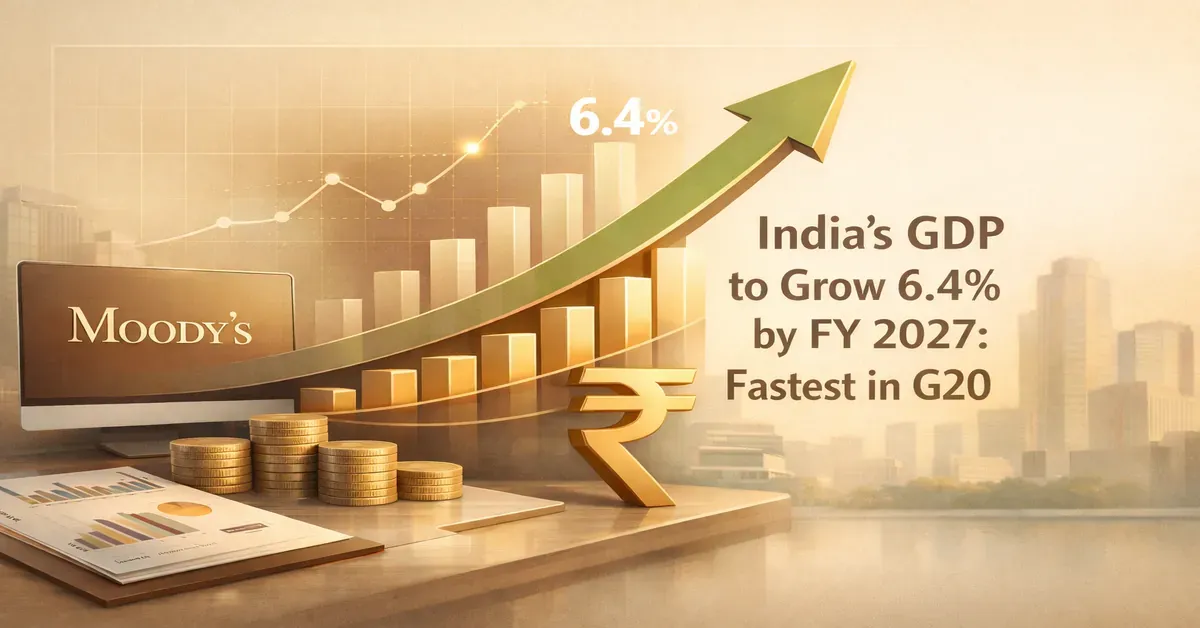
Moody’s projects India’s FY27 GDP growth at 6.4%, the fastest in G20, supported by GST rationalisation, higher tax thresholds, strong consumption, resilient banks, RBI’s 125-bps rate cuts, and steady credit growth.
India is poised to be the fastest-growing economy among the Group of Twenty (G-20) in the next financial year, according to a fresh projection from global ratings agency Moody’s. In its banking system outlook report released on 9 February 2026, Moody’s estimated that India’s real Gross Domestic Product (GDP) will expand by 6.4 per cent in FY 2026-27, outpacing growth forecasts for all other major G-20 economies. But how does it stack up against other forecasts and what are its major drivers?
Basis Of Moody’s 6.4% Projection
Moody’s Ratings has projected that India’s real GDP growth will reach 6.4% in FY 2026-27, the fastest among all G-20 economies for that period. This forecast factors in strong domestic consumption demand, ongoing policy support such as Goods and Services Tax (GST) rationalisation, and increased personal income tax thresholds, which the agency says will bolster consumer affordability and spending. It also reflects an expectation of a resilient banking sector that supports credit flows across the economy.
How Do These Figures Compare with Current And Official Estimates?
Moody’s FY27 projection is slightly below the Government of India’s Economic Survey estimate for the same year, which had suggested a range of 6.8 – 7.2% growth. According to official first advance estimates, India is also expected to record 7.4% growth in FY 2025-26, higher than the 6.5% realised in FY 2024-25.
By comparison, global growth is expected to be more subdued. Moody’s own global outlook indicates world GDP growth averaging around 2.5–2.6% in 2026-27, with advanced economies growing at slower rates and emerging markets largely led by India’s performance.
Why Does Moody’s See India Growing Fastest In the G-20?
Moody’s points to a consumption-led growth model as a key driver of growth. It further mentioned that the growth is supported by tax policy reforms that improve household disposable incomes. The report specifically cites the rationalisation of the GST regime in September 2025 and the personal income tax threshold. In addition, strong macroeconomic conditions and credit expansion with system-wide loan growth expected to rise slightly in FY27.
How Is The Banking Sector Factored Into The Forecast?
Moody’s assessment highlights a banking system with sufficient capital buffers and resilient asset quality, despite some stress anticipated in the MSME sector. Moreover, the report states that the banks have adequate provisions and reserves to absorb potential loan losses, while corporate loan quality is supported by strong balance sheets. These attributes are considered stabilising factors for investment and economic activity.
What Are The Broader Economic Context And Risks?
Recent official data for FY 2025-26 shows robust growth momentum driven by strong domestic demand. India’s real GDP grew 8.2% in Q2 and expanded consistently quarter-on-quarter. Marking a rise from 7.8% in Q1, according to government releases. Inflation has remained relatively benign, and labour market indicators have shown tightening.
Nevertheless, Moody’s forecast assumes that inflation will remain under control and that the Reserve Bank of India (RBI) will adjust monetary policy only if there are clear signs of slowing activity. The RBI has already cut its key policy rate by a cumulative 125 basis points during 2025, lowering the repo rate to 5.25% to support growth.
What External And Structural Challenges Will India Face?
India’s growth outlook is solid relative to peers and global economic uncertainties. However, slower demand in advanced economies and geopolitical trade pressures continue to pose significant risks. Moody’s also flagged that stress in MSMEs and uneven global recovery patterns could temper the pace of future expansions if domestic demand weakens.
Key Takeaways
-
Protect consumption momentum by continuing tax rationalisation and income-side support to sustain household demand.
-
Strengthen export competitiveness by reducing logistics costs, improving trade facilitation, and diversifying markets.
-
Keep policy rates pragmatic and avoid premature tightening.
Sources:
Livemint
PIB
Moody’s

Since its incorporation on 20 July 1994, Kotak Neo has grown into one of India’s most trusted brokerage houses - backed by over 30 years of expertise across stocks, funds, IPOs, and full-service investing.
With a pan-India footprint of 145+ branches, 1000+ franchises and presence across 310+ cities, Kotak Neo serves 5 million+ customers nationwide.
From equities and IPOs to mutual funds and derivatives, Kotak offers comprehensive, research-backed investment solutions - simplifying wealth management for retail and institutional clients alike.
Kotak News Desk brings you latest updates, expert insights, and market-ready ideas - helping you stay informed and invest smarter.
Connect on: Linkedin
0 people liked this article.