MF Ownership Nears FIIs As Holding Gap Narrows To 5.5% In Q3 FY26
- By Kotak News Desk
- 10 Feb 2026 at 12:37 PM IST
- Market News
- 4 minutes read
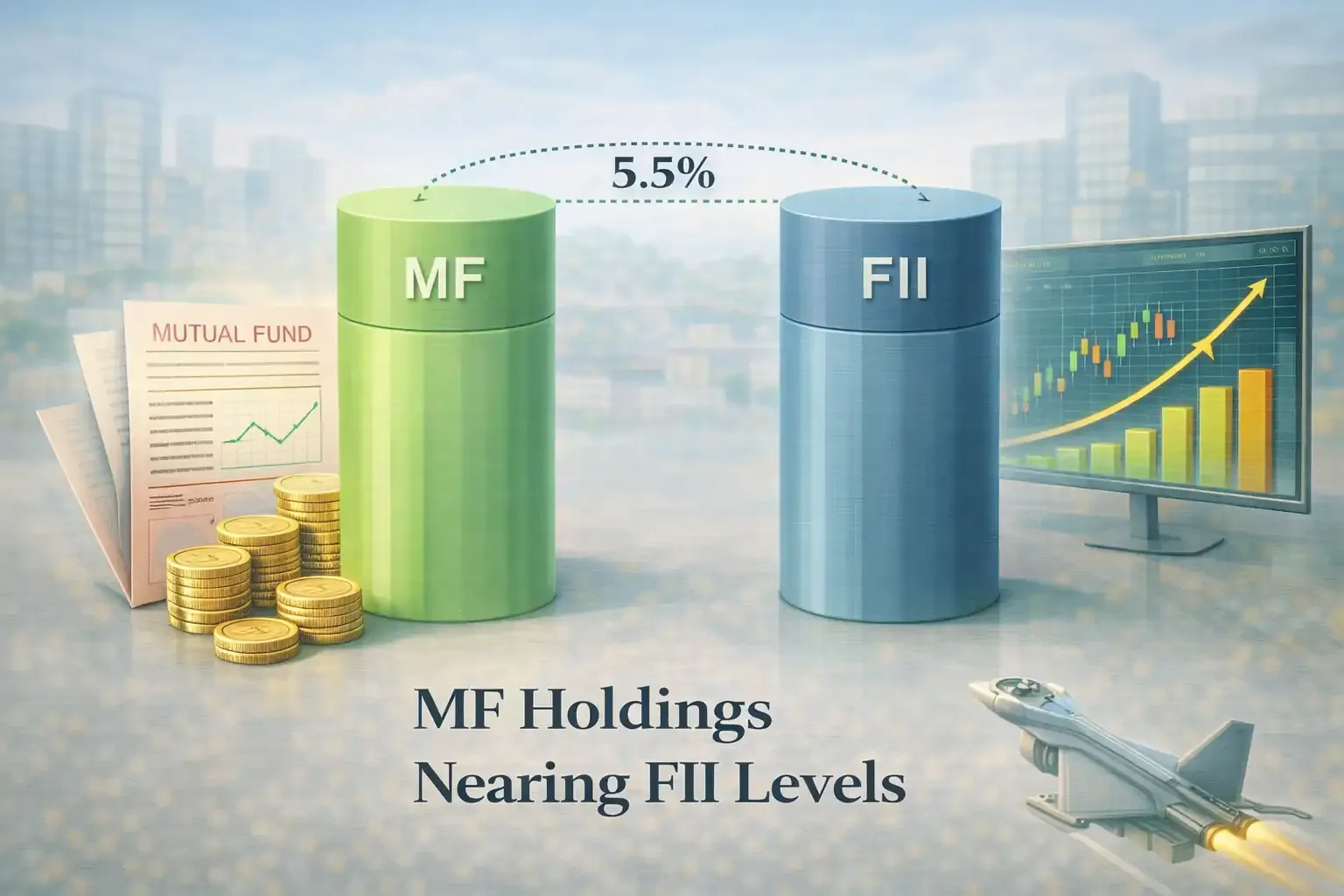
Domestic mutual funds narrowed the ownership gap with FIIs in NSE-listed stocks to 5.50% in the December 2025 quarter, according to PRIME Database. The shift reflects steady MF inflows and lower foreign holdings.
Domestic mutual funds (MFs) continued to strengthen their position in Indian equities during the December 2025 quarter, narrowing the ownership gap with foreign institutional investors (FIIs) in NSE-listed companies to just 5.50%, according to data from PRIME Database.
The gap reduced by 24 basis points sequentially and has nearly halved from 10.51% as of 31 December 2022, signalling a steady shift in market ownership toward domestic institutions.
Where Do FIIs And MFs Stand After Q3 FY26?
Recent statistics indicate that there is a definite shift in ownership patterns:
-
FII ownership decreased to 16.60%, compared to 16.68% in the previous quarter, the lowest FII ownership in 13 years.
-
Mutual fund ownership rose to 11.10%, up from 10.94%, a record high, and the tenth consecutive quarterly increase in MF holdings.
PRIME Database’s Pranav Haldea said mutual funds appear to be on track to potentially overtake FIIs in the coming quarters, driven by sustained domestic inflows.
Do Fund Flows Signal A Domestic Ownership Shift?
Here are a few points that help put this trend in context:
-
The change of ownership was supported by the sharply divergent flows in the quarter. Mutual fund net purchasers were ₹1.06 lakh crore, which was substantially facilitated by consistent retail purchases in the form of systematic investment plans (SIPs).
-
On the other hand, FIIs had net outflows of ₹11,765 crore, of which ₹42,090 crore was attributable to sales in the secondary market, which was partially counteracted by ₹30,325 crore in primary market inflows. This indicates that foreign investors were still picky, despite domestic institutions building up.
-
The rising MF participation also contributed to domestic institutional investors (DIIs), including insurers, alternative investment funds (AIFs), and portfolio management services (PMS) players, reaching another record high ownership share of 18.72%, up from 18.28% in the previous quarter.
-
DIIs collectively invested ₹2.09 lakh crore during the period. Insurance companies, AIFs, and PMS players contributed net purchases of ₹21,490 crore, ₹367 crore, and ₹1,205 crore, respectively.
What’s Happening To Retail And HNI Participation?
While institutional ownership strengthened, individual investor participation softened during the quarter.
-
Retail investor share fell to 7.25%, from 7.45%, marking a four-year low.
-
High-Net-Worth Individual (HNI) ownership declined to 2.03%, from 2.09%.
-
Combined retail and HNI ownership dropped to 9.28%, a three-year low. Individuals were net sellers worth ₹57,404 crore during the quarter.
Financials Draw Institutional Interest; Promoter Ownership Declines
Sectoral allocation trends showed that both FIIs and DIIs increased exposure most to financial services, while reducing allocation to consumer discretionary. DII allocation to financial services rose from 27.46% to 28.34%, while FIIs increased their exposure from 30.98% to 31.85%.
Promoter shareholding also continued to decline. Private promoter ownership rose marginally to 40.76%, but has fallen by 446 basis points over four years, while the government promoter share slipped to 8.96%. Total promoter holding declined to a five-year low of 49.73%, close to its historical low.
What Are The Investor Takeaways?
To investors, a reduction in the differences between mutual funds and FIIs signifies a structural change in Indian equity markets in terms of ownership and market influence. Domestic institutional flows are now dominating market stability and sector leadership, with MF ownership at a record 11.10% and DIIs at 18.72%.
At the same time, the decline in retail participation and promoter holdings suggests that the market’s ownership base is steadily institutionalising, which could reduce dependence on foreign flows over the long term, while making domestic SIP-driven inflows a key driver of market resilience.
Sources
Economic Times
indianexpress

Since its incorporation on 20 July 1994, Kotak Neo has grown into one of India’s most trusted brokerage houses - backed by over 30 years of expertise across stocks, funds, IPOs, and full-service investing.
With a pan-India footprint of 145+ branches, 1000+ franchises and presence across 310+ cities, Kotak Neo serves 5 million+ customers nationwide.
From equities and IPOs to mutual funds and derivatives, Kotak offers comprehensive, research-backed investment solutions - simplifying wealth management for retail and institutional clients alike.
Kotak News Desk brings you latest updates, expert insights, and market-ready ideas - helping you stay informed and invest smarter.
Connect on: Linkedin
0 people liked this article.