‘Classical, Speculative Blowoff’: Why Gold’s Whipsaw Is Linked To China
- By Kotak News Desk
- 16 Feb 2026 at 3:07 PM IST
- Market News
- 4m
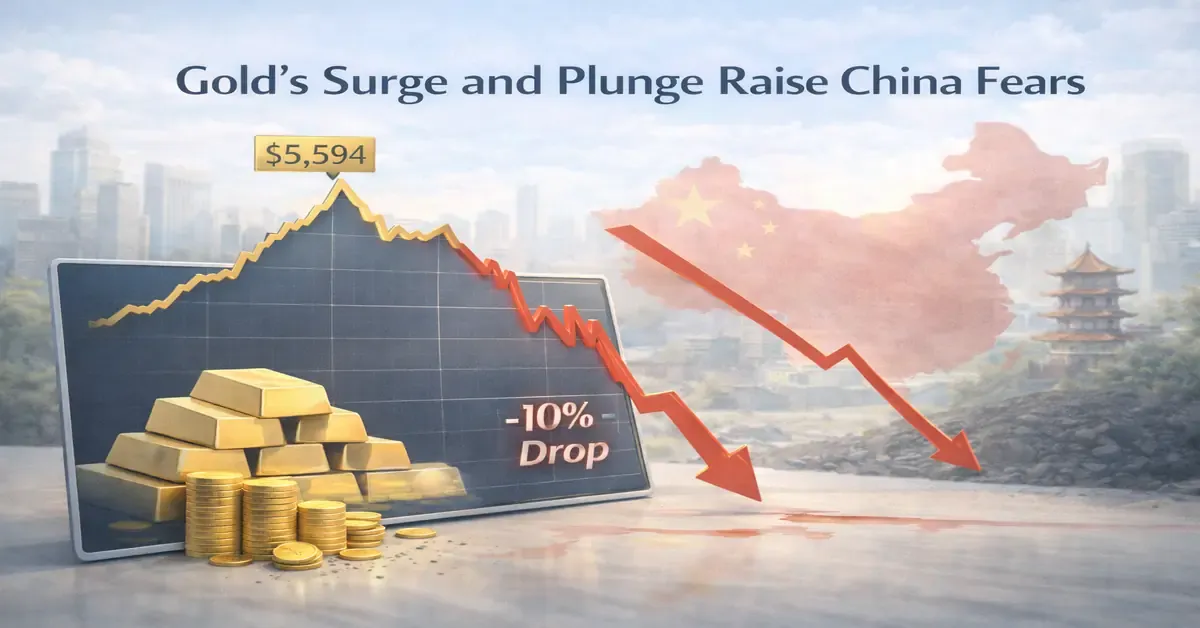
Gold surged to $5,594 per ounce before plunging nearly 10% in a day, as rising Chinese ETF and futures activity intensified volatility.
Gold’s recent surge and sudden pullback have left investors debating whether the metal is behaving like a traditional safe haven or something far more speculative.
In one of the most dramatic short-term reversals in recent times, gold fell about 10% the day after hitting a record $5,594 per ounce on 29 January 2026. Since then, prices have struggled to hold above the $5,000 level despite high volatility.
US Treasury Secretary Scott Bessent described the move as a “classical, speculative blowoff”, suggesting that the rally may have been driven more by trading momentum rather than defensive buying.
Why Are Analysts Linking China To Gold’s Swings?
Several market watchers have identified increased trade activity in China as a major factor in the most recent surge and decline.
According to analysts, Chinese participation in gold futures and Exchange-Traded Funds (ETFs) has accelerated sharply since the start of 2025.
Economics show that Chinese gold-backed ETF holdings have more than doubled since January 2025. Trading volumes on the Shanghai Futures Exchange have also climbed, with year-to-date averages approaching 540 tonnes per day, compared with around 457 tonnes daily in 2025.
This rise in activity has not gone unnoticed. Chinese regulators have repeatedly tightened margin requirements in recent weeks in an attempt to curb volatility, particularly as price swings intensified.
Easy access to products like gold futures and ETFs has added to the recent swings. When investors use leverage, prices can rise fast and fall just as quickly if the mood changes.
Is Gold Now A Trading Asset Instead Of A Safe Haven?
Historically, gold has been seen as a valuable asset to hold during times of economic volatility. But given the nature of the most recent price movement, some have questioned if the role is changing.
The spike in Chinese involvement, according to analysts, is a reflection of larger internal circumstances. Deposit rates have remained close to 1%, access to some financial assets is still limited, and declining house prices have put pressure on the real estate markets. Gold has become an alternative store of wealth in such a setting.
Currently, gold accounts for roughly 1% of Chinese household assets, but some strategists believe that figure could move toward 5% in the coming years. If allocations rise meaningfully, flows into bullion-linked instruments may continue to influence global pricing.
At the same time, economists caution that the growing use of leveraged futures contracts is not typical of long-term hedging behaviour. When investors use borrowed funds to gain exposure, price swings can become more pronounced.
There is also a broader geopolitical element. Official US Treasury data show that China’s holdings of US Treasuries fell to $682 billion in November 2025, down 11% year-on-year. Meanwhile, the People’s Bank of China has increased its gold reserves for 15 consecutive months through January, bringing holdings to roughly 2,300 tonnes.
What Does The Whipsaw Mean For Global And Indian Investors?
The recent move from a record $5,594 per ounce to a near 10% drop in a single day highlights how quickly gold sentiment can shift. What seemed like a consistent safe-haven rally is now turning out to be a series of rapid repositioning.
For global investors, the message is straightforward: volatility has returned to an asset traditionally viewed as stable. While many banks continue to see scope for higher prices over time, the near-term path may remain uneven if leveraged flows stay active.
The impacts can be noteworthy for Indian investors. Global gold prices tend to move in step with domestic rates, both on the MCX and in the jewellery market. When international prices rise, local prices generally follow, lifting the value of holdings in gold ETFs and sovereign gold bonds.
Also Read - AI Is Boosting Productivity, Not Cutting Jobs
The reverse can also happen. If prices correct sharply overseas, domestic rates can adjust just as quickly. Those who entered near recent highs may see fluctuations in portfolio values if global sentiment shifts again.
Sources:
NDTV Profit
Moneycontrol
CNBC

Since its incorporation on 20 July 1994, Kotak Neo has grown into one of India’s most trusted brokerage houses - backed by over 30 years of expertise across stocks, funds, IPOs, and full-service investing.
With a pan-India footprint of 145+ branches, 1000+ franchises and presence across 310+ cities, Kotak Neo serves 5 million+ customers nationwide.
From equities and IPOs to mutual funds and derivatives, Kotak offers comprehensive, research-backed investment solutions - simplifying wealth management for retail and institutional clients alike.
Kotak News Desk brings you latest updates, expert insights, and market-ready ideas - helping you stay informed and invest smarter.
Connect on: Linkedin
0 people liked this article.