Why Climate Change Is Now A Market Risk
- By Kotak News Desk
- 10 Feb 2026 at 2:55 PM IST
- Market News
- 4m
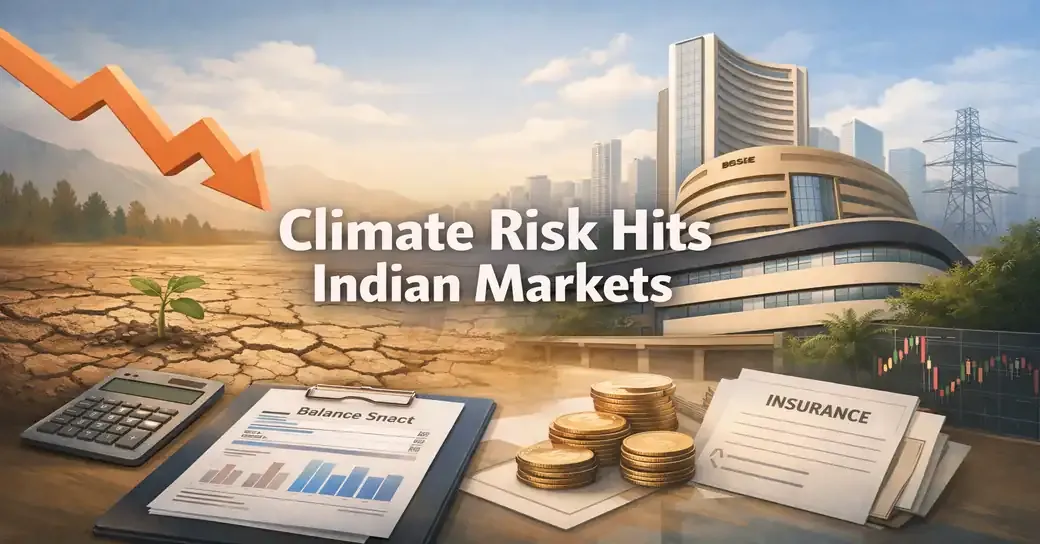
Climate change is no longer just an environmental issue as it begins to reshape earnings, risk, and valuations in Indian markets. Read on to understand what investors need to watch next.
While climate action continues to be debated across forums, the economic damage is already being felt. Every minute, the global economy is losing more than $250,000 to climate-related impacts. By the hour, that cost rises to about $16 million.
These numbers come from the FICCI–EY Risk Survey 2026. The report makes one thing clear. Climate change is no longer a distant environmental issue. It is now a present-day economic drain.
What used to be described as a long-term risk is already disrupting supply chains, food systems, and labour productivity. The effects are visible and growing.
The survey also warns that if current conditions continue, annual global climate damage could rise to as much as $38 trillion by 2050. Storms, floods, heatwaves, and ecosystem damage are no longer future scenarios. They are playing out in real time.
India’s Exposure Is Wider Than Many Businesses Assume
For India, the risks are sharper and more structural. One of the biggest concerns flagged in the survey is water scarcity. Per-capita water availability has fallen to around 1,341 cubic metres, which is already below the stress threshold.
States such as Punjab, Haryana, Rajasthan, and Karnataka are seeing severe groundwater depletion. These states are critical to agriculture, textiles, chemicals, and power generation. For water-intensive industries, this is not an abstract risk. It affects day-to-day operations.
Extreme heat is adding further pressure. Record temperatures are cutting output by 20 to 30% in sectors like construction, logistics, and mining. At the same time, higher cooling demand has pushed power costs up by roughly 15%. Margins are being squeezed across businesses and households.
These pressures are cumulative. They do not disappear after one season.
Climate Shocks Are Already Affecting Financials
The survey points out that repeated climate shocks are becoming routine. Urban flooding, desertification, and prolonged heatwaves have damaged infrastructure and agriculture across regions.
Since 2000, cumulative global losses from climate events have already run into the trillions. India is no exception.
Urban flooding has impacted transportation, power supply, and services in major cities. Desertification is affecting agricultural production and rural demand. These impacts manifest in cost escalations, revenue losses, and insurance claims.
The food supply chain is also impacted. The yield volatility is already resulting in an increase in food prices by 4 to 6%. The report warns that if current trends persist, food production could drop by 16% by 2030.
This directly impacts inflation, credit stress, and insurance claims in agriculture and micro, small and medium enterprises (MSMEs).
What This Means for Markets
For investors, these are no longer background risks. Climate disruptions make it more difficult to predict earnings. When output, costs, and timing are uncertain, it challenges the stability of valuations.
Infrastructure, building, logistics, electricity, agriculture-related industries, and insurance are particularly vulnerable. Severe weather events tend to result in an abrupt reassessment of the earnings profile and the risks involved.
On the other hand, companies that take climate risks into account tend to look more robust. Markets tend to favour predictability, especially in uncertain times.
Boards Are Aware, But Preparedness Is Uneven
The survey shows that 45% of respondents believe climate-related financial impacts pose a critical risk to their operations in India. A similar share sees environmental, social and governance (ESG) non-compliance as a material business risk.
What stands out is governance. Over 40% of respondents point to gaps in board-level oversight of climate and ESG issues.
That gap matters. Weak oversight increases the risk of sudden losses, regulatory setbacks, and poorly timed investments.
The message from the report is not subtle. Climate risk is no longer just about sustainability reporting. It is shaping capital allocation, asset strategy, and long-term growth decisions.
For India, the window to adapt is narrowing. For markets, climate risk is no longer outside the equation. It is already part of it.
Sources:
NDTV Profit
Science Direct

Since its incorporation on 20 July 1994, Kotak Neo has grown into one of India’s most trusted brokerage houses - backed by over 30 years of expertise across stocks, funds, IPOs, and full-service investing.
With a pan-India footprint of 145+ branches, 1000+ franchises and presence across 310+ cities, Kotak Neo serves 5 million+ customers nationwide.
From equities and IPOs to mutual funds and derivatives, Kotak offers comprehensive, research-backed investment solutions - simplifying wealth management for retail and institutional clients alike.
Kotak News Desk brings you latest updates, expert insights, and market-ready ideas - helping you stay informed and invest smarter.
Connect on: Linkedin
0 people liked this article.