Auto Sales Hit Record Q3 After GST Reclassification
- By Kotak News Desk
- 13 Feb 2026 at 9:17 PM IST
- Market News
- 4m
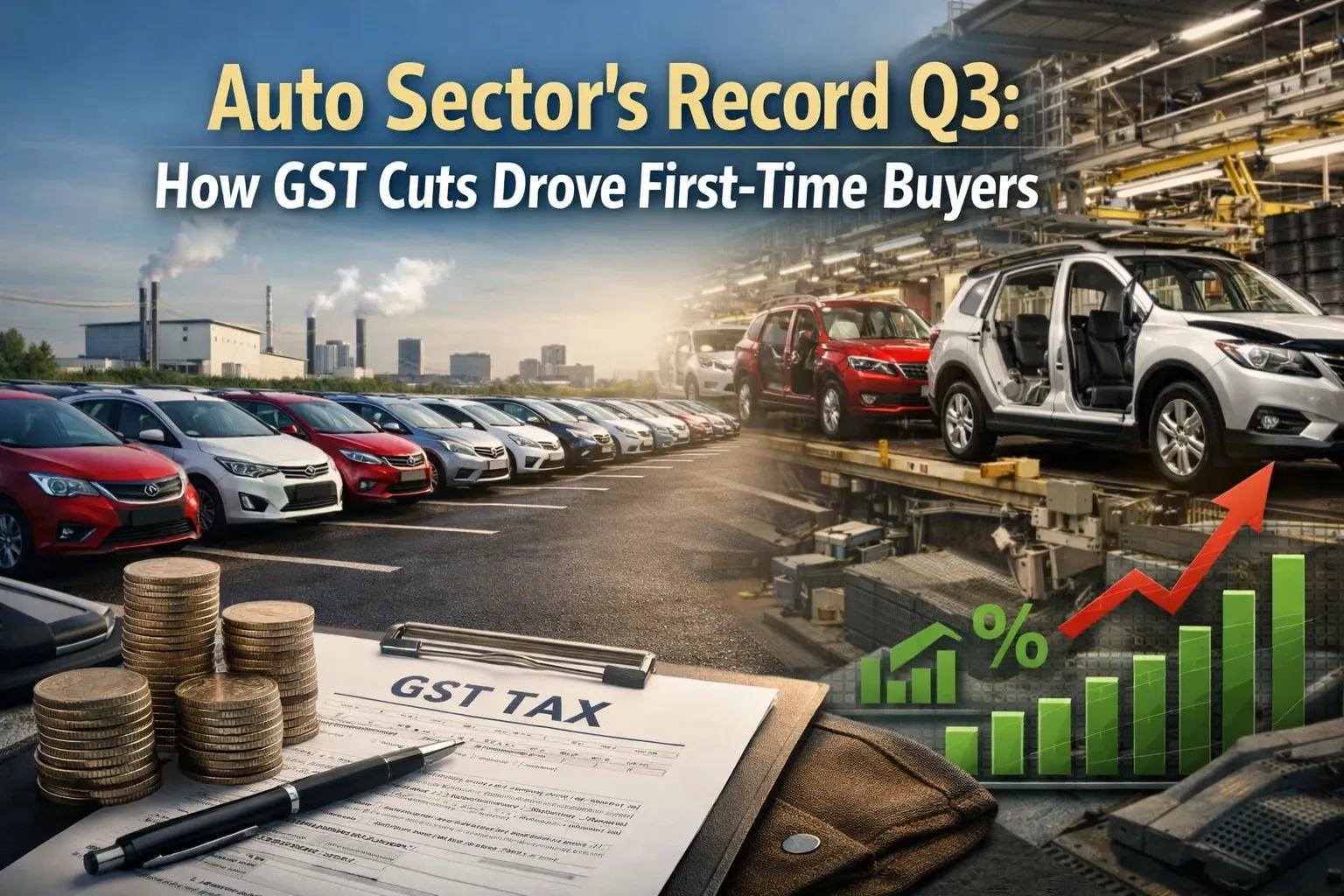
Q3 FY26 auto volumes recorded strong growth, with January 2026 registrations reaching 2.72 million units, up 17.6% year-on-year. The growth was mainly driven by GST reclassification.
The auto sector delivered a watershed Q3 as sales, wholesales and registrations all climbed to multi-year highs: driven largely by a sweeping GST reclassification and a fresh wave of first-time car buyers trading up from two-wheelers.
This marked the record quarterly wholesales for some OEMs, a jump in retail registrations and renewed capacity announcements across manufacturers. What exactly changed this quarter to redefine growth for India’s vehicle market?
Why Did Q3 Become A Record Quarter For Volumes?
The immediate impact was a sharp rise in retail registrations. January 2026 registrations rose 17.6% year-on-year to 2.72 million units, an early indicator of sustained retail demand into the quarter.
Manufacturers were able to translate that retail strength into historically high factory dispatches and wholesales. For example, Tata Motors Passenger Vehicles reported its highest-ever quarterly wholesales of 171,103 units in Q3 FY26, while Maruti made a sale of 5.85 lakh vehicles in 2025. Other mass-market players also recorded elevated dispatch and logistics activity to meet the spike.
Two structural inputs amplified the cyclical uptick:
-
Lower effective prices after GST reclassification for small cars.
-
A rise in entry-level buyers
While OEM seasonal promotions and festive buying pushed incremental volumes through the quarter.
How Much Did GST Cuts And First-Car Buyers Change The Buyer Mix?
The GST reform implemented in September 2025 reclassified several vehicle categories and substantially cut tax on small cars and many two-wheelers (under 350 cc cars saw GST fall from 28% to 18%), directly lowering on-road entry prices for the mass market.
This price improvement is reflected in showroom behaviour: Maruti Suzuki and Hyundai reported a meaningful rise in the share of first-time buyers.
Data from independent market trackers and industry statements point to two knock-on effects: accelerated upgrade from two-wheelers to compact cars (the “helmet-to-car” phenomenon) and a resurgence in sub-₹5 lakh models. This rekindled demand segments that had been subdued in recent years.
Also read - Coal India Q3 FY26
Can The Momentum Continue Amid Cost Pressures And Capacity Moves?
Momentum is visible on the ground: OEMs are announcing capacity investments and logistics expansions to capture the demand surge, for example, a major investment plan announced by one large OEM targets scaled output increases and EV/powertrain lines over the next decade.
But the upside is counterbalanced by cost headwinds. Several manufacturers have flagged rising commodity prices (steel, aluminium, copper) and FX-linked input inflation; the net effect has been stronger volumes but compression in margin levers for some players.
Moreover, the GST relief is asymmetric: while small, internal-combustion entry models saw lower taxation, higher-end and luxury segments faced increased effective rates under the same reclassification, reshaping unit economics across portfolios. Finally, sustaining first-time buyer flows will depend on continued financing availability, stable rural incomes and whether OEM incentives normalise once dealerships clear the initial backlog.
Sources
ET
Tata Motors
TOI
Cleartax
Forbes

Since its incorporation on 20 July 1994, Kotak Neo has grown into one of India’s most trusted brokerage houses - backed by over 30 years of expertise across stocks, funds, IPOs, and full-service investing.
With a pan-India footprint of 145+ branches, 1000+ franchises and presence across 310+ cities, Kotak Neo serves 5 million+ customers nationwide.
From equities and IPOs to mutual funds and derivatives, Kotak offers comprehensive, research-backed investment solutions - simplifying wealth management for retail and institutional clients alike.
Kotak News Desk brings you latest updates, expert insights, and market-ready ideas - helping you stay informed and invest smarter.
Connect on: Linkedin
0 people liked this article.