Tech Breakthroughs Could Drive India’s Energy Independence, Says Mukesh Ambani
- By Kotak News Desk
- 05 Feb 2026 at 11:53 AM IST
- Market News
- 4 minutes read
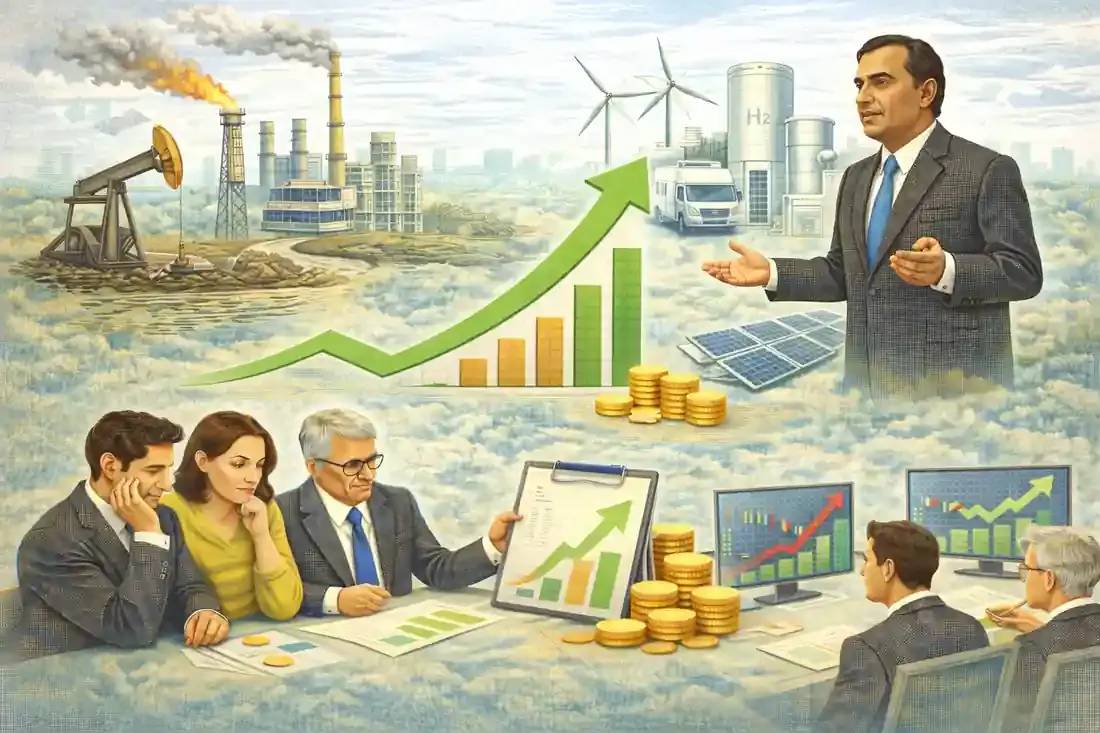
India’s long-term economic growth will be closely tied to achieving energy self-sufficiency, Reliance Industries Chairman Mukesh Ambani said on Tuesday, stressing that technological advances could sharply reduce the nation’s dependence on imported energy in the coming decade. Ambani made these remarks in an interview with a business news channel, outlining a multi-decade opportunity for India to change its energy sector through innovation and investment.
Tech Breakthroughs Could Cut Energy Imports
India currently imports close to 80% of its energy needs, Ambani noted, a structural dependence that exposes the country to external price shocks and geopolitical risks.
However, he said that with the right technological breakthroughs, especially in energy systems and production technologies, India could become “reasonably self-sufficient” in energy within the next decade.
This would demand concerted investment in new energy technologies and infrastructure, especially those that will improve domestic energy production and minimise reliance on imports.
Long-Term Growth And Investment Opportunity
Ambani highlighted the scale of the economic opportunity ahead. India is currently a $4-4.5 trillion economy in a global economic system valued at over $110 trillion.
He said India has the potential to expand to a $25-30 trillion economy over the next 30 years, creating a long-term, multi-decade opportunity for investment, particularly in energy and related sectors.
Ambani claimed that the solution to the energy problem in India will be the key to continuing its growth narrative, and investment in infrastructure, both physical and energy technologies, would be needed to improve the resilience of the economy and minimise its exposure to externalities.
Technology And Global Investor Focus
Ambani’s comments come at a time when global investors are increasingly focused on how technologies, particularly artificial intelligence, could reshape energy systems, productivity, and economic growth.
He said artificial intelligence and other digital tools are already changing how energy systems work around the world, helping speed up innovation and use resources more efficiently. However, he noted that turning this potential into results will take time, capital and sustained effort.
Ambani’s remarks came alongside comments from Larry Fink, CEO of BlackRock, who said the acceleration of science driven by AI could eventually make “energy abundance” possible for the Global South, though he cautioned that such outcomes remain distant.
Larry Fink Says AI Is Accelerating Scientific Discovery
Fink said AI is enabling researchers to absorb vast amounts of information within minutes, significantly speeding up discovery and opening new opportunities across sectors. However, he warned that AI will be disruptive in the near term and is likely to create clear winners and losers among countries and economies.
Fink said the key question is whether AI will broaden economic success or concentrate it. He added that this issue has been a dominant theme at discussions at the World Economic Forum in Davos in recent weeks.
He noted that AI could initially concentrate benefits in a limited set of economies and companies, but its longer-term impact could be more democratising if it is deployed in a way that promotes inclusive growth.
Fink said BlackRock is already deploying advanced AI tools to manage its $14 trillion in assets, improve its understanding of clients, and increase operational efficiency. He added that these trends are expected to shape how large companies operate globally, as AI becomes a more central tool in business decision-making and productivity improvement.
What This Means For Investors?
These comments by Ambani emphasise the point that the long-term economic growth of India is highly related to the decreasing level of overdependence on imported energy, which is at the moment almost 80 % of the total. This is an indication to the investors that areas associated with energy innovation and national capacity building may be of interest as India strives to enhance energy security.
The remarks made by Larry Fink create an additional dimension, emphasising how artificial intelligence is quickly transforming the manner in which economies and corporations are run. The fact that BlackRock is already deploying AI to manage 14 trillion dollars in assets confirms the extent to which AI is being incorporated into big-time decision-making.
Collectively, the comments indicate that India has a more extensive market story with the two key drivers, the energy transition and technology-driven efficiency, that have the potential to impact capital flows, long-term investment, and sector-level opportunities in the next decade.
Source:

Since its incorporation on 20 July 1994, Kotak Neo has grown into one of India’s most trusted brokerage houses - backed by over 30 years of expertise across stocks, funds, IPOs, and full-service investing.
With a pan-India footprint of 145+ branches, 1000+ franchises and presence across 310+ cities, Kotak Neo serves 5 million+ customers nationwide.
From equities and IPOs to mutual funds and derivatives, Kotak offers comprehensive, research-backed investment solutions - simplifying wealth management for retail and institutional clients alike.
Kotak News Desk brings you latest updates, expert insights, and market-ready ideas - helping you stay informed and invest smarter.
Connect on: Linkedin
0 people liked this article.