AI Disrupts Indian IT: Why TCS & Infosys Face Pain While Niche Players Surge
- By Kotak News Desk
- 06 Feb 2026 at 1:35 PM IST
- Market News
- 4m
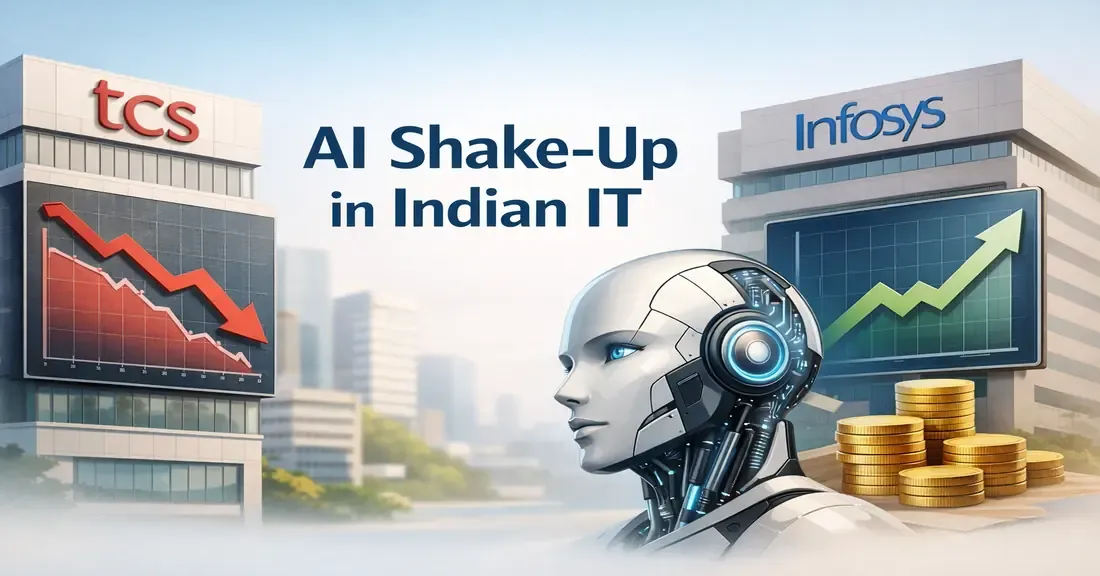
AI-led automation is reshaping India’s IT services model, pressuring large players like TCS and Infosys that rely on labour-heavy delivery. As repetitive work gets automated, margins and headcount face strain. Meanwhile, niche and mid-tier AI-focused firms are gaining deal wins, pricing power and faster growth.
Anthropic’s latest enterprise push — and markets’ sharp reaction — has torn open a central fault line in India’s IT model: large, labour-heavy integrators face margin and headcount pressure while specialised, outcome-focused vendors and AI-native boutiques gain pricing power. Is the era of scale-for-scale’s-sake over for Indian IT?
Why did Anthropic’s Product Launch Spook Indian IT Heavyweights?
Investors sold off broad IT names after Anthropic unveiled automation and “co-worker” offerings that can replace repetitive engineering and testing tasks historically outsourced to firms in India. The market reaction treated this as structural — not merely cyclical — because the automation targets high-volume, rule-based work that underpins large parts of contracts for legacy application maintenance, testing and support. The sell-off accelerated pressure on incumbents already coping with slower deal closures and client IT budgeting caution.
How are TCS and Infosys Feeling the Pain — and What Do the Numbers Say?
Tata Consultancy Services has signalled workforce rationalisation and margin recalibration. The company reported consolidated quarterly revenue and sizable employee reshaping as it integrates AI services; public filings and press releases show AI-driven services are becoming material, but so are restructuring costs and bench pressures.
Company filings suggest that TCS cut its workforce meaningfully in FY26, bringing total employee numbers down to the low hundreds of thousands. The company reported job reductions of around 11,151 roles as it pivoted towards higher-value digital services and greater use of automation.
Infosys has reacted differently: it lifted FY26 revenue guidance in January on AI momentum and reported improving attrition, but the growth rates remain modest.
That gap — AI opportunity on one hand, modest top-line expansion on the other — highlights a dilemma: translating experimentation and IP into sustained, high-margin, scalable contracts takes time and productised delivery.
Which Firms Are Winning — And Why Are Niche Players Surging?
Mid-tier and niche specialists — companies such as Coforge, Persistent Systems, Mphasis, LTIMindtree and other focused vendors — reported stronger deal flows, faster growth and healthier execution in recent quarters.
Their advantages: tighter industry vertical focus (travel, fintech, EVs), smaller legacy footprints, productised IP stacks and willingness to adopt outcome-based pricing.
Analysts and earnings commentary show these firms winning larger shares of new digital/AI budgets because clients prefer vendors who can deliver rapid proof-of-value rather than months of legacy transformation.
Deal-level data and Q3 FY26 commentary show mid-tier revenue growth exceeding that of the largest incumbents, and better margin expansion in some cases — a signal that cloistered scale no longer guarantees higher returns when the buyer asks for measurable AI outcomes.
What Does This Structural Shift Mean For Clients, Workers And Valuations?
For clients: faster, cheaper delivery of specific use cases (code generation, testing automation, data-ops) and more bargaining power.
For workers: increased reskilling pressure; mid- and senior-level roles tied to legacy delivery models are most at risk during bench rationalisations.
For markets: a re-rating is underway where growth and IP per employee matter more than sheer headcount and revenue size. TCS’s public results and workforce disclosures, and Infosys’s guidance tweak, illustrate both the opportunity and the transition cost.
What Should Investors And CIOs Actually Do Next?
Do not treat AI announcements as a single event; treat them as a supply-chain rewrite. CIOs should reprioritise vendor panels toward firms that can show repeatable, short-cycle ROI on AI use cases and insist on outcome metrics in contracts. Investors should shift due diligence from topline momentum to three variables:
(1) productised IP and repeatable use cases,
(2) revenue per employee and margin trajectory post-automation
(3) client concentration risk in AI spend.
For legacy behemoths, the path is clear but hard: accelerate productisation of capabilities, redeploy talent into higher-value roles, and restructure commercial models to price outcomes, not inputs.
That’s where survival becomes competitive advantage — and where the next generation of Indian IT leaders will be forged.
Sources:
TCS
People Matters
Inc42

Since its incorporation on 20 July 1994, Kotak Neo has grown into one of India’s most trusted brokerage houses - backed by over 30 years of expertise across stocks, funds, IPOs, and full-service investing.
With a pan-India footprint of 145+ branches, 1000+ franchises and presence across 310+ cities, Kotak Neo serves 5 million+ customers nationwide.
From equities and IPOs to mutual funds and derivatives, Kotak offers comprehensive, research-backed investment solutions - simplifying wealth management for retail and institutional clients alike.
Kotak News Desk brings you latest updates, expert insights, and market-ready ideas - helping you stay informed and invest smarter.
Connect on: Linkedin
0 people liked this article.