Oil Prices Stay Under Pressure As Bearish Sentiment Dominates Markets
- By Kotak News Desk
- 17 Feb 2026 at 12:32 PM IST
- Market News
- 4m
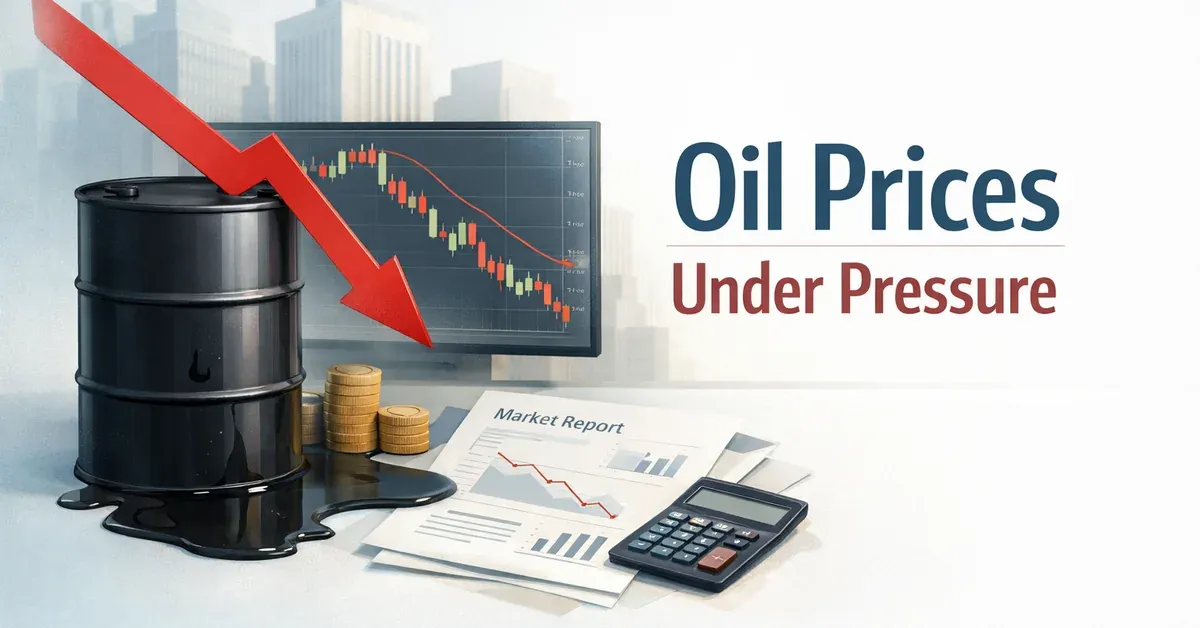
Oil prices are facing bearish pressure as traders focus on ample supply, rising inventories, and a softer demand outlook. Despite geopolitical risks, the market remains cautious and range-bound, awaiting a clear trigger for direction.
Right now, sentiment is steering the global oil market more than hard fundamentals. Traders are trying to weigh a well-supplied market against fast-moving geopolitical risks.
At last week’s International Energy Week in London, the mood was clearly cautious. Bearish voices dominated discussions, outnumbering the bulls by roughly three to one.
While discussions focused on oil demand, supply, and inventories, the larger battle was over the market narrative, and for now, pessimists appear to have the upper hand.
With uncertainty around mid-year production levels and geopolitical outcomes still unclear, crude prices remain stuck in a narrow trading range instead of showing a clear trend.
Why Are Bears Dominating The Oil Narrative?
The bearish argument has remained consistent over the past two years. The global oil supply is outpacing demand, causing inventories to rise.
The International Energy Agency reports that world stockpiles have grown by approximately 477 million barrels annually and amount to approximately 1.3 million barrels per day, with higher production in the US, Brazil, and the OPEC + grouping.
Demand growth has remained healthy at nearly 1 million barrels per day, but bears argue that the market’s problem is excessive production rather than weak consumption.
What Has Changed In Early 2026?
Preliminary data shows stockpiling continued into early 2026. Even so, those with a bearish view admit inventories have not risen as sharply as expected, partly because supply has faced disruptions.
In January, global production dropped by over 1 million barrels per day. A cold wave hit output in the US and Canada, while a fire disrupted operations at a major oilfield in Kazakhstan.
These unexpected outages tightened supply for a while, preventing inventories from building up further.
Are All Surpluses Equal?
This is where the bullish argument becomes louder. Bulls argue that the location of the surplus matters as much as its size.
If excess oil is accumulating in areas that do not directly influence benchmark pricing, such as China’s strategic reserves or sanctioned offshore supply, the surplus may not translate into immediate downward pressure on Brent or WTI.
At the London gathering, traders pointed to growing evidence that much of the excess oil is building up in “less visible” channels.
How Important Is China’s Strategic Stockpiling?
Bulls argue that much of the inventory buildup is occurring in areas with limited influence on benchmark pricing, such as China’s strategic petroleum reserves and the shadow trade in sanctioned Russian and Iranian crude.
China’s stockpiling has also become a major focus. The country added more than 100 million barrels to strategic storage last year, accounting for roughly a quarter of the global inventory build-up.
The uncertainty lies in whether China will continue buying at the same pace. Traders believe that if China stops suddenly, the world could be flooded with crude, strengthening the bearish outlook.
Nevertheless, despite the fact that China is likely to keep adding reserves, the additional barrels can be stored in inventory, which curtails their short-term influence on benchmark prices.
How Do Sanctioned Barrels Add To The Uncertainty?
Russian and Iranian supply remains tied closely to geopolitical decisions involving leaders such as Donald Trump, Vladimir Putin, Volodymyr Zelenskyy, and Ayatollah Ali Khamenei.
Bulls think that Russia and possibly Iran will one day have to reduce output, which might restrict the market. Bears believe that such barrels will ultimately be sold, probably at a discount, and will eventually leak into China, which will subsequently increase the supply worldwide.
Bears also note that Trump has been favourable towards lower oil prices in the past, particularly as the mid-term US elections are coming near, and this would have an effect on the market perspective.
For now, oil prices might remain stuck in a holding pattern. Brent has traded within a $60–$70 range for nearly six months, neither collapsing nor rallying sharply. The key question is whether surplus barrels will start appearing in regions like the Atlantic Basin, where they would have a more direct impact on benchmark pricing.
Also Read - NSE Set To Roll Out Natural Gas Futures
What Does This Mean For Investors?
Right now, the oil market sits between two forces. On one side, inventories are rising. On the other hand, geopolitical tensions remain active.
With Brent around $67 per barrel, the near-term downside is seen at about $10 to $15 if prices correct. At the same time, the upside risk is much larger.
If tensions, particularly between Iran and the United States, intensify, Brent could move towards $125. For now, the bearish view may dominate, but this market can change direction quickly on headlines.
Sources:
Economic Times
Investing

Since its incorporation on 20 July 1994, Kotak Neo has grown into one of India’s most trusted brokerage houses - backed by over 30 years of expertise across stocks, funds, IPOs, and full-service investing.
With a pan-India footprint of 145+ branches, 1000+ franchises and presence across 310+ cities, Kotak Neo serves 5 million+ customers nationwide.
From equities and IPOs to mutual funds and derivatives, Kotak offers comprehensive, research-backed investment solutions - simplifying wealth management for retail and institutional clients alike.
Kotak News Desk brings you latest updates, expert insights, and market-ready ideas - helping you stay informed and invest smarter.
Connect on: Linkedin
0 people liked this article.