All About Dematerialization
- 6 min read
- 2,913
- Published 18 Dec 2025

What Is Dematerialisation?
Technology has brought about a drastic change in people’s everyday lives. The stock markets too have not been left untouched by the change. In 1875, the Bombay Stock Exchange was founded with an open outcry floor trading exchange. Traders would stand on the floor and shout prices of stocks for buying or selling. Then, money would be exchanged for physical receipts of the shares, which were called certificates. This led to a great amount of paperwork. Even the settlements of trade agreements took time because of the need to deliver the share certificates.
Dematerialisation: A Brief History
Dematerialisation in India began in the mid-1990s to overcome the limitations of the physical share trading system, which included theft, forgery, loss, and long settlement cycles. The turning point came with the establishment of the National Securities Depository Limited (NSDL) in 1996, followed by the Central Depository Services (India) Limited (CDSL) in 1999. These institutions facilitated the electronic holding and transfer of securities. The Securities and Exchange Board of India (SEBI) made it mandatory for listed companies to trade shares in dematerialised form, leading to faster and safer transactions. Over the years, dematerialisation gained popularity, and now most equity transactions in India are conducted in demat form. This transition has significantly improved transparency, efficiency, and investor confidence in the Indian capital markets.
Process of Dematerialisation
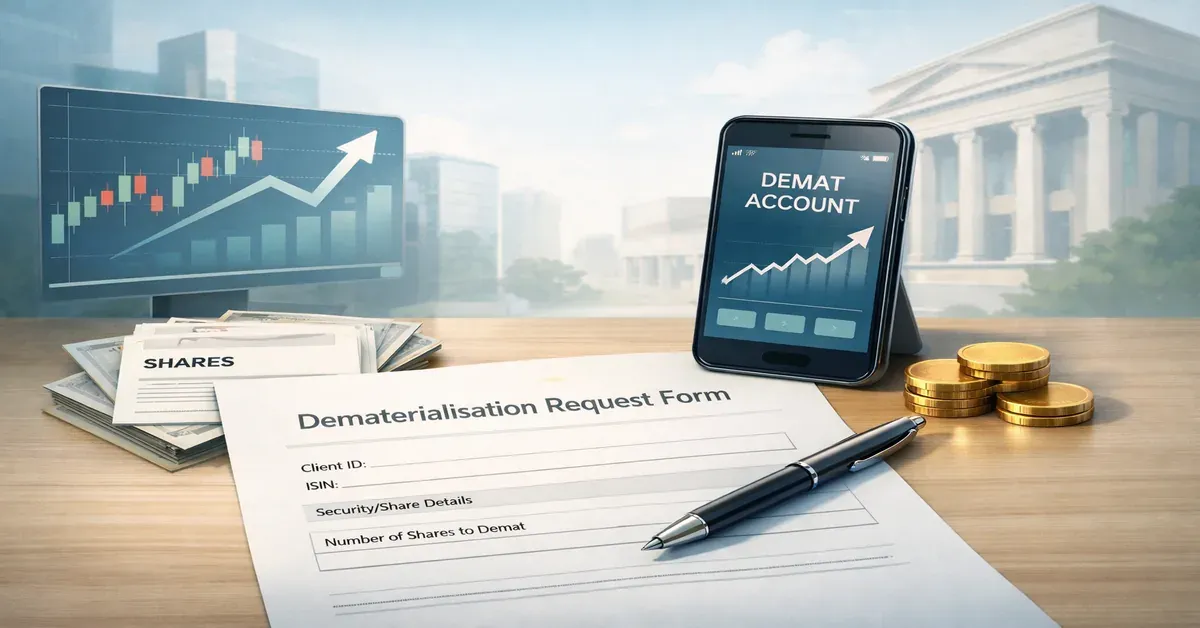
To convert physical shares into dematerialised form, as an investor, you must first open a demat account with a registered Depository Participant (DP) such as a bank or brokerage. After opening the account, you need to submit a Dematerialisation Request Form (DRF) along with the original physical share certificates to the DP.
The DP then forwards the documents to the concerned registrar or transfer agent. If all details match and the certificates are valid, the registrar approves the request and updates the electronic records. The shares are then credited to your demat account. This process usually takes about 15–30 days. Once completed, you can view and trade these shares electronically, without needing to handle any physical certificates.
Benefits of Dematerialisation
- Common Bank:
Dematerialisation is not just for shares, but also for debt instruments like bonds. Now, you can hold all your investments in a single account.
You can read all the benefits offered by Kotak’s Trinity account.
- Automatic Update:
Since this is a common account, you don’t have to keep giving all your details like addresses every time you transact or every time you change the details. These details are automatically made available to companies you transact with.
However, you will have to complete your KYC in the first go.
- Odd-lot Problem:
Earlier, shares were transacted in lots. A single or odd number of securities could not be transacted. This problem is now eliminated. As an investor, the entire process of investing has become a whole lot easier with a host of trading tools offered by Kotak Neo.
- Delivery Risks:
Dematerialisation has also eliminated the risks of fake shares, thefts, deliveries gone wrong, and so on, and reduced the paperwork involved. Time of delivery has also reduced drastically. Once your trade is approved, the securities are automatically credited to your account. This applies to other company-related activities like stock splits, stock bonuses, and so on.
- Cost Reduction:
Earlier, when you transferred the securities, you incurred extra costs due to the stamp duty. This is not a problem with securities in their dematerialised forms
- Easy To Hold:
Paper certificates are vulnerable to tears and damage. In contrast, the dematerialised format is a safe and convenient way to hold securities. You also have a nomination facility, whereby you can facilitate a transfer of shares in the event of your demise.
Demerits of Dematerialisation
While dematerialisation has made investing more efficient, it comes with certain drawbacks.
- One major concern is the risk of cyber fraud or hacking, as all securities are stored electronically.
- As an investor, you may also face technical glitches on trading platforms or during the transfer of shares.
- The process involves annual maintenance charges and transaction fees that can reduce profits for small investors.
- Additionally, if you are an investor who is not tech -savvy may find it difficult to adapt to online systems.
- Incorrect data entry or discrepancies in demat account details can lead to issues in the transfer or sale of shares, requiring lengthy resolution processes.
Dematerialisation vs Rematerialisation
Definition | Conversion of physical share certificates into electronic form | Conversion of electronic holdings back into physical certificates |
Objective | To simplify trading and storage of securities | To revert to holding physical certificates |
Account Requirement | Requires a demat account with a depository participant | Requires submitting a Rematerialisation Request Form (RRF) |
Time Taken | Around 15–30 days | May take a few weeks |
Trading Flexibility | Easy and fast trading via electronic platforms | Cannot be traded easily; slower processing |
Popularity | Widely used in Indian markets | Rarely used |
Risk | Cybersecurity and technical glitches | Risk of physical loss, damage, or forgery |
How to Open a Demat Account?
-
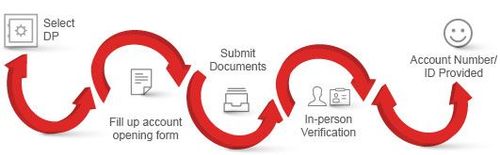
Fill up an account opening form and submit along with copies of the required ID and address proofs and a passport-sized photograph. You also need to have the original documents for verification.
-
You will be provided with a copy of the rules and regulations, the terms of the agreement and the charges that you will incur.
-
During the process, an In-Person/Online Verification would be carried out. A member of the DP’s staff would contact you to check the details provided in the account opening form.
-
Once the application is processed, the DP will provide you with an account number or client ID. You can use the details to access your account online.
-
As a demat account holder, you would need to pay some fees like the annual maintenance fee levied for maintenance of account and the transaction fee -- levied for debiting securities to and from the account on a monthly basis. These fees differ from every service provider. While some DPs charge a flat fee per transaction, others peg the fee to the transaction value, and are subject to a minimum amount. The fee also differs based on the kind of transaction (buying or selling). In addition to the other fees, the DP also charges a fee for converting the shares from the physical to the electronic form or vice-versa.
-
A demat account can be opened with no balance of shares. It also does not require that a minimum balance be maintained. To know the entire process in detail, you can check how to open a demat account.
To know the entire process in detail, you can check how to open a demat account.
What Are the Documents Required for a Demat Account?
You need to submit proof of identity and address along with a passport size photograph and the account opening form. Only photocopies of the documents are required for submission; originals are required for verification.
Here is a broad list of documents that can be used as proofs:
Proof of identity: PAN card, voter's ID, passport, driver's license, bank attestation, IT returns, electricity bill, telephone bill, ID cards with applicant's photo issued by the central or state government and its departments, statutory or regulatory authorities, public sector undertakings (PSUs), scheduled commercial banks, public financial institutions, colleges affiliated to universities, or professional bodies such as ICAI, ICWAI, ICSI, bar council etc.
Proof of address: Ration card, passport, voter ID card, driving license, bank passbook or bank statement, verified copies of electricity bills, residence telephone bills, leave and license agreement or agreement for sale, self-declaration by High Court or Supreme Court judges, identity card or a document with address issued by the central or state government and its departments, statutory or regulatory authorities, public sector undertakings (PSUs), scheduled commercial banks, public financial institutions, colleges affiliated to universities and professional bodies such as ICAI, ICWAI, Bar Council etc.
All you need to do is fill in the Demat Request Form (DRM), fill in the appropriate details of the share certificates you hold, and submit it with the physical share receipt. Every share certificate needs a separate DRM form. Once the form is approved, your demat account will automatically be updated to reflect your newly dematerialiszed shares.
Conclusion
Dematerialisation has transformed the way investors like you interact with the stock market, making trading quicker, safer, and paperless. While there are a few limitations to consider, the benefits far outweigh them for most investors. By opening a demat account, you get access to a more streamlined and secure investment experience. Whether you are just starting out or looking to convert old physical certificates, dematerialisation is now the default route for investing in today’s digital first markets.
0 people liked this article.