
What Is BO ID? Understanding Beneficiary Owner Identification In Demat Accounts
- 4 min read
- 1,002
- Published 17 Feb 2026
Every investor remembers a phase where trading feels exciting, and filling account details boring. You wanted to place your first order, watch prices move, maybe tell a friend you bought your first stock. The paperwork part fades into the background.
Somewhere in that background, a number gets assigned to you. It does not come with drama. No explanation. No emphasis. It just exists.
That number is the BO ID.
Most people do not care about it. Until the day they suddenly have to. And when that day comes, the question is always the same: what BO ID actually is and why everyone suddenly wants it?
What Is BO ID?
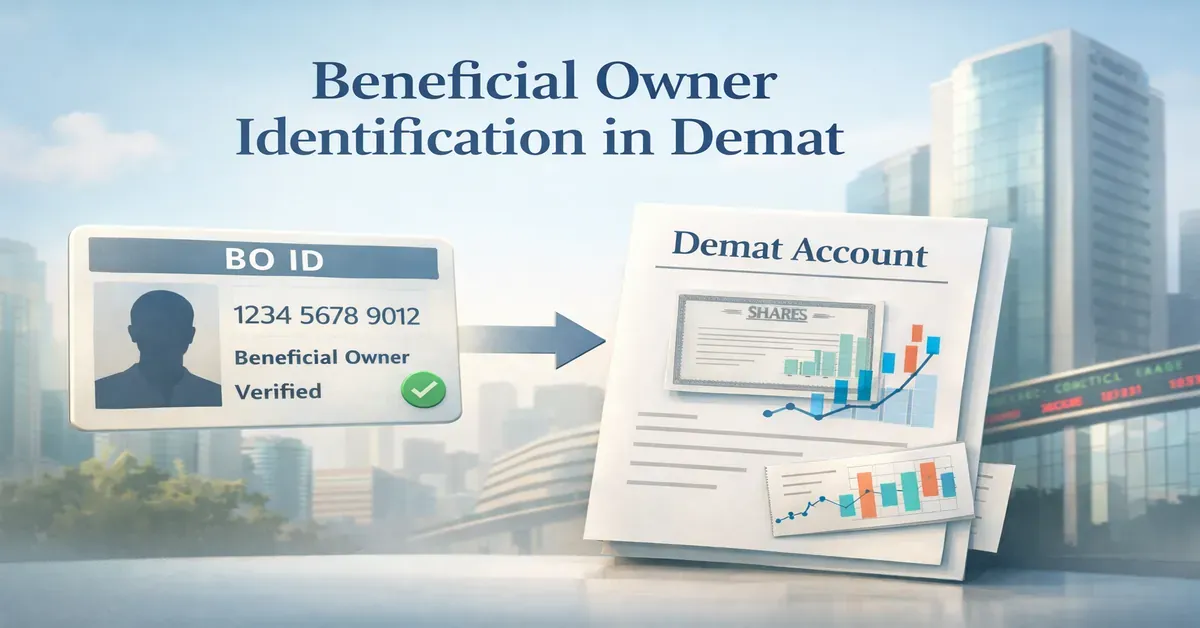
BO ID is short for Beneficial Owner Identification.
That name sounds heavier than it needs to be, so let us slow it down.
In the stock market, ownership must be recorded somewhere. Earlier, this was done using physical certificates. Now, everything is digital. Shares are numbers in a system. To ensure those numbers belong to the right person, the system needs a way to identify the owner.
The BO ID is that recognition.
If you have a CDSL Demat account, your BO ID is a 16-digit number. For investors asking what is BO ID in CDSL, this number is the primary identifier CDSL uses to record and track ownership of your securities. That number represents you as the owner of whatever securities sit in that account. Not your name. Not your email address. Not your broker login. Just that number.
This is why spelling mistakes, name changes, or similar names do not break the system. The BO ID is what the system trusts.
Who Issues The BO ID?
This part is often misunderstood, even by experienced investors.
Since you open your Demat account with a broker, it's natural to assume the broker issues the BO ID. In reality, the broker only facilitates the process.
The depository issues the BO ID itself. In a CDSL-linked account, the depository is Central Depository Services Limited.
Your broker is officially known as a Depository Participant. They collect documents, complete verification, and forward the details. Once the account is approved, CDSL creates the BO ID and maintains the ownership record.
This is also why your shares are not “with the broker” in the true sense. Even if a broker app is down or you stop trading for months, the ownership record tied to your BO ID exists independently.
Importance Of BO ID
The BO ID does not feel important because it does not ask for attention.
You can trade for years without ever having to type it manually. Orders get placed. Shares appear. Money moves. Everything works.
That smoothness is precisely why the BO ID matters.
Each time a trade settles, the system uses the BO ID to decide where securities should go. When you sell, it checks whether the BO ID holds those shares. When dividends are announced, the BO ID is used to determine eligibility.
It also shows up quietly during things like audits, reconciliations, or disputes. If there is ever a mismatch, the BO ID serves as the reference point to settle the question.
In practical terms, it is the anchor that keeps ownership stable, even when everything else around it changes.
How To Find Your BO ID?
Most investors do not remember where they first saw their BO ID. They remember seeing it, but not when.
It usually appears in the account-opening email, in early Demat statements, or in the profile section of the broker’s app or website. Sometimes it is labelled clearly.
Sometimes it is just called the Demat account number.
If your account is with CDSL, the giveaway is simple. The BO ID will be a 16-digit numeric code.
You do not need to memorise it. But it helps to know where to find it quickly, especially when dealing with transfers, pledges, or service requests that cannot move forward without it.
BO ID In Trading And Investing
For daily trading, the BO ID stays invisible.
You place an order. The exchange matches it. Settlement happens. The system takes care of the rest. The BO ID is used in the background, not on your screen.
Its relevance increases as your activity becomes more varied.
If you ever move shares from one Demat account to another, both accounts are identified using their BO IDs. If you pledge shares to get margin, the pledge is recorded against your BO ID. If you change brokers, the holdings remain linked to the same BO ID until they are remapped.
Some long-term investors also prefer checking holdings directly through depository access rather than relying only on broker dashboards. In those cases, the BO ID serves as the key to retrieve the entire account.
Security And Compliance
The way a BO ID functions is shaped less by convenience and more by regulation, with clear rules governing how it is created, linked, and maintained.
Regulatory Requirement Under SEBI
The Securities and Exchange Board of India sets the rules that govern how Demat accounts function, including how BO IDs are issued and maintained.
These rules exist to ensure that ownership is transparent, traceable, and legally defensible. Every BO ID is tied to verified KYC information. Anonymous ownership is simply not allowed in the system.
This framework is one of the reasons large-scale digital investing works without collapsing into disputes.
How Does BOID Help In KYC And Anti-Fraud Measures?
The BO ID acts like a central spine.
Your PAN, bank account, address, and nomination details are all linked through it. When something changes, it needs to be verified before the update reflects across systems.
From a fraud perspective, this reduces gaps. If something looks off, it can be traced back through the BO ID. That traceability acts as a deterrent as much as a control.
It is not perfect, but it is compelling enough to keep large-scale misuse in check.
Importance Of Keeping Your BO ID Confidential
The BO ID is not a password, but it is still sensitive.
You will share it with brokers, registrars, or depository-related services when required. Outside of that, there is no real reason for it to be public knowledge.
Treat it the way you treat other financial identifiers. Useful when needed. Protected otherwise.
Conclusion
Most investors go through their entire market journey without thinking about their BO ID. It sits quietly in the background while trades settle, dividends arrive, and portfolios grow or shrink with time. There is no reason to focus on it every day, and that is precisely how the system is designed.
Still, understanding what the BO ID represents changes how you look at a Demat account. It is not just a technical label or a compliance requirement. It is a single reference through which ownership is recognised, verified, and protected across the market ecosystem.
Sources
CDSL
FAQs
0 people liked this article.