

Kotak
Stockshaala
Chapter 2 | 2 min read
Correlation of Interest Rates and Bond Values
Remember that money you lent to a friend at a fixed interest rate. Now, what if the market interest rates suddenly rise? Your friend’s loan becomes less attractive compared to new loans with higher rates, right? Similarly, in the bond market, there is an inverse relationship between interest rates and bond prices. Understanding this correlation is vital for fixed income investors.
How Are Interest Rates and Bond Values Related?
When market interest rates rise, the price of existing bonds tends to fall, and when interest rates fall, bond prices generally increase. This inverse relationship occurs because new bonds reflect current higher rates, making existing bonds with lower coupons less attractive unless their prices drop to compensate.
Why Does This Happen?
- Coupon Rate vs. Market Yield:
Existing bonds have fixed coupon rates. When new bonds offer higher coupons due to rising interest rates, investors prefer the new bonds. To sell existing bonds, holders must reduce the price to offer an equivalent yield.
- Opportunity Cost:
Investors demand compensation for holding bonds with lower returns than the prevailing market rates. Example: Suppose you hold a bond with a 6% coupon, but the prevailing market interest rate rises to 7%. To match the new yield, the price of your bond will fall below its face value.
Example: Suppose you hold a bond with a 6% coupon, but the prevailing market interest rate rises to 7%. To match the new yield, the price of your bond will fall below its face value.
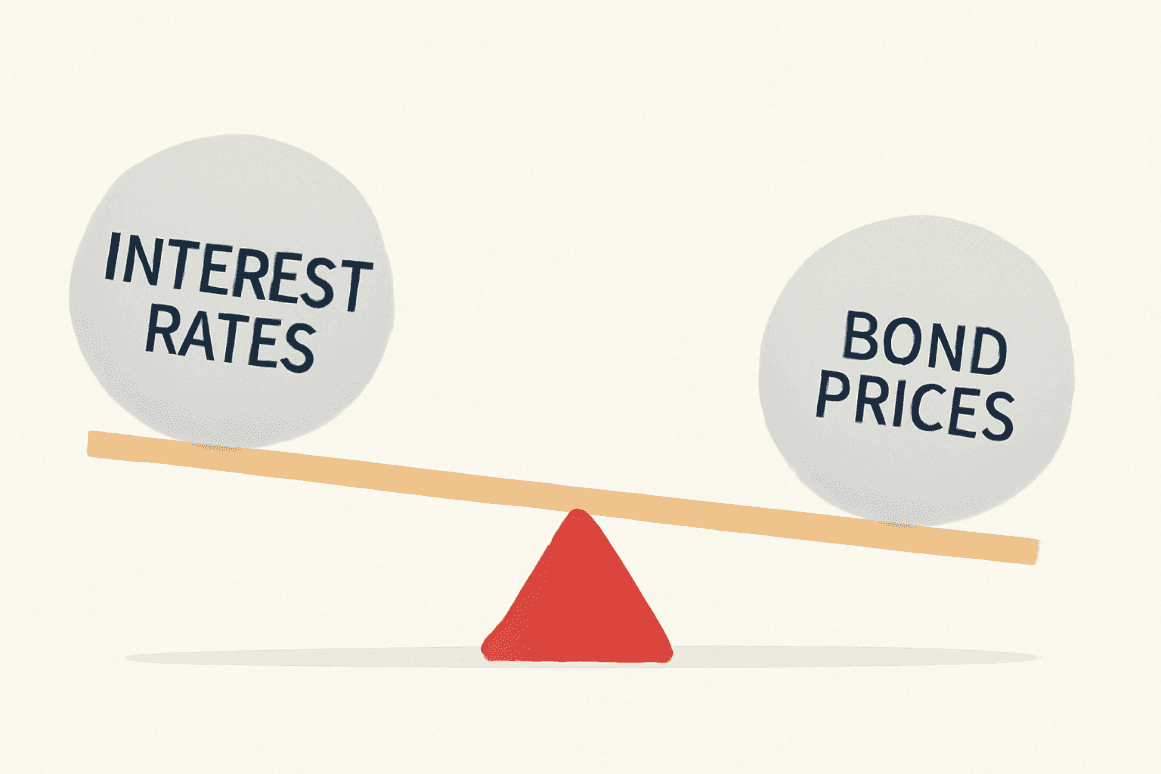
Correlation of Interest Rates and Bond Values
Duration and Price Sensitivity:
The degree to which bond prices change due to interest rate changes is measured by duration (discussed in detail in later chapters). Generally, bonds with longer maturities or lower coupons are more sensitive to interest rate changes.
In India, RBI’s monetary policy decisions directly affect interest rates, impacting bond prices. For instance, when the RBI raises repo rates to curb inflation, bond prices tend to fall as new issues offer higher yields. Interest rates and bond prices move in opposite directions. For investors, understanding this relationship is key to managing risk and making informed investment decisions. In the next chapter, we will explore Inflation and Its Impact on Bonds, examining how rising prices affect fixed income investments.
Recommended Courses for you

















Learn, Invest, and Grow with Kotak Videos
Explore our comprehensive video library that blends expert market insights with Kotak's innovative financial solutions to support your goals.

Trading with collateral as margin with Kotak Neo

How India is Redefining Space Exploration