

Kotak
Stockshaala
Chapter 1 | 4 min read
The Labour Market & Unemployment Rate
Have you ever wondered how people find jobs? It might seem like magic, but is it that you finish school and suddenly you're a teacher, a mechanic, or a video game designer?
But there's actually a fascinating system behind it all, called the labour market. It's kind of like a giant game of matching, where people with skills find jobs that use them, and businesses find the people they need to get things done.
Concept of Labour Market
The labour market serves as a bridge between job seekers and employees, where employers search for workers and individuals seeking jobs connect with potential employers. It includes all available jobs and the individuals who are ready to work, showing how jobs are created and filled within the economy.
Importance of labour market
-
The labour market serves as a key indicator of the overall economic health. High employment rates typically signal economic growth, while high unemployment can point to economic downturns.
-
It helps to efficiently allocate human resources to sectors where they are most needed, thus optimizing productivity and economic output.
-
The labour market affects wage levels by influencing supply and demand dynamics, which in turn impact workers' living standards and purchasing power.
-
As workers strive to improve their employability in response to changing demands, it encourages the development of skills and education,
-
A well-functioning labour market can help maintain social stability by reducing unemployment and poverty, resulting in a fairer society.
-
Understanding labour market trends helps governments and policymakers to develop effective economic policies, such as minimum wage laws and employment programs.
Key Players in the labour market
-
Employers: Businesses and organizations that require labour.
-
Employees: Individuals seeking work/job.
-
Government: Entities that regulate labour practices and provide support.
Who is a worker?
We all know someone who is a worker – a doctor, a teacher, a construction worker. But what exactly defines a worker? Is it the kind of work they do? The way they get paid? Or something deeper?
A worker is an individual engaged in some production activity or in the process of value addition, who contributes to the national income of a country in one way or the other.
Now, Let's learn about the types of workers.
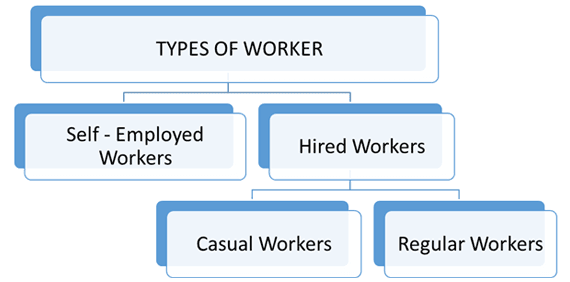
The above flowchart depicts Types of Worker
Self-employed workers are those who are engaged in their own business or profession. For example, a farmer working on his farm, or an entrepreneur working in his factory.
Hired Workers are those who work for others; they render services to others and as a reward, they get salary/wages or may be paid in kind. For example, a teacher working in a school.
Casual Workers are the daily wagers. They are not hired by their employers on a regular basis; they are not given social security benefits, like provident fund, gratuity or pension fund.
Regular Workers are on permanent payroll of their employers and are entitled to all social security benefits including pension, gratuity and provident fund.
Unemployment
Unemployment is a key measure of economic well-being, indicating the number of people actively looking for work but unable to find employment. The definition of unemployment can be summed up as follows:
Unemployed: Individuals who are without work, actively seeking work, and available to start work. This includes people who have been laid off, those who have left their jobs, or those who are new to the labour market.
Not Considered Unemployed:
-
Discouraged Workers: Individuals who are not actively looking for work because they believe no jobs are available for them.
-
Not Seeking Work: Those who are not seeking work for other reasons, such as full-time students, retirees, or homemakers.
Types of Unemployment:
-
Frictional Unemployment: Short-term unemployment refers to the period when individuals are temporarily out of work as they switch between jobs or are in the process of entering the workforce for the first time. For example, a recent college graduate looking for their first job.
-
Structural Unemployment: Structural unemployment occurs when there is a mismatch between the skills possessed by workers and the qualifications demanded by job openings. For example, a factory worker whose job has been automated and who needs retraining to find new employment.
-
Cyclical Unemployment: Cyclical unemployment is associated with changes in the business cycle, increasing when the economy enters a recession and decreasing during times of economic expansion. For example, a construction worker was laid off during a housing market downturn.
-
Seasonal Unemployment: Seasonal unemployment occurs due to seasonal variations in employment opportunities. For example, agricultural workers who are unemployed during the off-season.
In this chapter, we explored the labour market and discussed the importance of understanding unemployment and its types. This knowledge sets the stage for a deeper look into the labour market's dynamics.
In the next chapter, we'll explore other important labour market indicators like labour supply, labour force, and participation rate. These will help us understand how the labour market works and what it means for economic policies and job opportunities. By examining these indicators, we'll gain valuable insights into workforce trends and how to improve employment and productivity. Stay tuned as we continue to learn about the labour market!
Recommended Courses for you

















Learn, Invest, and Grow with Kotak Videos
Explore our comprehensive video library that blends expert market insights with Kotak's innovative financial solutions to support your goals.

Trading with collateral as margin with Kotak Neo

How India is Redefining Space Exploration