India Allows Controlled Duty Concession On US DDGS
- By Kotak News Desk
- 09 Feb 2026 at 11:49 AM IST
- Market News
- 4 minutes read
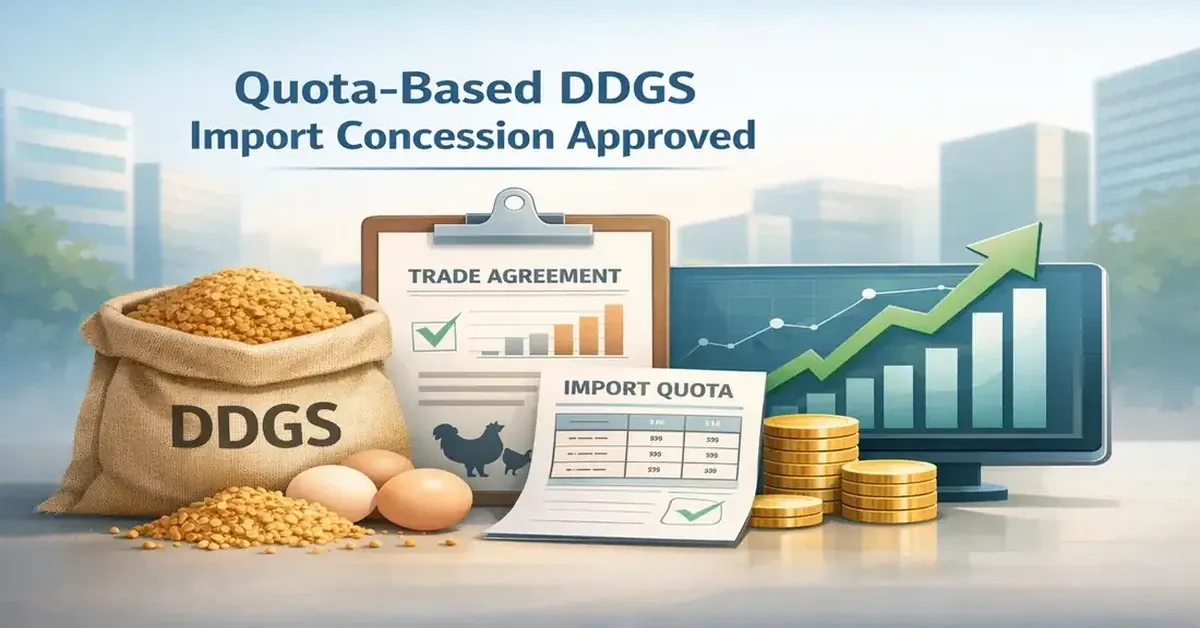
India has agreed to a quota-based duty concession on US DDGS imports to support the animal husbandry and poultry sectors. The move is part of the first phase of the India-US trade agreement and aims to improve access to high-protein feed inputs.
India has agreed to extend a quota-based duty concession on imports of dried distillers’ grains with solubles (DDGS) from the United States, the Commerce and Industry Minister, Mr Piyush Goyal, said on Sunday. This move is expected to ease input constraints for the animal husbandry and poultry sectors.
The decision is part of a broader framework agreed upon by India and the US for the first phase of a bilateral trade agreement, which, according to a joint statement, is likely to be finalised by mid-March.
Why Has India Agreed To Duty Concessions On DDGS?
DDGS, a by-product of ethanol production, is widely used as a protein-rich feed ingredient across global livestock and poultry markets. Mr Goyal said the decision to allow limited duty concessions was driven by strong demand from domestic feed users.
“I have given them a quota in DDGS. It is an animal feed with very high nutritional value. The animal husbandry sector wants it, and poultry producers are actively seeking it. It improves poultry health and has high protein content,” the minister told PTI Videos.
He added that the concession has been structured carefully to address concerns raised by some experts regarding tariff reductions on imported feed materials. Rather than opening the market fully, India has opted for a quota-based approach to ensure balance.
“Quota on DDGS is good for the economy,” Goyal said, underlining that the move is intended to supplement domestic feed availability without disrupting existing market structures.
What Is DDGS, And How Significant Is Global Trade In It?
According to the US Grains and Bioproducts Council, DDGS is a nutrient-dense co-product obtained during dry-mill ethanol production and is commonly used as both an energy source and protein supplement in animal feed.
The US ethanol industry has substantial production capacity, with plants capable of producing over 15 billion gallons of ethanol annually, along with around 44 million metric tonnes of DDGS.
Global demand for DDGS has grown steadily over the years. The council notes that exports have more than doubled from about 5 million tonnes in 2009 to over 10 million metric tonnes during 2022–23, reaching markets in 58 countries.
Mexico remains the largest importer, accounting for more than 20 per cent of total exports. South Korea ranks second, while Vietnam, Indonesia and Canada are also among the leading buyers.
The quota-based concession is expected to improve access to high-quality feed inputs for Indian poultry and livestock producers while maintaining safeguards to protect domestic interests.
How Does The Move Fit Into India’s Trade Strategy?
Goyal said India has followed a calibrated approach while opening up sectors under trade negotiations, keeping long-term growth and domestic interests in mind.
“Every decision has been taken in a balanced and well-thought-out manner. These steps will support India’s growth story and ultimately benefit Indian farmers as well, particularly those looking to export processed and value-added products,” he said.
The minister stressed that trade concessions are being aligned with export opportunities for Indian producers, rather than being treated as standalone import relaxations.
Sources:
The Economic Times
Business Standard
Kotak News Desk brings you latest updates, expert insights, and market-ready ideas - helping you stay informed and invest smarter.
Connect on: Linkedin
0 people liked this article.