India‑Germany Forge Ahead on Deals in Chips, Green Energy, and EVs
- By Kotak News Desk
- 12 Jan 2026 at 2:57 PM IST
- Market News
- 4 minute read
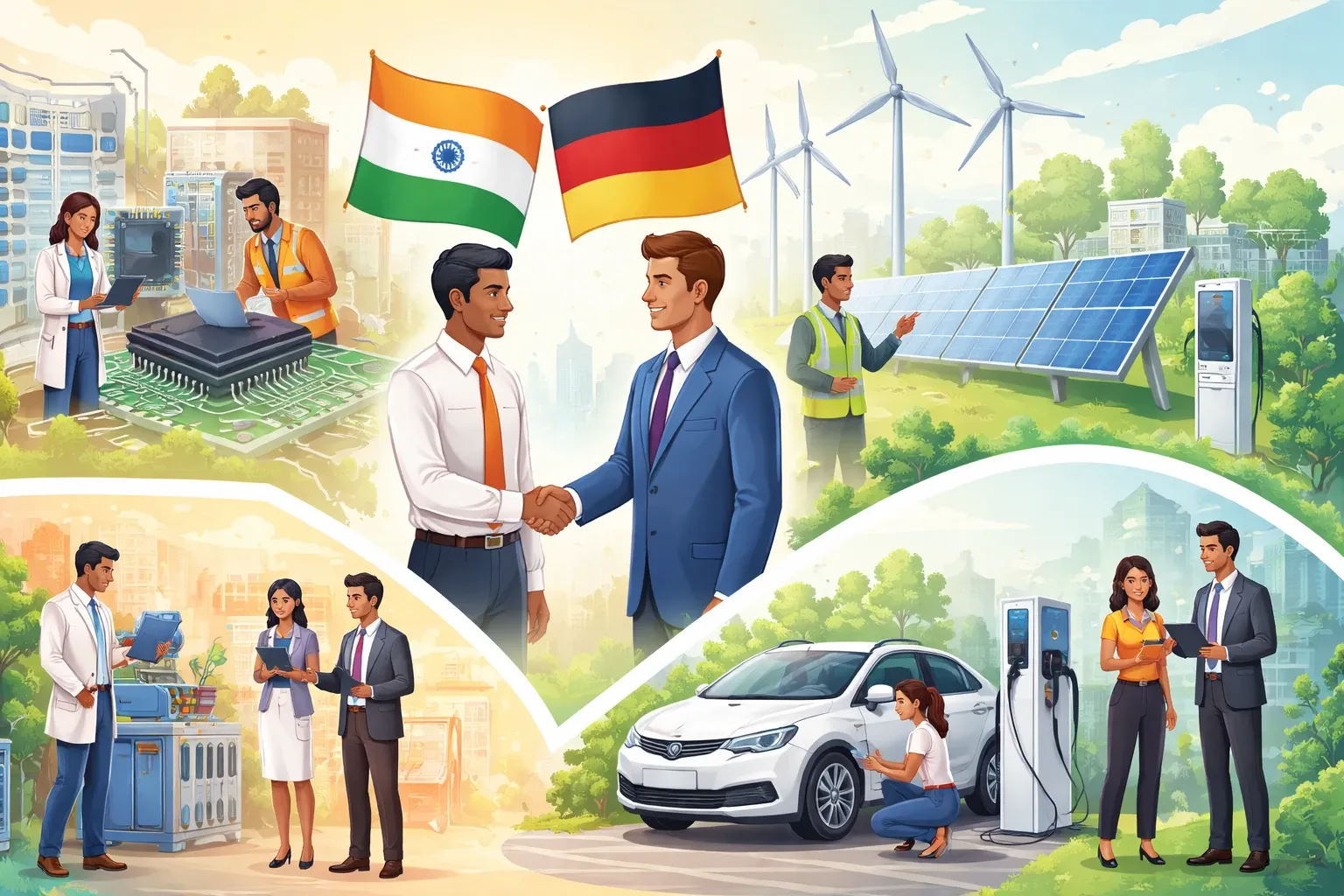
On January 12, 2026, German Chancellor Friedrich Merz began a two‑day visit to India. The purpose was to finalise key economic and technology pacts and boost the India‑European Union (EU) trade agenda.
Chancellor Merz’s visit, his first to Asia since taking office, follows months of negotiations on technology, trade, talent, and critical supply chains, with a goal of doubling bilateral trade beyond the current roughly $50 billion level.
Semiconductors: From Roadmaps to Agreements
Both countries are set to move forward on semiconductor cooperation. Germany will provide technical support, equipment collaboration, and engineering expertise to support India’s efforts under the India Semiconductor Mission.
India’s semiconductor sector is booming under the Mission. In 2025 alone, 10 projects worth around ₹1.6 lakh crore (~$19 billion) were approved, and four new chip manufacturing fabs were announced.
The negotiations are likely to wrap up with a semiconductor agreement during Chancellor Merz’s visit, covering everything from research and development to production support. This move builds on the EU‑India semiconductor Memorandum of Understanding (MoU) that was signed back in November 2023.
Green Energy: Hydrogen, Ammonia and Renewables
During the visit, green energy will take centre stage. As part of the Indo‑German Partnership for Green and Sustainable Development, Germany has committed an initial €10 billion, with €1.3 billion pledged by December 2025 for projects covering urban mobility, clean energy corridors, and infrastructure.
Significant developments include:
- Germany’s state‑owned utility, Uniper SE, is nearing a deal with Indian producers to import green ammonia.
- Collaborative clean energy projects are already in motion, including a $1.3 billion green hydrogen hub in Andhra Pradesh, which is set to produce 180,000 tonnes of green hydrogen each year and up to 1 million tonnes of green ammonia for export by 2029.
- Germany and India have established working groups on solar, wind, battery storage, R&D, and skilled workforce development to strengthen renewable energy value chains.
In recent years, Germany has been actively backing renewable projects. Its KfW Development Bank has invested around €1 billion to expand solar energy capacity in India. The investment helped install over 4 GW of solar power and cut around 6 million tonnes of CO₂ every year.
Mobility: Electric Vehicles and Urban Transport
The focus will also be on mobility cooperation. It is expected that both nations will advance partnerships related to electric vehicles (EVs), charging infrastructure, and sustainable urban transport.
-
In 2025, at a high‑level Indo‑German e‑mobility roundtable, both the countries have identified EV financing models, battery readiness, and workforce skills as key priorities.
-
The India‑Germany Platform for Investments in Renewable Energy Worldwide has four working groups covering solar, wind, battery storage, and research, which underpin mobility infrastructure efforts.
-
German engineering and investment are widely viewed as key to helping India reach its 500 GW renewable energy target by 2030, especially as this push goes hand in hand with the growing need for electric vehicles and charging infrastructure.
Trade, Investment and Strategic Context
India is a key partner for Germany in Europe. Germany alone accounts for around 25% of India’s total trade with the EU, and bilateral services trade touched a record $16.65 billion in FY25.
German companies have invested about $15.4 billion in India between April 2000 and June 2025. In FY25 alone, investments touched $469 million, helping support the operations of more than 2,000 German companies across the country.
As discussions on an India-EU Free Trade Agreement advance, Germany sees these sectoral deals as anchoring broader economic ties and diversifying supply chains away from concentrated global dependencies.
Business Standard
The Week
Pm India
Reuters
Entrepreneur
KFW
The Tribune
ET
CNBC
Kotak News Desk brings you latest updates, expert insights, and market-ready ideas - helping you stay informed and invest smarter.
Connect on: Linkedin
0 people liked this article.