GST 2.0 vs Current GST: A Breakdown of What’s Changing
- By Kotak Neo Team
- 18 Dec 2025 at 10:26 PM IST
- Market News
- 4 min read
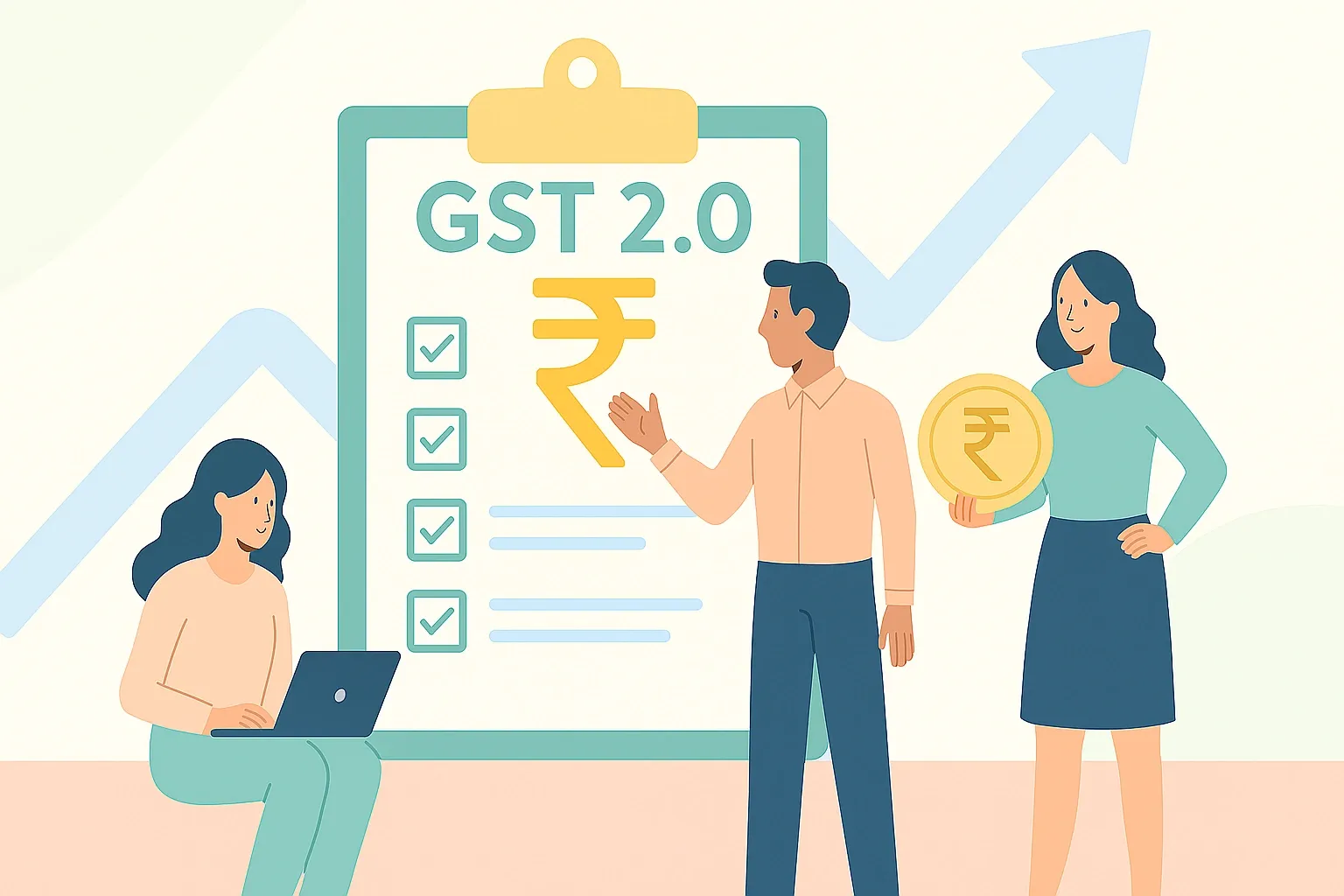
India’s landmark Goods and Services Tax (GST), launched in 2017, was envisioned as a “Good and Simple Tax.” Fast forward to 2025, and with the Prime Minister’s Office (PMO) giving the green light to a major GST overhaul, it’s clear that the next version—GST 2.0—must fulfill that original promise through simplification, wider inclusion, and greater fairness (Finshots).
Quick Snapshot of Current GST vs GST 2.0
Tax Slabs | Four major slabs: 5%, 12%, 18%, 28% + Cess | Fewer slabs: 5%, 12%, 18% or a 3-slab structure; 12% may be scrapped |
Coverage | Petroleum, electricity, real estate largely excluded | Broader base: likely inclusion of ATF, natural gas, insurance |
Compliance Complexity | Varying return forms, limited amendment windows | Simplified filing, longer amendment timelines, MSME-friendly tiering |
Return Filing | Auto-filled GSTR-3B is locked; manual correction limited | More flexible returns; better integration across forms and systems |
Dispute Resolution | Limited tribunal presence; slow appeal process | Establishment of GST Appellate Tribunals across regions for faster redressal |
E-Way Bill System | Existing version with gaps in real-time sync | E-Way Bill 2.0 with real-time sync, AI tracking, and reduced data duplication |
MSME Support | Same compliance load as large firms | Tiered compliance norms, simplified UX for small businesses |
Revenue Compensation for States | Compensation Cess continues, but structure is unclear | Revamped compensation framework or alternate mechanisms to support states |
1. Rate Rationalization: Fewer, Smarter Slabs
The current structure includes four major tax slabs—5%, 12%, 18%, and 28%—along with a Compensation Cess. This fragmented system complicates compliance, encourages disputes, and burdens both businesses and tax officials.
A simplified three-slab structure (possibly 5%, 12%, and 18%) is under active review by the GST Council and the PMO, with plans to remove the contentious 12% slab altogether (The Economic Times).
Such restructuring would:
- Eliminate confusion between similar goods/services taxed differently.
- Ease invoice classification.
- Streamline the audit and appeals process.
2. Expanding the GST Base: Petroleum, Electricity, and More
Despite strong collections (₹1.4–1.5 lakh crore/month), key sectors remain excluded. Bringing in petroleum products like ATF and natural gas under GST could help standardize input costs across industries and reduce cascading taxes (NDTV Profit).
There’s also consideration to lower GST on insurance premiums, improving penetration and aligning with national financial inclusion goals (The Week).
3. User-Friendly Compliance and Automation
The GSTN portal has seen major digital upgrades—including e-invoicing, auto-populated GSTR-3B, and e-way bill synchronization. However, small businesses still face challenges due to:
- Locked return fields post-auto-population.
- Invoice mismatches.
- Time-barred return rectifications (now capped at 3 years).
Simplifying UI/UX, improving offline support, and tiered compliance frameworks for MSMEs—as suggested by the Parliamentary Accounts Committee (PAC)—can reduce this burden (CFO.com ET).
4. Dispute Resolution and Appeals Reform
One of the biggest pain points in GST has been the resolution of disputes. After years of delay, the upcoming GST Appellate Tribunal, with regional benches, is expected to offer faster redressal and reduce legal uncertainty for businesses (The Week).
GST 2.0 must prioritize:
- Uniform application of laws across states.
- Faceless appeal mechanisms.
- Better taxpayer grievance redressal through AI-enabled chatbots and tracking.
5. Streamlined E-Way Bill System
With the rollout of E-Way Bill 2.0, logistics tracking and fraud prevention will improve—but implementation support is crucial.
GST 2.0 should ensure:
- Seamless integration with ERP systems.
- Fewer manual steps for MSMEs.
- Real-time reconciliation with GSTR filings (Finshots).
6. Revenue Assurance for States
A thorny issue remains: once petroleum is subsumed under GST, states could lose significant revenue. A reimagined Compensation Cess framework or alternate equalization mechanism will be needed. This will help balance central reforms with state-level autonomy.
Why Now? The Case for Reform
India’s GST system has matured. Here’s why 2025 is the right time for GST 2.0:
- Stable revenue base: GST collections have stabilized, with ₹1.5 lakh crore as the monthly norm (The Economic Times).
- Digital readiness: Tools like e-invoicing and the Invoice Registration Portal (IRP) have gained traction.
- Business demand: MSMEs and corporates alike are demanding a simpler, faster, and more logical GST experience.
Balanced Reform for Inclusive Growth
The following table outlines a win-win roadmap:
Rate rationalization | Lowers errors, boosts tax morale |
Base expansion | Broadens net without raising rates |
Tech-driven compliance | Enhances ease of doing business |
Dispute resolution | Increases trust, lowers litigation |
MSME focus | Eases entry, formalizes economy |
What’s the real promise—and the real risk—of GST 2.0?
GST 2.0 carries the potential to be a transformational upgrade: it can simplify compliance, widen the tax base, reduce disputes, and foster a more business-friendly environment. For many stakeholders—especially small businesses and digital-first enterprises—it could unlock new levels of efficiency and predictability.
But it’s not without risks. A rushed implementation or poorly coordinated rollout could deepen compliance headaches instead of solving them. If rate changes are not carefully calibrated, they may unintentionally raise the tax burden on essentials. And without strong federal coordination, expanding the GST net to include petroleum or electricity could spark pushback from states concerned about revenue loss.
In essence, GST 2.0 is a double-edged opportunity. If executed with foresight, consensus, and flexibility, it could fulfill the original promise of a Good and Simple Tax. But if ambition outpaces groundwork, it may simply add another layer of complexity to an already demanding system.
Sources:
Finshots
Economic Times
NDTV Profit
The Week
ET CFO
Economic Times

Kotak Neo (Kotak Neo) is India's venerable stockbroking company with a rich legacy. It offers comprehensive investment services across asset classes, prioritising a technology-first approach for a seamless experience. Trusted by 5 million+ customers, it guides you toward financial success with ease of investment and speed of trade.
Note: The opinions expressed in this blog are personal viewpoints and should not be construed as recommendations.
0 people liked this article.