Amazon Hits $20 Billion in Indian E-Commerce Exports; Eyes $80 Billion by 2030
- By Kotak Neo Team
- 18 Dec 2025 at 10:26 PM IST
- Market News
- 4 min read
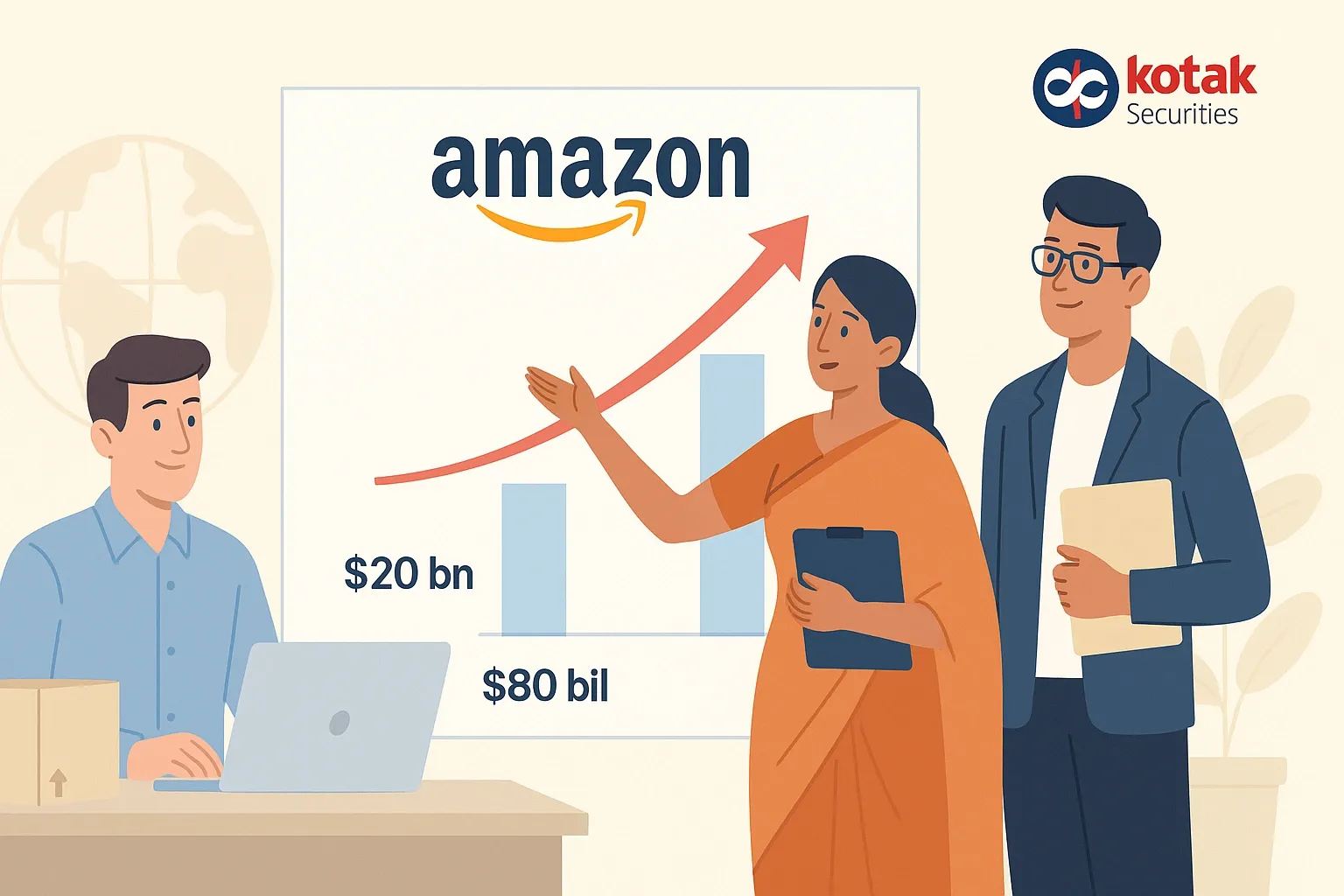
On 27 October 2025, Amazon announced that its Global Selling initiative has enabled over 200,000 Indian exporters to ship more than 750 million ‘Made in India’ products worldwide since its launch in 2015. This milestone was achieved two years ahead of schedule, reflecting strong global demand for Indian goods across categories like textiles, leather, home décor, and electronics.
Amazon emphasised that India’s export strengths are structural, not cyclical, and reaffirmed its commitment to scaling capabilities that support long-term growth. Despite trade and tariff uncertainties in key markets like the US, Amazon remains focused on controllable factors such as seller enablement and logistics infrastructure. The company’s new $80 billion target by 2030 signals a bold expansion of India’s digital export footprint.
What Factors Have Helped Amazon Achieve This Growth
Here are the factors that supported Amazon’s India export growth:
Strategic Partnerships
In 2025, Amazon entered into memorandums of understanding with the Federation of Indian Export Organisations (FIEO) and the Micro, Small & Medium Enterprise (MSME) departments of state governments. These resulted in joint workshops, export fairs, and a host of onboarding drives. In addition, Amazon partnered with the Directorate General of Foreign Trade (DGFT) and Invest India to develop an easy-to-use export documentation process to address compliance pain points. These partnerships enabled Amazon to expand its seller base and drive export volumes in Tier-2 and Tier-3 cities that had not previously established a digital footprint with traditional exporters.
Category Expansion
Amazon’s export growth was not consistent but was primarily driven by expansion into strategic categories. Over the last 10 years, Amazon has prioritised health and personal care, beauty, toys, home apparel, and furniture, which grew by as much as 45% year-over-year, which incidentally aligned with growing global demand for sustainable, handcrafted, and Ayurvedic products. Amazon employed predictive analytics to identify export-ready stock-keeping units (SKUs) and to assist sellers with packaging, certifications, and compliance for markets such as the United States, the United Kingdom, and Germany.
AI-Driven Export
Amazon utilises artificial intelligence (AI) tools to assist Indian sellers in determining global demand, establishing prices, and managing stock across geographies. Exporters received timely information about seasonal spikes of demand, competitors, and cost-saving logistics options. Data-driven solutions enable them to reduce dead stock and increase conversion rates. It also allowed sellers to tailor their products to the marketplace—for example, eco-friendly packaging for Europe, or complying with the standards of the US Food and Drug Administration (FDA) for wellness products bound for the US.
Cross-Border Fulfilment Infrastructure
Amazon has made substantial investments in cross-border logistics by including Indian sellers in its global fulfilment network. Exporters could churn up their inventory in Amazon’s warehouses outside of India, allowing faster shipments and eligibility for Prime. Amazon’s negotiations also led to bulk flight rates with service providers, such as DHL and FedEx, enabling exporters through Amazon to achieve a more affordable per-unit export shipping cost. This infrastructure allowed Indian products to compete on delivery speed and reliability in mature markets.
Seller Financing
To solve working capital constraints, Amazon began working with fintechs and Non-Banking Financial Companies (NBFCs) to offer export-linked credit lines, invoice financing, and insurance-backed loans. The benefit sellers receive is access to funds based on export performance, thereby reducing their dependency on banks. These loans and other financial products are now available in the seller dashboard, streamlining applications and disbursements. These liquidity products allow sellers to scale production, pursue additional certifications, and develop more products for global markets.
What Comes Next—Specific Checkpoints to Watch
- How many new Indian exporters join the platform each year? Growth in smaller towns will be significant.
- Is export growth remaining concentrated in the current high-growth categories, or is new category diversification underway (e.g., furniture, grocery, industrial goods)?
- Watch how much growth comes from non-US, non-UK markets (the Middle East, Latin America, and Africa). A more diversified market portfolio will reduce risk.
- Keeping an eye on average order value, return rates, shipping costs, and whether exporters are profitable or primarily volume‐driven.
- Trade agreements, export incentives, digital trade norms, and cross-border logistics facilitation in India. Positive reforms will accelerate growth.
- Other platforms, marketplaces, and logistics players will be rising. How Amazon’s position evolves will matter.
- Are Indian exporters becoming recognised global brands, rather than just ‘export units’? Brand strength will influence long-term sustainability.
What’s for Investors
Amazon’s expansion may catalyse demand for GST-compliant invoicing, customs integration, and export financing. Additionally, sectors like textiles, handicrafts, and processed foods—key beneficiaries of Amazon’s global reach—may boost earnings visibility for relevant listed firms. Investors should also track policy tailwinds, such as simplified export norms and Open Network for Digital Commerce (ONDC) synergies, which could amplify sectoral momentum. While Amazon itself isn’t listed in India, its ecosystem impact may influence mid-cap and small-cap stocks tied to digital infrastructure, logistics parks, and MSME onboarding. Volatility may rise around budget announcements or trade policy shifts linked to e-commerce exports.
Sources
Outlook Business
The Economic Times
About Amazon
Republic World
Fashion Network
Money Control

Kotak Neo (Kotak Neo) is India's venerable stockbroking company with a rich legacy. It offers comprehensive investment services across asset classes, prioritising a technology-first approach for a seamless experience. Trusted by 5 million+ customers, it guides you toward financial success with ease of investment and speed of trade.
Note: The opinions expressed in this blog are personal viewpoints and should not be construed as recommendations.
0 people liked this article.