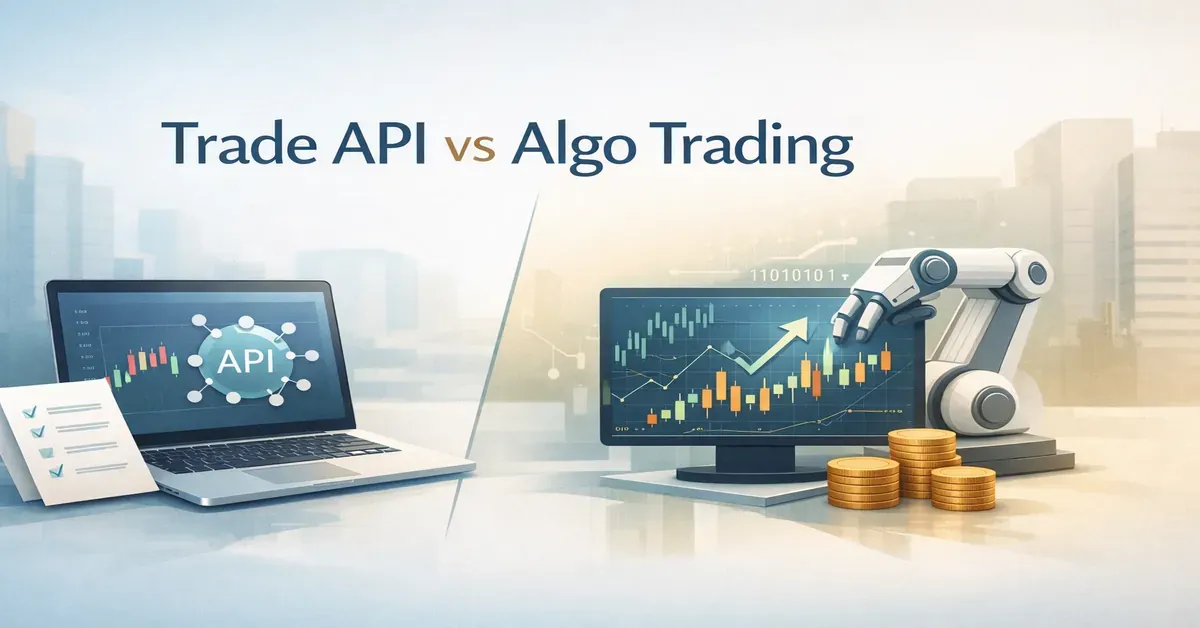
How To Use Trade API?
- 4 min read
- 2,158
- Published 23 Dec 2025

Trade API (Application Programming Interface) is a secure connection between your application and the trading system of a broker. The Trade API enables developers and traders to automate as well as programmatically execute trading strategies. It supports users to directly tie their trading platforms with the infrastructure of a broker so as to place orders more quickly and efficiently, monitor their portfolios, and analyse data. This guide outlines the entire API trading setup and the way you can start using it to your personal advantage.
Kotak Neo API Trading Setup
Prior to using API for trading make sure that your account is API enabled with your broker. The basic steps commonly used in the API trading system are:
- Account Access:
○ On the trading account, log in and find an API or developer section.
○ Generate an API key/token on the broker’s portal.
- Authentication:
○ Use your credentials, client ID, and two-factor authentication (such as TOTP or MPIN) to secure access.
○ This ensures only authorised users can execute API calls.
- Environment Configuration:
○ Set up your development environment with the broker’s Software Development Kit (SDK) or API library.
○ Verify endpoints, API versions, and rate limits as per the documentation.
- Testing Environment:
○ Begin with a sandbox or test environment to validate your requests before going live.
- Production Access:
○ Once the setup is verified, move to the live environment for executing real trades.
How To Use Kotak Neo API: Step-by-step Guide
The following is a breakdown of how to use trading API step by step that can be used to interact with the live market for placing orders:
-
Generate an API Key:
Get the access token of your API in the trading platform. This token will be used as authentication. -
Authenticate Your Session:
Log in with your client code, registered mobile number, and TOTP, which is a two-step verification. -
Fetch Market Data:
Request GET Endpoints to get live stream stock or index data. This assists you in the analysis of trends till you trade. -
Place and Manage Orders:
POST requests should be sent with parameters of exchange type, order type (market/limit), quantity, and symbol. -
Check Order Status:
Use GET endpoints to check the order execution, opening, or rejection. -
Monitor Portfolio:
Get your real-time fundamental positions, profit and loss, and holdings.
This is a simplified step to ensure accuracy and to go through with the trading systematically.
How To Automate Trades Using Kotak Neo API
Automation of API-based trading can be regarded as one of its chief benefits. When you are exploring how to automate trades using API, it means writing scripts or using algorithms to automate trades as they hit specified criteria.
For example:
- Buy a stock when the stock price moves over a moving average.
- Automatic sale once the profit goals are achieved.
- Rebalance portfolio hourly according to specified parameters.
Automation reduces mistakes, ensures higher speed in execution, and allows 24/7 operation of its strategies, particularly when it is associated with sophisticated analytics or machine learning models.
How To Integrate Kotak Neo API With Your Platform
The question that developers ask the most is: how to integrate trading API with your platform. Integration generally requires linking the REST or WebSocket endpoint of a broker with your web or mobile application.
Steps include:
- Importing the API SDK or libraries.
- Initializing credentials (API token, the session ID, and base URL).
- Map endpoints to market data, order placement, and portfolio tracking.
- Handling response and error codes properly.
- Installation of safes in the storage of sensitive data.
Most of the APIs are compatible with Python, JavaScript, or Java, and this means that you can include trading functionalities in your analytics dashboard or bot application.
FAQs
0 people liked this article.