FII or DII or Retailers, Who is Dominating the Markets?
- 6 min read
- 24,835
- Published 03 Feb 2026

Stock markets are a sum total of the actions of all the traders and investors. Any market participant’s buy or sell decision results in an impact on the price of any stock. Therefore, it is crucial to understand which segment of market participants are dominating.
People who individually invest in the stock market all come under the retail category. Investment institutions like mutual funds, pension funds fall under the foreign institutional investors (FII) or domestic institutional investors (DII) category. All three together form a critical part of the markets.
Historically, FIIs have been key participants in the Indian markets. Their moves have often weighed heavily on the direction of the markets. Are they still a dominant force? Let’s take a look.
FII Activity in India - A Timeline
A Glimpse of FII Participation in Indian Equity Markets
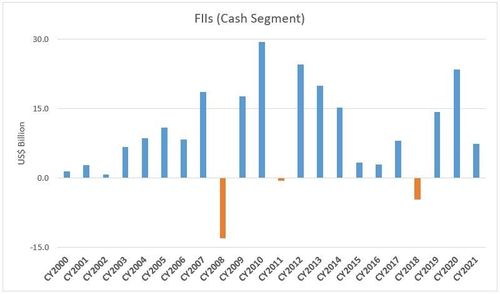
Over the years, FIIs have been showing diversified magnitude and changing trends. The FII flows witnessed a tepid trend from 2000 to 2003, which coincided with the Dotcom bubble.
During the Bull Run from 2004 to 2007, FIIs poured in US$ 46.4 billion into the Indian markets. However, in 2008, the whole world felt the heat of the global financial crisis that originated in the US. And FII investment took a dip.
From 2009 to 2015, we had an excellent period of foreign investor participation. In 2010 alone, FIIs injected US$ 29.3 billion in Indian equities. The reason was Quantitative Easing (QE) adopted by the developed economies. QE in simple terms means - money printing. These central banks printed money and flooded with cheap liquidity. This flood of cheap money found its way into many emerging markets, including India.
The period from 2016 till 2018 of weak FII participation coincided with the US central bank's goal to normalise the monetary policy
Fast Forward to Present
FII flows into Indian stocks have been up and down from 2022 to 2025. There have been huge inflows well into 2023 and early 2024; there also have been big outflows in late 2024 and early 2025 due to global risk aversion, high valuations, and restricted global liquidity. FII activity has been affected by global interest rate forecasts and macroeconomic factors since the beginning of 2025 and will continue to be so through 2026.
With all this volatility, FIIs now own about 16.7% of the active equity market capitalisation in BSE-500 businesses. They are still important, but they are no longer the most important players in Indian equity markets. DIIs have been able to handle FII sales and also assist in keeping the market stable.
Even while short-term FII flows are still very volatile, India expects to continue to be a top long-term investment choice for global investors because of its robust economic development, ongoing reforms, and massive domestic consumer base.
India – A Preferred Destination for Foreign Investors
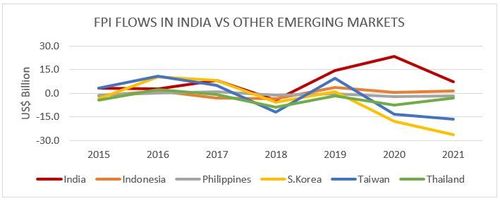
FIIs - Not the Sole Movers Anymore
FII statistics have been proved pivotal in predicting the undercurrent of the market over the years. But in today's market, it is not only FIIs that influence markets. The share of retail, high net worth individuals (HNI), and domestic mutual funds have also increased since the last year.
Before Covid-19, the retail segment was not very dominant. The lockdown changed the tone of the market because of the proactive and aggressive retail segment participation. FY21 saw approximately 1.4 crore new demat accounts opened. Meanwhile, the monthly SIP run rate of Rs 8,000-9,000 crores also adds up to US$ 14-15 billion annually, which helped cushion against any major FII pullout.
In fact, DII flows from April 2021 to August 2021 stood at US$ 7.1 billion versus FII flows of US$ 2.4 billion. Note that, during the same period, Sensex and Nifty both gained nearly 15%!
By October 2025, there were more than 21 crore demat accounts in India. This was because more people were entering the market. As we move into April 2026, SIP inflows will still be at ₹31,00 crores every month (and increasing). Strong domestic liquidity has kept markets stable even while FIIs have been selling a lot in the marketplace.
Because there is a lot of strong domestic capital coming into the market, the Indian equities markets will no longer depend only on FIIs for momentum. This makes the Indian equity markets more structurally stable than they were in prior cycles.
How Rising Retail Participation Has Changed Market Dynamics?
The rise in retail participation, pushed by Systematic Investment Plans and online platforms, has brought stable liquidity to Indian markets from within the country. These regular inflows often protect volatility and help markets stay firm, even when foreign investors sell a lot.
FII vs DII - Highlighting Their Impact
Definition | Institutions from outside India investing in Indian markets | Indian institutions investing in domestic markets |
Examples | Mutual funds, pension funds, hedge funds from abroad | Indian mutual funds, insurance companies, banks |
Impact on Market | Often cause significant volatility due to large inflows/outflows | Provide market stability with consistent investments |
Market Sentiment | Strongly influence sentiment; heavy buying/selling moves indices | Influence is steady, supports market during FII exits |
Investment Horizon | Generally short- to medium-term; opportunistic | Tend to have a longer-term perspective |
Regulatory Control | Subject to global and local regulations | Regulated primarily by Indian authorities |
Currency Impact | Large FII flows can affect the rupee’s value | Minimal direct impact on currency |
Overall Role | Drive market rallies and corrections | Act as a stabilising force, especially in volatile times |
Who Has More Influence: FIIs, DIIs or Retail Investors?
Foreign Institutional Investors can influence rapid changes in the market due to huge capital flows. Domestic Institutional Investors help keep things steady by investing for the long run. Retail investors are also playing significant roles by keeping a steady cash flow through SIPs.
What FII and DII Flows Indicate About Market Sentiment?
Foreign investor activity shows the risk appetite of global investors and what they think about the macro trends. Domestic investors' activity reflects the confidence of domestic citizens. Together, they give a hint about sentiment, but they don’t promise which way the market will shift.
What Should Act as Key Indicators to Assess Market Impact?
While FII and DII activity can be an indicator of market activity, one cannot base their investing decisions on whether FIIs or DIIs are buying or not. It is best to go for a bottom-up approach. Investors should place their bets only on companies that have strong fundamentals, robust management, and sustainable growth prospects. Valuations should also be considered, ensuring investments are made at reasonable prices to maximise long-term returns.
Why Following Only FII or DII Data Can Be Misleading for Retail Investors
Focusing only on data from Foreign or Domestic Institutional Investors indicates ignoring key things such as, fundamentals, valuations, and yields. Often, the institutional flows function in a reactive way, so following them blindly might lead to poor timing decisions.
What It Means for Investors?
For investors, the evolving dynamics of market participation underline the importance of diversification and a disciplined investment strategy. As both foreign and domestic institutions, as well as retail investors, influence market trends, relying solely on any one group’s activity can be misleading. Instead, investors should focus on building a well-researched portfolio that aligns with their risk tolerance and long-term goals. The increased participation of retail and domestic investors has added resilience to the Indian markets, reducing volatility from FII outflows.
Regular investing through SIPs and careful stock selection based on fundamentals and valuations can help investors navigate short-term market fluctuations. Staying informed, being patient, and avoiding herd mentality are crucial for long-term wealth creation in today’s dynamic market environment.
How Retail Investors Should Interpret FII and DII Activity?
Retail investors should look at data from Foreign and Domestic Institutional Investors as context, not directions. Instead of focusing on how these institutions move for a temporary period, paying attention to long-term goals, the fundamentals, and the smart investment practices might help.
Conclusion
While FIIs, DIIs, and retail investors all play significant roles in shaping the Indian stock markets, no single group exclusively drives market direction today. The landscape has become more balanced, with domestic participation rising steadily. For investors, this means relying on sound research, focusing on company fundamentals, and maintaining a disciplined approach is more important than ever. By avoiding knee-jerk reactions to institutional flows and instead investing with a long-term perspective, investors can better navigate volatility and capitalise on India’s promising growth story.
Read More:
FAQs
0 people liked this article.