Volatility Skew: Definition, Example, and Its Role in Portraying Market Sentiment
- 4 min read
- 2,628
- Published 18 Dec 2025
Understanding market sentiment is crucial for making informed investment decisions. One way to gauge this sentiment is through the concept of volatility skew. Whether you are a seasoned trader or a curious investor, understanding this concept can provide a significant edge. Read on to learn what volatility skew is, how it works, and what its implications are for investors like you.
What is volatility skew?
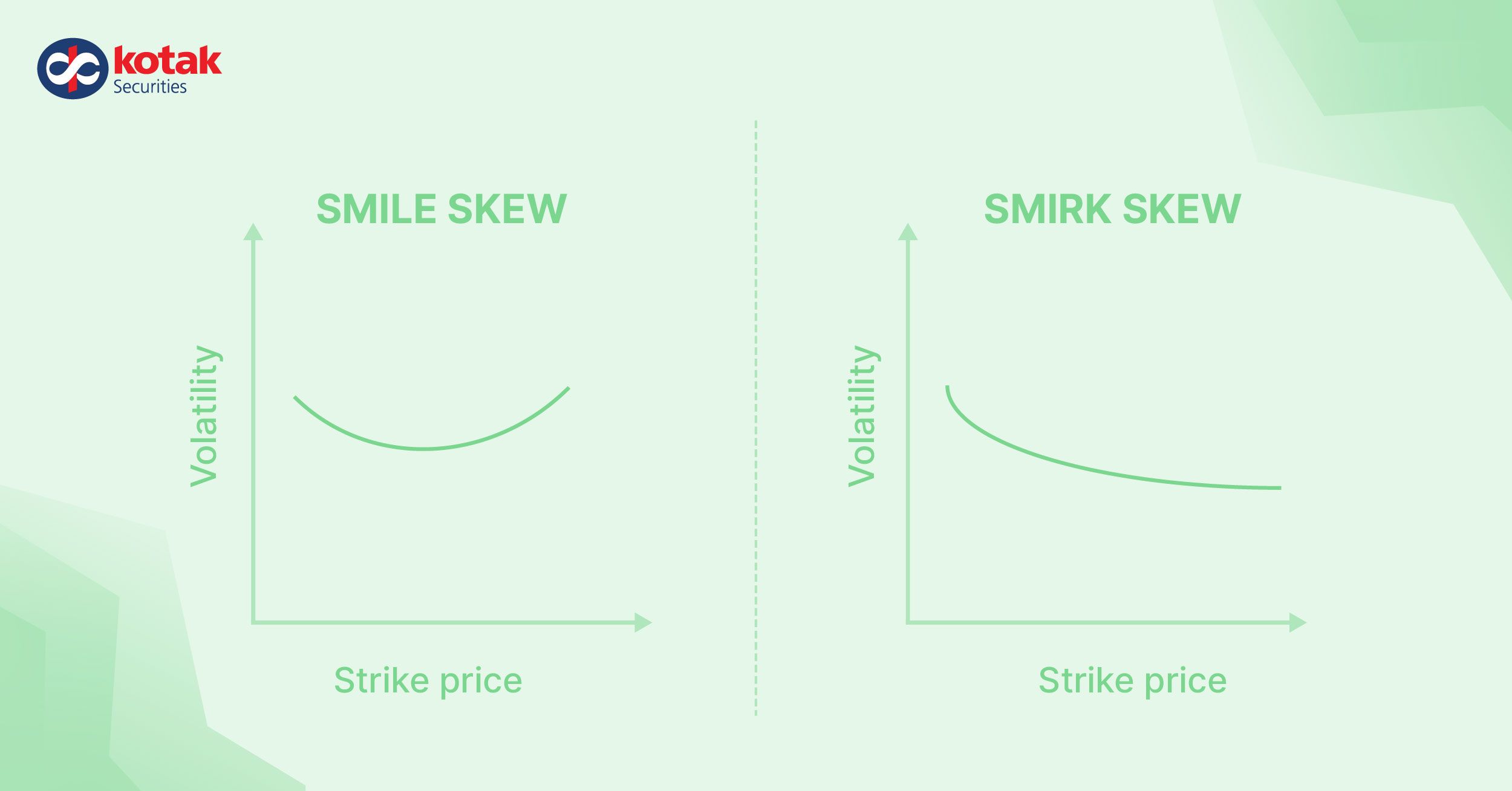
Volatility skew refers to the pattern observed when the implied volatility of options with the same expiration date but different strike prices is plotted on a graph. Typically, this graph shows that out-of-the-money (OTM) options have higher implied volatilities than at-the-money (ATM) options. This phenomenon is known as the volatility skew.
Volatility skew: An illustration
Consider a stock currently trading at ₹100. If the implied volatility for the ₹90 and ₹110 strike price options is higher than that for the ₹100 strike price option, a skew is present. This skew indicates that investors may expect greater price movement in one direction, reflecting underlying market sentiment.
What is implied volatility?
Implied volatility represents the market's expectation of the future volatility of the underlying asset. It is a crucial factor in option pricing and is derived from the market prices of options themselves. Higher implied volatility suggests that investors expect significant price swings, whereas lower implied volatility indicates expectations of relative stability. Understanding implied volatility can provide insights into market sentiment and potential price movements.
What Causes Volatility Skew?
Some of the common factors that cause volatility skew are:
- Supply and Demand Imbalance
Imbalance in option supply and demand directly influences implied volatility levels and causes skew. When certain strike prices attract more trading activity, typically protective options, their implied volatility rises.
- Asymmetric Risk Perception
Traders perceive upward and downward risks differently due to psychological and structural factors. Loss aversion causes investors to overestimate the probability of negative outcomes, assigning higher volatility to options that protect against price declines.
- Event Risk Anticipation
Volatility skew is amplified around specific anticipated events, such as earnings announcements, regulatory decisions, or economic data releases. Traders adjust option prices to account for potential abrupt moves, increasing implied volatility for strikes likely to be impacted.
- Historical Price Movements
The past behaviour of an asset influences current implied volatility and contributes to skew. Assets with a history of sharp declines tend to exhibit higher implied volatility for lower strike options. Market participants expect the historical pattern to repeat, pricing downside protection more expensively.
- Liquidity Differences
Liquidity variations among different strike options also create volatility skew. Options with higher trading volumes have tighter bid-ask spreads and more reliable pricing, whereas illiquid options often show exaggerated implied volatility due to limited trading.
Understanding reverse skew
A reverse skew occurs when the implied volatility of OTM call options is higher than that of OTM put options. This situation typically arises in markets where there is a higher demand for call options, perhaps due to bullish sentiment or expectations of a significant upward price movement. The reverse skew can be a valuable indicator for traders looking to capitalise on expected market rallies.
Understanding forward skew
Conversely, a forward skew is observed when the implied volatility of OTM put options is higher than that of OTM call options. This scenario often occurs in bearish markets or when there is heightened concern about potential downward price movements. The forward skew can signal investor caution and a greater demand for protective puts, which can be useful for hedging strategies.
Volatility Skew in Index Options Vs Stock Options
Here is how volatility skew differs in index and stock options.
Underlying Asset | Based on a broad market index (e.g., Nifty, S&P 500) | Based on individual company stock |
Skew Pattern | Often shows a mild skew; usually lower for at-the-money (ATM) options | Can show significant skew due to company-specific events or news |
Impact of Market Sentiment | Reflects overall market fear/greed; less affected by single stock events | Highly sensitive to earnings, management changes, or sector news |
Liquidity | Generally, more liquid, narrower bid-ask spreads | Less liquid for certain strikes, wider spreads, causing skew variations |
Implied Volatility Range | Smaller difference across strikes | Large difference across strikes due to concentrated risk |
Hedging Effect | Used for broader portfolio hedging | Used for hedging individual stock positions |
Implication of Volatility Skew for Investors
The volatility skew has significant implications for investors. It can provide insights into market sentiment, helping investors make more informed decisions about their positions. For example, a pronounced forward skew might indicate that investors are wary of potential downturns, suggesting it could be a good time to consider protective strategies. Conversely, a reverse skew could signal bullish sentiment, indicating opportunities for taking more aggressive positions.
How Do Institutional Traders Use Volatility Skew?
Here is how institutional traders use volatility skew.
- Hedging Strategies
Volatility skew helps institutional traders design better hedging strategies. When a trader holds a large stock or derivative position, they often buy or sell options to offset potential losses. By analysing skew, traders can determine which strikes are overpriced or underpriced and select options that provide maximum protection at minimal cost.
- Volatility Arbitrage
Institutional traders often exploit volatility skew through arbitrage opportunities. Volatility arbitrage involves taking positions in options that are mispriced relative to expected future volatility. By comparing implied volatility across strikes and maturities, traders identify discrepancies and construct trades that profit when the market corrects these imbalances.
- Portfolio Diversification Strategies
Volatility skew informs institutional traders about correlation and risk distribution across multiple instruments. When skew suggests asymmetric risks, traders can adjust positions in related assets or derivatives to achieve better diversification.
- Using Complex Strategies
Institutional traders use volatility skew when structuring complex option products, such as collars, butterflies, or straddles. These products combine multiple strikes and expirations to achieve specific payoff profiles. The skew directly influences the cost and potential profitability of these structures.
- Market Making Adjustments
Market makers in options rely heavily on volatility skew to quote fair prices. They must manage both inventory and risk while ensuring liquidity. By incorporating skew, market makers adjust bid-ask spreads across different strikes and maturities to reflect market-implied risk more accurately.
Measuring Volatility Skew
Measuring volatility skew involves plotting the implied volatilities of options with different strike prices on a graph. The resulting curve can help investors, like you, understand the market's expectations of future volatility. By regularly monitoring the skew, you can stay attuned to changes in market sentiment and adjust your strategies accordingly.
Volatility Skew Vs Volatility Smile—What is the Difference?
While volatility skew refers to the asymmetric pattern observed in implied volatilities, a volatility smile describes a U-shaped curve where both OTM call and put options have higher implied volatilities than ATM options. The volatility smile is more common in markets where extreme price movements are expected, but the direction of these movements is uncertain. Understanding the difference between these two patterns can help you better interpret market signals.
Trading with Volatility Skew
Trading with volatility skew involves leveraging the information provided by the skew to make strategic decisions. For instance, in a market with a forward skew, traders might purchase puts to hedge against potential downturns or sell calls to capitalise on higher implied volatilities. Conversely, in a market with a reverse skew, traders might buy calls to benefit from anticipated upward movements or sell puts to take advantage of higher premiums. By incorporating implied volatility and volatility skew into your strategies, you can enhance your ability to navigate market fluctuations.
Conclusion
Understanding the volatility skew and its implications can provide valuable insights into market sentiment and help you, as an investor, make more informed decisions. Analysing the skew and incorporating it into your trading strategies could help you better navigate the complexities of the financial markets.
FAQs
0 people liked this article.