A Small Tax Wanders Into a Very Big Market
- 6 min read
- 5,115
- Published 06 Feb 2026

There is something quietly mischievous about small numbers.
The kind that sit politely in spreadsheets.
These possess an uncanny ability to rearrange human behaviour.
The Securities Transaction Tax (STT) hike in the Union Budget 2026 belongs firmly to this category.
These are not dramatic enough to feel like a policy earthquake but also not harmless enough to be dismissed.
Hence, making them far more interesting than they appear.
Effective 1 April 2026.
Futures STT moves from 0.02% to 0.05%.
Options STT inches up from 0.125% to 0.15%.
On paper, these look like rounding errors.
In practice, they behave more like sand in finely tuned gears.
Invisible at first glance, but capable of changing how fast certain wheels are willing to spin.
Which is where the central idea begins to reveal itself.
STT is too small to stop trading, and that is precisely why it is effective.
When Screens Turn Red Before Minds Catch Up
Every STT hike seems to begin with the same opening act.
Budget day arrives, terminals flicker, commentators sharpen their vocabulary, and markets briefly behave as though something structural has snapped.
The Union Budget 2026 followed the script neatly.
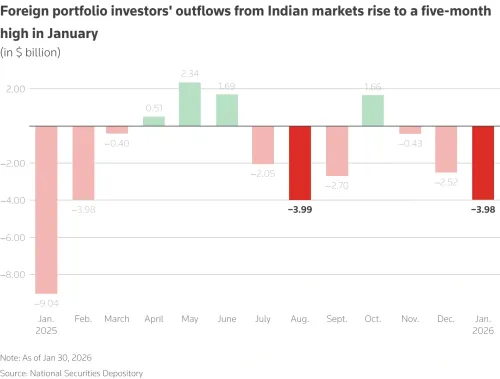
The Nifty 50 slid about 1.96%, closing at 24,825.45 points in the special session of Sunday.
The Sensex too dropped by a similar margin as traders digested the news.
Derivatives-heavy segments took the brunt of the reaction.
Brokerage stocks felt particularly unloved.
Cost concerns floated to the surface, and fear briefly masqueraded as foresight.
Then, quietly and without ceremony, prices began to find their footing.
This pattern is not new.
In 2013, immediately after an STT-related announcement, the Nifty dropped roughly 40 points, around 0.6%, while the Sensex fell by 124 points.
In 2008, changes around STT coincided with a noticeable drop in trading volumes.
None of these episodes ended with empty exchanges or deserted trading terminals.
They ended with adjustments.
Markets do not storm out when STT changes.
They reshuffle.
Source: Reuters
A Tax That Has Been Nudging Behaviour Since 2004
The story of STT is less about one dramatic hike and more about a slow, deliberate choreography.
It has been unfolding since 2004, when the government first introduced the tax under the Finance Act.
The objective back then was to curb tax avoidance on capital gains and simplify how trades were taxed.
It replaced more cumbersome tracking mechanisms with a cleaner, centralised approach.
Delivery trades initially attracted 0.125%.
Intraday trades were set at 0.025%.
Derivatives came in at 0.017%.
Four years later, in June 2008, the government changed how options were taxed.
STT would be charged on the option premium if the option was not exercised.
And it would be charged on the settlement price if it was exercised, paid by the buyer.
Option trading suddenly became far cheaper.
Volumes responded enthusiastically.
A small rule change rewired behaviour almost overnight.
In June 2013, several STT rates were reduced to encourage participation.
Equity futures STT on the sell side fell from 0.017% to 0.01%.
Equity delivery STT remained unchanged at 0.10%.
Mutual fund and ETF transactions, both on-exchange and off-exchange, also saw significant reductions.
Then came the tightening cycle.
In April 2023, the government increased STT by 25%.
This pushed the futures sell-side STT to 0.0125% and options sell-side STT to 0.0625%.
On 1 October 2024, futures STT moved further up to 0.02%, while options rose to 0.10%.
Now, from 1 April 2026, futures will jump to 0.05% and options to 0.15%.
Across two decades of tweaking, cutting, nudging, and hiking, and one thing stubbornly refuses to happen.
Trading activity does not collapse.
What Small Frictions Actually Do
Big barriers invite rebellion, while small frictions invite calculation.
That distinction matters.
When costs rise modestly, traders do not leave all at once.
Instead, they start asking uncomfortable questions about their own strategies.
Does this trade still make sense after costs?
Does this frequency still justify the effort?
Is this edge real or merely an accounting noise?
This is why STT hikes rarely create spectacular exits and far more often create something subtler.
Strategy decay.
Certain ultra-short-term, churn-heavy approaches become less attractive.
Marginal edges vanish.
High-frequency styles that live on microscopic profits feel the pressure first.
But the ecosystem itself remains very much alive.
The effect, intentional or otherwise, is a market where fragile strategies feel the pressure first.
A Global Mirror
India’s approach looks remarkably restrained when placed next to global peers.
The UK charges a Stamp Duty Reserve Tax of 0.5% on most share purchases.
France applies a financial transaction tax on large-cap share acquisitions, and from 1 April 2025, that rate rose from 0.3% to 0.4%.
The United States does not impose a federal financial transaction tax, although the idea resurfaces periodically in policy discussions.
Sweden’s experience from the 1980s stands as a cautionary tale.
Transaction taxes there peaked at 0.5%, market liquidity suffered badly, and the tax was eventually abolished by 1991.
India’s STT rates, even after the latest hike, sit firmly in the realm of friction rather than force.
Who Notices, Who Adjusts, Who Shrugs
Retail F&O traders feel the change almost immediately because higher STT directly raises transaction costs and trims profits from frequent trading.
Brokers and financial intermediaries face second-order pressure, as lower derivatives volumes can compress margins and dampen trading activity.
Arbitrage and hybrid mutual funds that rely on rapid futures-to-spot strategies may see slightly lower returns because higher turnover now carries a higher cost.
Long-term equity investors in delivery markets remain largely untouched, since STT on regular equity trades stays exactly where it was.
This distribution of pain is revealing.
The part of the market that thrives on speed feels it most.
The part of the market that thrives on patience barely feels it at all.
Volumes Fall, Markets Stay Standing
There is evidence that derivative volumes drop sharply after regulatory curbs combined with STT hikes.
This has happened before. It is happening again.
What has not happened before, and does not appear likely now, is a structural breakdown of market infrastructure.
Exchanges continue to function. Brokers continue to operate. Participation persists.
For investors, this is not a footnote. It is the headline.
The Quiet Opportunity Layer
When speculative froth cools, even modestly, market behaviour changes in small but useful ways.
Price moves tend to stretch a little further.
Whipsaws become marginally less violent.
Panic-driven liquidity vacuums can create short-lived mispricings.
Brokerage and trading infrastructure stocks, which often sell off sharply on STT news, have historically reacted first and thought later.
For long-term investors, these episodes often trigger sharp reactions that say more about sentiment than structure.
More broadly, capital that stops funding fragile strategies does not disappear.
It migrates toward sturdier ones.
That migration is slow. It is boring. It is powerful.
The Strange Power of Almost-Nothing
The most fascinating aspect of STT is not its size, but its psychology.
It is too small to trigger rebellion.
Too visible to be ignored and too persistent to avoid.
Which makes it a remarkably effective behavioural filter.
Union Budget 2026 did not announce a war on traders.
It did not signal hostility toward markets.
It quietly reminded participants that speed has a cost, churn has a price, and not every trade deserves to exist.
For investors and serious traders, the message is somewhat reassuring.
India’s market structure remains intact.
Long-term equity investing remains untouched.
Derivatives become a little more expensive.
Bad strategies quietly fade. Good strategies adapt.
Small taxes have a large behavioural consequence.
And in markets, that is often where the real stories begin.
Sources and References:
- Moneycontrol
- TheHindu
- IndianExpress
- TaxGuru
- TimesofIndia
- Reuters
- BankofBaroda
- BusinessStandard
- LiveMint
- EconomicTimes
- Avocats
- Emirates247
0 people liked this article.