India's LPG Price Is Not the Real Number
- Posted: 12 Jun 2026, 3:15 PM IST
- | 9 min read
- 12,899
 Add Preferred News Source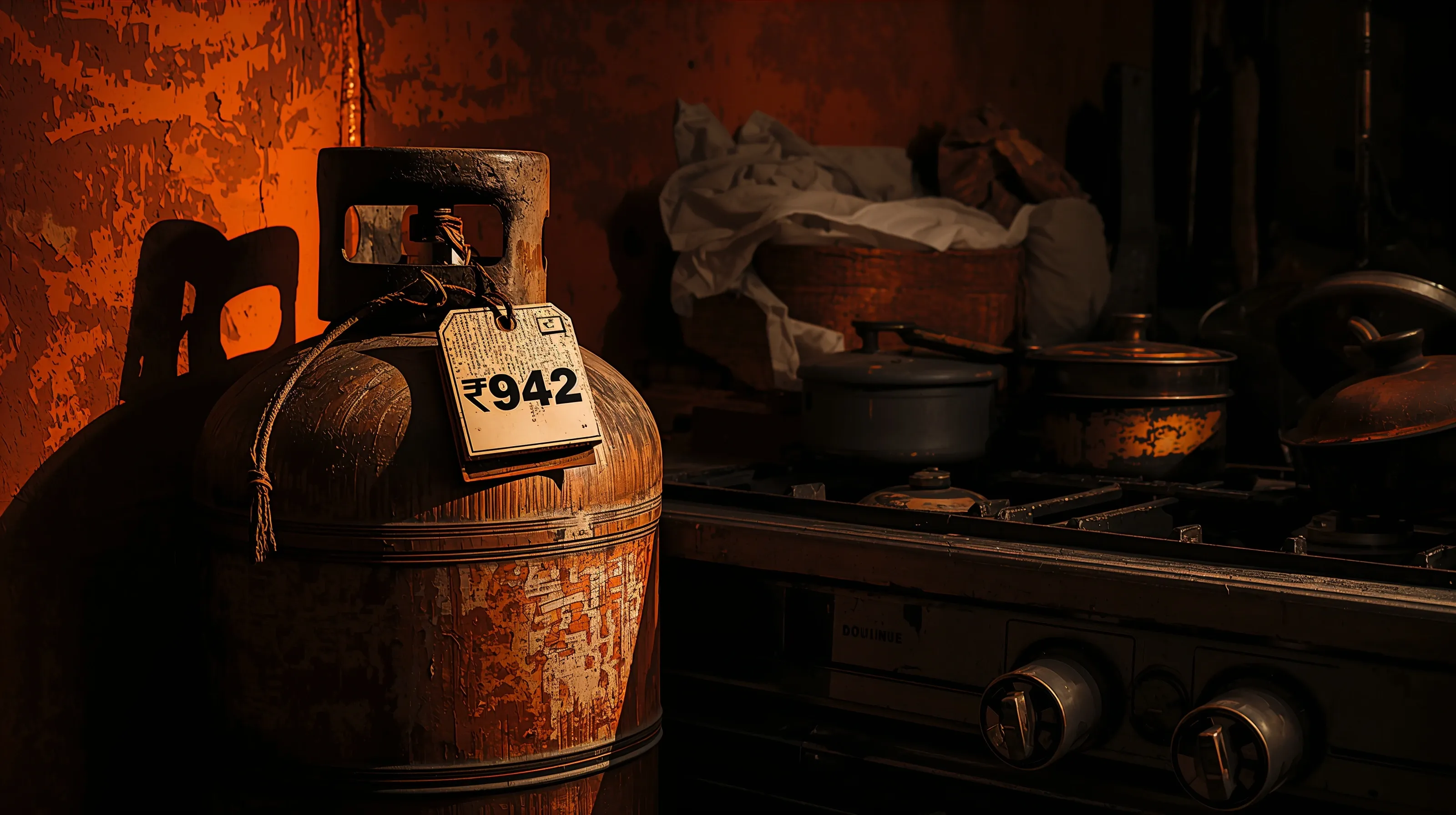
On a weekday morning in June, somewhere in a Delhi colony, a blue-and-red cylinder arrives at the door.
The delivery man hands over a receipt.
The number on it reads ₹942.
The woman who answers folds it quietly and goes back inside.
The cylinder will last perhaps three weeks.
For most households, the cooking gas cylinder is one of those expenses that sits in the background.
Someone books it. Someone receives it. The month moves on.
Until the price changes. And then, briefly, everyone notices.
Earlier this month, the price of a 14.2-kg domestic LPG cylinder in Delhi rose to ₹942 following a ₹29 increase.
It was the second hike in three months, taking the cumulative increase since March to ₹89.
That is the number most people noticed.
But the more interesting number isn't ₹942. It is ₹703.
According to industry estimates, that is the under-recovery that state-owned oil marketing companies still absorb on every domestic LPG cylinder sold, even after the latest increase.
In other words, the price consumers pay and the actual economic cost of supplying LPG remain far apart.
And that gap tells a much larger story about India's energy policy, inflation dynamics, rural consumption and corporate balance sheets.
The Invisible Part of the Bill
One of the peculiar things about India’s energy system is that different fuels operate under completely different rules.
Petrol was deregulated in 2010. Diesel followed in 2014.
In theory, both are supposed to reflect market prices.
Cooking gas never fully made that transition.
LPG occupies a unique space where economics, politics, public health and welfare policy collide, often in ways that make pure market pricing impossible.
The reason is not difficult to understand.
Over the last decade, LPG stopped being merely a household fuel and became part of a national development programme.
The Pradhan Mantri Ujjwala Yojana transformed the gas cylinder into a symbol of cleaner cooking, improved health outcomes and greater convenience for millions of women across rural India.
Once that happened, LPG pricing ceased to be a simple commercial decision.
As of May 2026, India had roughly 332 million active domestic LPG connections.
More than 105 million of them belonged to Ujjwala beneficiaries.
At that scale, even a small mismatch between cost and selling price creates an enormous burden somewhere in the system.
The bill does not disappear.
It simply moves through the system until it finds its final payer.
To understand the scale of that gap, industry estimates suggest that the economic cost of a domestic LPG cylinder is currently well above ₹1,600, far higher than the retail price households pay today.
A Subsidy Hidden In Plain Sight
Most subsidies are visible.
They appear in government announcements, budget speeches or direct transfers.
The LPG subsidy is different because a large part of it sits quietly inside the balance sheets of oil marketing companies.
Consider the math.
If only half of India’s domestic LPG consumers purchase one refill in a given month, that would translate into approximately 166 million cylinders being sold.
At an estimated under-recovery of ₹703 per cylinder, the monthly burden exceeds ₹11,600 crore.
Suddenly, a kitchen cylinder begins looking less like a consumer product and more like a macroeconomic variable.
This explains why a seemingly modest ₹29 increase attracted so much attention.
The hike was not designed to eliminate losses.
It was simply an acknowledgement that the gap had become too large to ignore.
Global LPG prices have risen sharply this year, partly reflecting geopolitical pressures in West Asia and broader tightening in international energy markets.
Since India imports more than 60% of its LPG requirements, domestic costs inevitably rise when international markets tighten.
The latest revision therefore represents only a partial pass-through of those higher import costs.
The system is still cushioning consumers, but the price of that cushion is climbing steadily.
The obvious question then becomes: if households are not paying the full cost, who is?
The Companies Carrying The Weight
Investors often focus on the consumer side of fuel pricing because that is where the headlines appear.
However, the more important implications sit elsewhere.
Indian Oil Corporation, Bharat Petroleum Corporation and Hindustan Petroleum Corporation are effectively carrying a significant portion of the burden today.
Estimates for Q1 FY27 suggest combined under-recoveries across petrol, diesel and LPG could approach ₹2 lakh crore, with actual losses running close to ₹1 lakh crore.
Put differently, the losses accumulated in a single quarter may be sufficient to erase the entire annual earnings that oil marketing companies posted in FY26.
Separate industry estimates place current fuel under-recoveries at roughly ₹1,000 crore to ₹1,200 crore every day.
Annualised, that figure would exceed ₹4.3 lakh crore if current conditions persist.
Numbers of this scale matter because oil marketing companies are not merely fuel retailers.
They are among the largest investors in refining capacity, distribution infrastructure, pipeline networks and energy-transition projects.
When profitability comes under severe pressure, those investment plans tend to follow.
That is why investors tracking IOC, BPCL and HPCL are watching government policy almost as closely as they are watching crude oil prices.
Nobody disputes the losses; the debate is about who ends up carrying the cost.
The Same Cylinder Means Different Things To Different Households
A ₹29 increase does not affect every household equally.
For many urban middle-income families, it is an irritation rather than a crisis.
The additional expense becomes another line item in an already crowded monthly budget.
People notice it, complain about it briefly and move on.
The experience is very different in large parts of rural India.
News reports from Uttar Pradesh indicate LPG refill costs ranging between ₹850 and ₹1,100 before delivery charges.
Similar affordability concerns have emerged in Chhattisgarh, where some households were already spending around ₹1,000 for a refill even before the latest escalation in global energy prices.
In some areas, the alternative is not particularly attractive either, with firewood prices reportedly rising by 40% to 50%.
This is where the economics collide with public policy.
Ujjwala was never merely about fuel consumption.
It was designed as a public-health intervention that encouraged households to move away from biomass fuels such as firewood, crop residue and dung cakes.
The programme delivered meaningful gains by reducing indoor air pollution and improving access to cleaner cooking energy.
Yet clean-energy transitions depend on affordability.
When LPG prices rise beyond what lower-income households can comfortably absorb, refill frequencies tend to decline.
Families begin stretching cylinders for longer periods.
A household that once booked a refill every month may start making the same cylinder last six weeks instead.
The kitchen still runs on LPG, but less often than before.
Some revert partially to traditional fuels.
Others adopt a hybrid approach, using LPG sparingly while returning to biomass for part of their cooking needs.
The policy dilemma becomes obvious.
Raising prices helps reduce under-recoveries and protects OMC balance sheets.
Raising prices too aggressively risks undermining some of the behavioural gains that Ujjwala was designed to create.
Neither outcome is particularly attractive.
How A Cylinder Becomes An Inflation Story
One of the most useful habits for investors is learning to follow second-order effects.
The LPG hike itself is not the destination; it is the starting point.
Fuel inflation rarely remains confined to fuel.
Higher energy costs gradually work their way through transport, agriculture, manufacturing and household budgets before eventually appearing in broader inflation data.
Nuvama Institutional Equities recently projected FY27 consumer inflation at around 5.7%, materially above the RBI’s forecast of 4.6%.
The brokerage identified fuel pass-through, weather-related disruptions and rising fertiliser costs as key contributors.
An equally important observation concerns the composition of rural inflation.
Food accounts for approximately 42% of the rural CPI basket compared with roughly 30% in urban India.
This means rural households experience inflation differently.
When food and fuel inflation rise simultaneously, the squeeze on disposable income becomes much more severe because a larger share of household spending is already devoted to essentials.
The result is rarely immediate.
Inflation first erodes purchasing power.
Purchasing power then affects discretionary spending.
Discretionary spending eventually influences corporate earnings.
The transmission mechanism is slow, but it is remarkably reliable.
Where Investors May Feel It First
The sectors most exposed to this chain reaction are not necessarily the ones that appear in the LPG headlines.
Rural-focused FMCG companies are likely to be among the earliest indicators.
Higher fuel and food expenses can gradually compress household budgets, reducing spending on categories that are not considered essential.
Companies such as Hindustan Unilever, Dabur and Marico derive a significant portion of their revenue from rural markets and therefore sit close to this transmission channel.
Britannia and Nestlé face a different version of the same challenge, where higher input costs may coincide with softer demand conditions.
Entry-level two-wheelers, tractors, value retail and consumer durables also remain sensitive to changes in rural purchasing power.
When households allocate a larger share of income towards fuel and food, discretionary purchases are often postponed rather than cancelled.
The impact therefore tends to emerge gradually through slower volume growth rather than through an abrupt collapse in demand.
Investors looking at Q1 FY27 results may not immediately see the full effect.
The more revealing signals are likely to emerge during the second half of the fiscal year, when the cumulative impact of higher fuel costs has had time to work its way through household budgets.
The Number Worth Watching
Most people will remember the ₹29 increase.
The more revealing number may be the ₹703 gap that still remains.
That gap tells us something important about how India absorbs economic shocks.
The objective is not simply to sell cooking gas.
It is to balance affordability for households, the financial health of oil marketing companies and the broader goals of public policy.
Every rise in global energy prices forces a fresh negotiation between those competing priorities.
Energy pricing is often discussed as a question of fuel costs.
In reality, it is a question of distribution: who ultimately absorbs the shock when those costs rise.
The answer may change over time.
The bill, however, never disappears.
It simply moves through the system until someone pays it.
Sources and References:
- BUSINESSSTANDARD
- THELOGICALINDIAN
- PRSINDIA
- BUSINESSTODAY
- DOWNTOEARTH
- FINSHOTS
- PPAC
- UPSTOX
- OUTLOOKBUSINESS
- THEHINDU
- ECONOMICTIMES
- ANINEWS
This article is for informational purposes only and does not constitute financial advice. It is not produced by the desk of the Kotak Securities Research Team, nor is it a report published by the Kotak Securities Research Team. The information presented is compiled from several secondary sources available on the internet and may change over time. Investors should conduct their own research and consult with financial professionals before making any investment decisions. The above images were generated using AI. Read the full disclaimer here.
Investments in securities market are subject to market risks, read all the related documents carefully before investing. Brokerage will not exceed SEBI prescribed limit. The securities are quoted as an example and not as a recommendation. SEBI Registration No-INZ000200137 Member Id NSE-08081; BSE-673; MSE-1024, MCX-56285, NCDEX-1262.
0 people liked this article.