India's IT Dream Is Not Dying. It Is Being Repriced.
- Posted: 24 Jul 2026, 2:15 PM IST
- | 5 min read
- 8,768
 Add Preferred News Source
There was a time when an engineering degree came with an almost predictable ending.
Study hard, crack campus placements, and join TCS, Infosys, Wipro or HCLTech.
Buy a bike with the first salary, a flat a few years later and, if things went especially well, perhaps a flight to the US somewhere in between.
For nearly three decades, that is how it was.
India’s IT industry became much more than an export success story.
It became a social contract that millions of families quietly believed in.
An engineering seat was not merely an education expense.
It was a down payment on a different life.
The formula worked remarkably well.
It created employment for nearly six million people, generated more than US$250 billion in annual export revenue, and turned cities like Bengaluru, Hyderabad, Pune and Chennai into tech capitals that grew almost as quickly as the ambitions of the people moving into them.
Today, the same industry is being discussed rather differently.
The conversation has become less about coding and more about whether coding will survive coding itself.
Artificial intelligence has arrived with enough confidence to convince markets that India’s biggest white-collar success story may finally be running out of road.
Investors have certainly behaved as though they believe it.
Since their peak in August 2024, India's five largest IT companies have collectively shed more than ₹15 lakh crore in market value as concerns around weak US discretionary spending and AI disruption gathered pace.
The market has almost reached a verdict.
The numbers, however, seem rather less convinced.
The quarter that won’t toe the line
Every earnings season has one company that quietly forces everyone to rethink the narrative. This time, it was TCS.
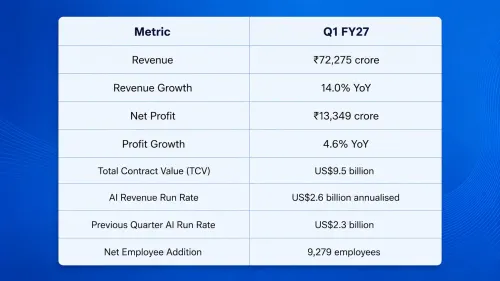
Source: TCS
Those are respectable numbers, and the revenue line in particular sits oddly against the story of weak Western spending.
But they are not the interesting ones.
The interesting number was 9,279.
That was TCS’s net headcount addition during the quarter, its strongest hiring in four years.
It arrived at precisely the moment everyone was preparing for AI to start shrinking India’s largest technology workforce.
Markets had been pricing AI as though it were about to replace programmers.
But India’s largest IT employer responded by hiring more of them.
It looks as though the two sides are reading different reports. They are not.
They are reading different parts of the same business.
The pyramid did not collapse; it changed shape
Source: ANI
The Indian IT services industry was never built like Silicon Valley. It was built like a pyramid.
Thousands of fresh engineering graduates formed the base, writing routine code, testing software, maintaining applications and handling first-level support.
As experience increased, the pyramid narrowed into architects, consultants and specialists solving increasingly complex problems.
It was a remarkably efficient model because every new client usually meant another batch of fresh graduates entering the workforce.
Artificial intelligence has not demolished that pyramid. It has started squeezing its widest layer.
Routine coding, documentation, software testing and first-level support happen to be the tasks generative AI performs rather well.
Companies therefore need fewer people for standardised work while simultaneously searching for far more professionals who understand AI engineering, enterprise platforms, cybersecurity, cloud architecture, data science and large-scale digital transformation.
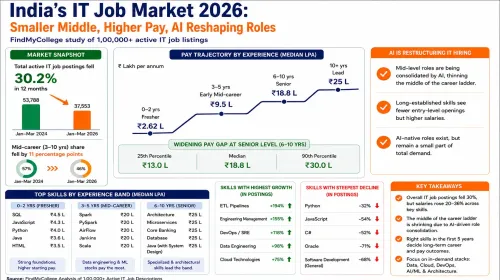
The hiring data is already telling that story, though not in the way the headline numbers suggest.
Total active IT job postings have fallen by around 30% over twelve months.
What has changed more than the total, however, is what remains inside it.
Naukri's data shows postings below ₹20 lakh a year broadly flat, those in the ₹20 lakh- plus bracket up by around 19%, and those above ₹50 lakh up roughly 45% year-on-year.
The Foundit Insights Tracker points the same way.
Perhaps that explains why everyone seems to be having the same conversation but arriving at entirely different conclusions.
One group sees hiring, the other sees fewer campus offers. Both are correct.
The missing offer letter
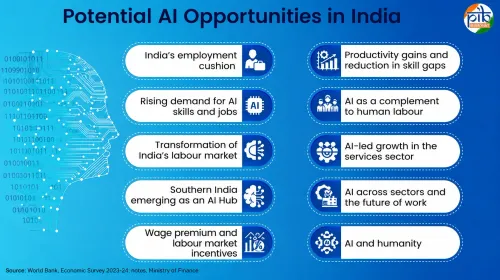
Source: Press Information Bureau
The IT jobs have not disappeared. The automatic ones have.
The opportunity is still there.
The qualification threshold has simply moved higher.
That difference is subtle, and it changes everything.
Parents are still steering children towards the same degree that transformed middle- class India over the past 30 years.
The destination remains attractive.
The route has become considerably narrower.
And perhaps that is why this placement season feels so different.
The anxiety isn’t really about whether technology jobs exist.
It is about whether the gap between being qualified and being employable has quietly become much wider than anyone expected.
For investors, that distinction matters well beyond the placement cell.
Once the nature of hiring changes, the way the industry is read changes with it.
Headcount alone stops telling the full story.
If TCS gave the market something to think about, the next clues may not come from the earnings line at all.
AI is no longer a possibility the industry is preparing for. It is already inside the delivery model.
What separates one company from the next is no longer whether they have adopted it, but what they are able to charge for it.
The scorecard is changing
For years, analysing an IT company was a straightforward calculation of revenue growth, margins, and headcount.
These three numbers explained most of the story. Not anymore.
Very different metrics may judge the next phase of Indian IT: revenue per employee, AI- led revenues, the mix between fresh graduates and lateral hires, productivity improvements, and the size of transformation deals rather than the number of people deployed to execute them.
TCS offered an early glimpse of that transition.
Its annualised AI revenue run rate climbed to US$2.6 billion, even as the order book moderated to US$9.5 billion from US$12 billion in the previous quarter.
That combination points to a market beginning to weigh the quality of future revenue rather than simply counting large deals.
A smaller order book and a stronger revenue mix are no longer a contradiction.
The ripple travels further than IT parks
Technology hiring has always done much more than fill office buildings.
Every fresh batch joining Bengaluru, Hyderabad, Pune or Chennai also rented apartments, bought two-wheelers, ordered food online, filled cafés and slowly became first-time homebuyers.
That ecosystem grew because the flow of fresh graduates rarely stopped.
If that flow becomes more selective, the effects will not stay inside technology companies.
A thinner intake could gradually slow demand for entry-level housing, rentals and discretionary spending in India’s largest technology hubs.
At the same time, hiring is steadily shifting towards Global Capability Centres, AI-native companies and specialised engineering firms, where expertise matters more than scale.
The cities will look much the same for a while. The households inside them will not.
Where investors may look
This is why the sector deserves a more nuanced reading than “AI is good” or “AI is bad.”
Large IT services companies such as TCS, Infosys, HCLTech, Wipro, Tech Mahindra and LTIMindtree remain the first places to watch how AI translates into productivity, pricing power and revenue quality.
Mid-sized engineering-led firms such as Persistent Systems, Coforge and Mphasis are where AI-led enterprise spending will show up in reported numbers earliest, while firms like TeamLease and Quess sit on both sides of the transition as demand for specialised skills continues to evolve.
This is not a shopping list. It is simply a map of where this structural shift is likely to become visible first.
Perhaps the dream was never disappearing
For nearly two years, investors have debated whether AI would kill India’s IT story. That may have been the wrong question all along.
The industry is not abandoning the labour-arbitrage model overnight.
It is steadily moving towards one where productivity matters more than headcount, specialised skills command a premium, and AI becomes another layer of delivery rather than a replacement for it.
For investors, that means watching different signals.
Revenue per employee may matter more than total employees.
AI-led business may matter more than traditional outsourcing.
Hiring quality may matter more than hiring volume.
The offer letter that once built India’s middle class has not disappeared, but has simply become harder to earn.
And perhaps that is the quiet story of this earnings season.
India's IT dream is not dying. It is being repriced.
Sources and References:
- ECONOMICTIMES
- BUSINESSTODAY
- TCS
- ANINEWS
- NAUKRI
- PIB
- INVEZZ
This article is for informational purposes only and does not constitute financial advice. It is not produced by the desk of the Kotak Securities Research Team, nor is it a report published by the Kotak Securities Research Team. The information presented is compiled from several secondary sources available on the internet and may change over time. Investors should conduct their own research and consult with financial professionals before making any investment decisions. The above images were generated using AI. Read the full disclaimer here.
Investments in securities market are subject to market risks, read all the related documents carefully before investing. Brokerage will not exceed SEBI prescribed limit. The securities are quoted as an example and not as a recommendation. SEBI Registration No-INZ000200137 Member Id NSE-08081; BSE-673; MSE-1024, MCX-56285, NCDEX-1262.
0 people liked this article.

Kotak Neo (Kotak Neo) is India's venerable stockbroking company with a rich legacy. It offers comprehensive investment services across asset classes, prioritising a technology-first approach for a seamless experience. Trusted by 5 million+ customers, it guides you toward financial success with ease of investment and speed of trade.
Note: The opinions expressed in this blog are personal viewpoints and should not be construed as recommendations.