What a Box of Sweets Says About Indian Markets
- Posted: 04 Sep 2026, 4:04 PM IST
- | 7 min read
- 6,145
 Add Preferred News Source

Diwali in India has a simple economic model.
Buy sweets, buy more sweets, insist you have bought enough sweets, and then buy another box because someone is coming over.
Sugar rarely feels like a serious commodity in that moment.
It is simply there, disappearing into laddoos, jalebis, kaju katli and mithai boxes travelling from one home to another.
This year, however, sugar has acquired a rather more complicated personality.
It has become expensive enough for the government to open the doors to imports, while wheat, another kitchen staple, has become cheap enough for the government to export it.
Yes, in the same month, India decided to import sugar to bring one price down and export wheat to push another one up.
That is a rather revealing picture of how India’s food economy works.
Two opposite trades
On 20 August, the government allowed 1 million tonnes of raw sugar to enter India under a tariff-rate quota (a capped volume permitted at a lower duty rate than the standard tariff) at zero duty until 31 October.
The normal import tariff is 100%, making the move significant.
India had not undertaken a major sugar import for domestic consumption in roughly a decade.
The reason was straightforward.
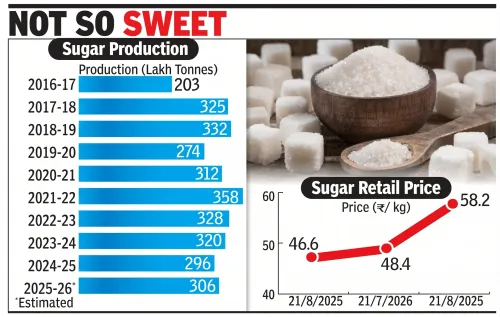
The government's production estimate had been cut by nearly 11%, from 343 lakh tonnes to around 306 lakh tonnes.
Ex-mill prices (the price at which mills sell to wholesalers) had reached ₹5,400 to ₹5,500 per quintal, roughly 40% higher year on year, while retail prices were climbing past ₹55 a kilogram and rising sharply week on week.
Four days later, on 24 August, the Directorate General of Foreign Trade moved wheat, durum wheat, wheat flour, atta, maida and semolina from “prohibited” to “free” for exports, ending a ban that had been in place since May 2022.
Here the problem was almost the exact opposite.
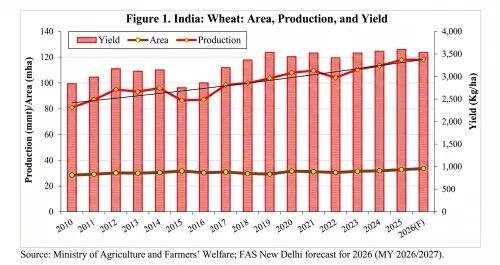
Wheat production had reached a record 120.65 million tonnes in 2025–26, up around 2.3% year on year.
FCI wheat stocks had crossed 40 million tonnes by mid-2026, well above the mandated buffer norms, after the government procured a record 35 million tonnes from the latest harvest.
Domestic mandi wheat prices were hovering around the MSP of ₹25.85 per kilogram and broadly flat.
The government wanted wheat prices to rise enough to improve farmgate realisations and keep farmers interested in sowing the next crop.
So there it was: export the grain that had become too plentiful, import the sweetener that had become too expensive.
The wheat pile-up
The wheat decision makes more sense when you look backwards.
India banned wheat exports in May 2022 as domestic prices rose amid the disruption following the Russia-Ukraine war.
The restriction remained even after domestic production recovered.
With wheat production reaching a record 120.65 million tonnes, government procurement also surged 17% to over 35 million tonnes in the 2026–27 rabi marketing season, comfortably exceeding the 34.5 million tonne target and the previous year’s 30 million tonnes.
Procurement was particularly strong in Punjab, Madhya Pradesh and Haryana, helped by mandi prices remaining below the MSP (the minimum support price at which the government guarantees to buy from farmers) amid robust domestic production.
That creates a peculiar problem.
A full warehouse looks reassuring from Delhi.
It does not necessarily look reassuring from a farmer’s field.
When prices remain weak, farmers eventually start asking whether the economics of the next sowing make sense.
That is why the export opening is not simply a trade-policy adjustment.
It is also an attempt to restore some incentive at the farmgate, improving the prices farmers actually receive for their crop.
Source: United States Department of Agriculture (USDA)
There is a global market waiting as well.
The US Department of Agriculture projected another record Indian wheat harvest in 2026-27, estimating production at 120 million tonnes, supported by a record 33.5 million hectares under cultivation.
It also warned that successive bumper harvests had created a massive build-up in government grain stocks.
After four years of restrictions, even a modest return to the export market changes the outlook for processors, exporters and logistics businesses.
Sugar changed direction faster
Source: The Times of India
Sugar has travelled the other way.
By February 2026, the government had raised the approved sugar export quota for the 2025–26 season to 20 lakh tonnes, citing surplus availability.
Mills exported around 8 lakh tonnes against that allocation.
Then the production picture deteriorated.
Estimates were cut, with excessive rainfall in Maharashtra, crop disease in Uttar Pradesh and Maharashtra, weaker cane recovery and diversion of some cane towards khandsari units (small-scale raw sugar processors, largely unregulated) affecting supply.
By August, the policy response had moved from encouraging exports to restricting them, imposing stock limits and finally allowing duty-free imports.
The speed of that reversal matters.
The government is trying to protect consumers without making the domestic market so unattractive that future supply suffers.
Sugar also has another competing destination: ethanol.
The share of sugar diverted to ethanol fell from around 12% in 2022–23 to 9% in 2025–26, while nearly three-fourths of India’s ethanol now comes from foodgrains.
Every tonne diverted towards ethanol is therefore a tonne that does not enter the food market.
When the crop disappoints, that trade-off becomes harder to manage.
The draft Sugarcane (Control) Order 2026 attempted to formalise some of these issues but was withdrawn in May after pushback from states and khandsari operators, who feared tighter regulation would threaten their livelihoods.
The structural tension remains.
The grocery bill knows first
Strip away the notifications and commodity terminology and the whole thing becomes simpler.
An Indian household buys both atta and sugar.
The atta packet is not getting dramatically more expensive, but sugar is.
The farmer growing wheat is dealing with relatively weak prices, while the sugar producer is enjoying much stronger realisations (the actual selling prices mills receive) but facing a government that has shown it will intervene when consumer prices rise too far.
This is where food policy plays its role in investment planning.
In India, commodity companies do not operate in a completely free price-discovery environment.
Procurement, minimum support prices, export restrictions, import duties, stock limits and production decisions can all change the economics.
A sugar mill can have a brilliant quarter because it sells inventory at high prices.
Then a government notification can change the outlook before the next quarter arrives.
Wheat offers a different dynamic.
Lower domestic prices can hurt farmers, but an export opening creates another outlet for excess production and potentially improves economics across processing, trading and logistics.
Policy is part of the commodity equation.
Sugar stocks get a sugar rush
The stock market has already demonstrated how quickly that equation can change.
Sugar company share prices rose sharply through mid-August as investors priced in higher realisations.
Balrampur Chini rose over 13% in a single session, while Dwarikesh Sugar and Dalmia Bharat Sugar reached 52-week highs.
Then came the duty-free import announcement on 20 August. Sugar stocks fell sharply, with some losing 5% to 7% intraday.
The lesson for investors is simple.
A high sugar price may be good for a mill, but it can also increase the probability of policy intervention.
There is also a useful twist in the import story.
Domestic sugar prices subsequently fell around 20% from their highs, reducing the import arbitrage (the price gap between global and domestic markets that makes importing worthwhile).
Mills and refiners may therefore import only around half of the 1 million tonne quota.
The immediate earnings impact may therefore be smaller than the headline suggests.
Sugar companies could still report strong Q2 FY27 earnings, but those numbers may not provide a reliable guide to the following quarters.
For investors, the watchlist extends beyond sugar prices to export quotas, import access, ethanol diversion and the government’s policy for the 2026–27 season.
The policy swing
The larger pattern is worth watching.
India’s food policy often works like a swing.
Surplus can trigger exports. Shortage can trigger imports.
Rising prices can bring stock limits. Weak farmgate prices can bring market-opening measures.
What matters for investors is how quickly that swing can move.
Sugar went from a 20 lakh tonne export allocation in February to restrictions and duty- free imports by August.
Wheat went from a four-year export ban to an open export regime because domestic supply had become abundant and prices were no longer providing enough incentive to farmers.
Each decision responds to the conditions visible at the time.
But companies exposed to these commodities cannot be valued by the current commodity price alone.
The policy response has to sit somewhere in the model.
Food commodity stocks are therefore inherently policy-sensitive.
A strong quarter can be genuine without being durable.
The effects also move in less obvious directions.
Businesses that use sugar as a raw material feel price swings very differently from those that produce it, and wheat processors now have access to an export channel that did not exist a year ago.
Across the value chain, businesses with processing capacity, export infrastructure, logistics or diversified revenue streams may be better placed to absorb a sudden change in the commodity cycle.
And then there is Diwali
There is something almost perfectly Indian about the timing.
The country is preparing for the season of mithai boxes, while the government is importing sugar because the domestic price has become too high.
At the same time, it is encouraging wheat exports because the domestic price has become too low.
One kitchen staple needs an outside market; the other needs outside supply.
Between the two sits the real Indian food economy, balancing farmers, mills, consumers, exporters, processors, ethanol producers and government intervention.
For investors, that balance is the point to watch.
The opportunity is not simply in guessing whether wheat or sugar prices go up next.
It is in understanding which businesses can benefit when the government opens a door, and which ones get hurt when it closes one.
In India’s food markets, the commodity cycle matters.
But the policy cycle can move faster.
Sources and References:
- ECONOMICTIMES
- REUTERS
- INDIATIMES
- KOTAKNEO
- LIVEMINT
- TAXGURU
- THEHINDU
- MONEYCONTROL
- USDA
- PIB
- BUSINESSSTANDARD
- MOGGS
This article is for informational purposes only and does not constitute financial advice. It is not produced by the desk of the Kotak Securities Limited Research Team, nor is it a report published by the Kotak Securities Limited Research Team. The information presented is compiled from several secondary sources available on the internet and may change over time. Investors should conduct their own research and consult with financial professionals before making any investment decisions. The above images were generated using AI. Read the full disclaimer here.
Investments in securities market are subject to market risks, read all the related documents carefully before investing. Brokerage will not exceed SEBI prescribed limit. The securities are quoted as an example and not as a recommendation. Registered Office: 27 BKC, C 27, G Block, Bandra Kurla Complex, Bandra (E), Mumbai 400051. Kotak Securities Limited; SEBI Registration No. INZ000200137(Member of NSE, BSE, MSE, MCX & NCDEX), Member Id: NSE-08081; BSE-673; MSE-1024; MCX-56285; NCDEX-1262. For compliance T&C and disclaimers, Visit bitly link.
0 people liked this article.

Shreyas is a capital markets enthusiast and content strategist at Kotak Neo, driving content for Kotak Stockshaala and Kotak Insights. His work sits at the intersection of market analysis and financial literacy, turning what's moving the market into content people can actually act on.
Outside the 9-to-5, he's usually chasing his next sneaker drop, planning his next vacation, or elbow-deep in a crossword.