Why India Keeps Turning Its Cooking Oil Duty Up and Down
- Posted: 01 Oct 2026, 3:36 PM IST
- | 4 min read
- 1,002
 Add Preferred News Source
It is the first week of October, and Diwali is only a few weeks away.
In a Mumbai suburb, a family is planning its Diwali faraal, doing the mental arithmetic of chakli, karanji and shankarpali, almost all of it fried.
At the local kirana shop, the distributor has sent a new price list for cooking oil.
The numbers are a little lower than last week.
Not dramatically lower, but enough for the shopkeeper to notice.
He still has old stock to clear, though, so the lower price has not quite reached the shelf.
Several hundred kilometres away, near Dewas in Madhya Pradesh, a soybean farmer has brought the new crop to the mandi.
The tractor-trolley is loaded, the crop is fresh, and the government support price is printed clearly on the board. The bids, however, are hovering below it.
Two people and two very different worries, but, rather oddly, the same policy decision sits between them.
The same dial, turned the other way
On 23 September, the government notified cuts in the Basic Customs Duty, or BCD (the main tax charged on goods entering the country), on edible oils, effective 24 September.
Crude (unrefined) palm and soybean oil saw BCD fall from 10% to 5%, and crude sunflower oil from 10% to nil. Refined oils saw similar cuts.
Once two smaller add-on levies are included (the Agriculture Infrastructure and Development Cess and the Social Welfare Surcharge), the effective duty on crude palm and soybean oil falls from 16.5% to 11%, while crude sunflower oil falls from 16.5% to 5.5%.
Refined oil still pays 19.25 percentage points more duty than crude, an incentive to do the refining in India.
Then came the advisory that makes the policy particularly interesting for the kitchen.
The Food Ministry advised edible-oil companies and associations to pass the full benefit of the lower import duty to consumers, revising both the Price to Distributor (what a company charges its distributors) and the Maximum Retail Price.
Similar advisories accompanied the duty changes of 2024 and 2025.
Each is a reminder that a tariff is not merely a number in a customs notification.
It eventually finds its way into a frying pan.
Why cut the duty now?
Source: FAO
The September-November period is India’s festive season, when demand for cooking oil rises with sweets, snacks and fried food.
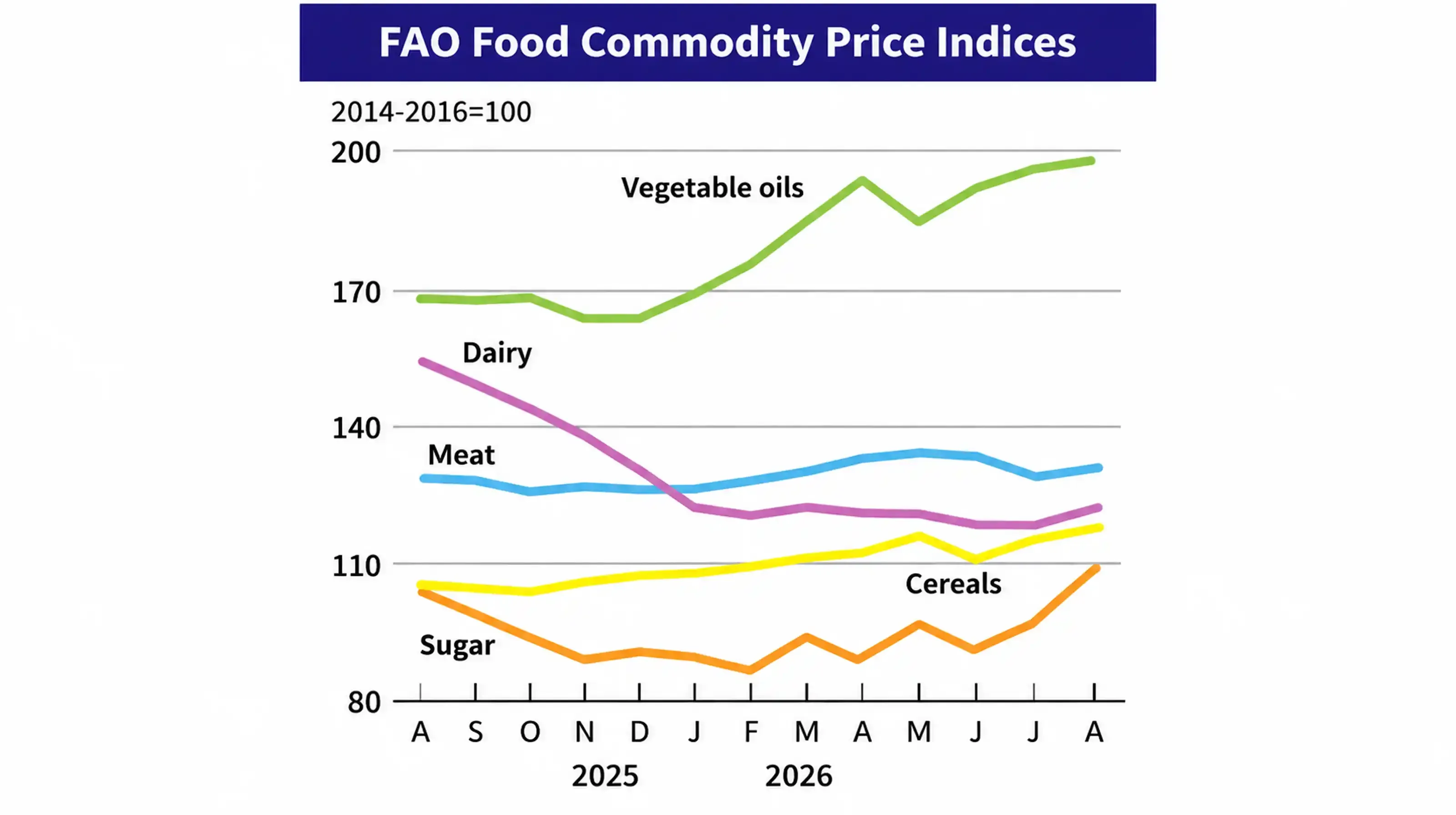
At the same time, international vegetable-oil prices have been climbing.
The Vegetable Oil Price Index of the FAO (the UN’s Food and Agriculture Organization) averaged 196.9 points in August 2026, up 0.6% from July and marking its third consecutive monthly increase.
It was the highest reading since June 2022, driven mainly by stronger palm and soybean oil prices.
Domestic prices were already feeling the pressure, and edible-oil companies had been considering a further 7–8% price increase ahead of the festive season.
Then there is inflation.
Source: MoSPI, via Press Information Bureau
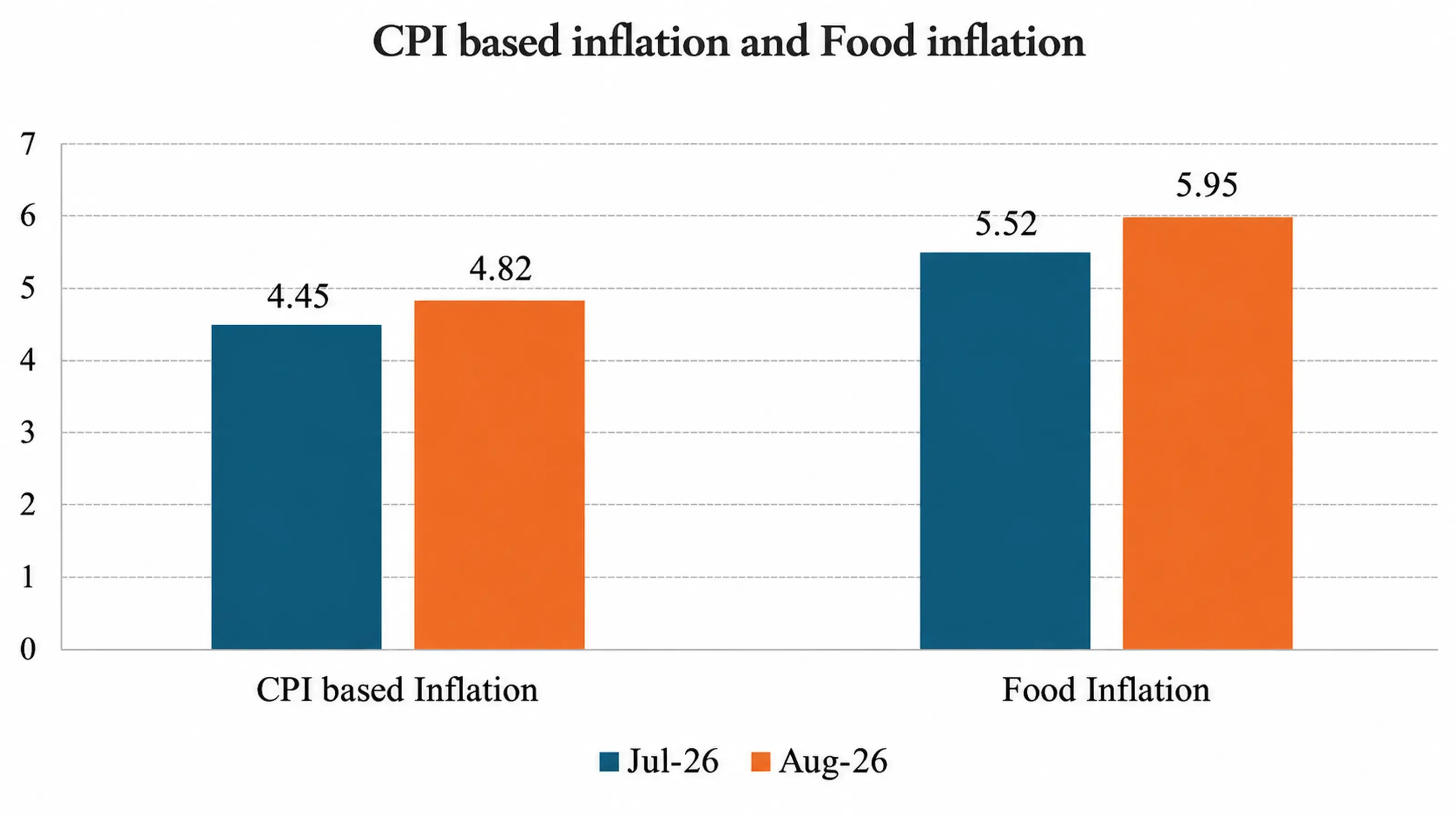
India’s headline CPI inflation (the official gauge of retail price rises) reached 4.82% in August, up from 4.45% in July, while food inflation rose to 5.95% from 5.52%.
That leaves policymakers with a familiar balancing act.
Festival demand is arriving, global edible oil is expensive, and the domestic food-price basket is already carrying some weight.
Cutting the import duty is one of the quickest ways to reduce the landed cost of imported oil.
And India has a lot of imported oil to land.
The Solvent Extractors’ Association, an industry body, estimates the country’s edible-oil import bill for the 12 months ending October 2026 at ₹1.75 lakh crore, around 9% higher than the previous year’s ₹1.61 lakh crore.
This is where the story stops being a simple consumer-relief measure.
Two years ago, the kitchen was the other side of the argument
Cast the calendar back to September 2024.
The government was looking at the same cooking oil market and turning the same dial in the opposite direction.
On 14 September 2024, it raised the BCD on crude soybean, palm and sunflower oils from 0% to 20%.
With other levies, the effective duty on crude oils became 27.5%.
Why?
Global edible-oil prices were weak. Cheaper imports were increasing.
Domestic oilseed prices were under pressure. And soybean and groundnut crops were about to arrive in the mandis.
The government wanted to support domestic oilseed farmers by making imported oil more expensive.
Even then, inventory set the pace.
Around 30 lakh tonnes of oil imported at the older, lower duty, enough for an estimated 45–50 days of consumption, led the government to ask companies not to raise prices until those stocks ran out.
This time, old stock may slow the move in the other direction.
Then, from 31 May 2025, the duty on crude palm, soybean and sunflower oil was cut from 20% to 10%, partly because the earlier increase had contributed to higher edible-oil prices alongside rising international prices.
By September 2026, the effective duty on crude palm and soybean oil had travelled from 27.5% in September 2024 to 16.5% in 2025 and now 11%.
It is tempting to call this inconsistency.
It is probably more useful to call it the economics of a country that imports nearly two-thirds of the vegetable oil it consumes.
The same tariff has two jobs.
Lower it and imported oil becomes cheaper for refiners and consumers.
Raise it and domestic oilseeds get some protection from cheaper global supplies.
The government is effectively choosing which side of the market needs help at a particular moment.
The farmer gets the other side of the invoice
The 2026–27 Minimum Support Price, or MSP (the government’s announced floor price for a crop), for yellow soybean is ₹5,708 a quintal (100 kg), up 7% from ₹5,328 the previous year.
But mandi prices around Dewas on 24 September were roughly ₹5,200 at Dewas APMC (the regulated local market yard), ₹5,000 at Kannod and ₹4,941 at Khategaon, with actual prices varying by quality, moisture, quantity and mandi.
That is an uncomfortable gap to have just as the new crop begins arriving.
Cheaper imported oil can help the consumer, but it can also put pressure on what domestic processors are willing to pay for oilseeds.
A processor buying soybean is really buying two products: the oil pressed out of it and the protein-rich meal left behind, sold as animal feed.
When imported oil becomes cheaper, the oil inside a domestic soybean is worth less, and that tends to show up in the bids at the mandi.
Rural Voice points to another consequence that is easy to miss: farmers do not make sowing decisions by looking only at today’s crop.
The prices they see now influence what they choose to plant for the next season.
Mustard therefore enters the picture too.
October and November are when farmers decide what to sow for rabi, the winter crop season.
If imported edible oils remain cheaper, that changes the price signal facing mustard growers.
An import-duty cut can travel much further than the supermarket shelf.
India wants more oil at home, too
There is a policy tension sitting in the background.
India wants cheaper edible oil today and greater domestic production tomorrow.
The National Mission on Edible Oils-Oilseeds, approved in October 2024 with an outlay of ₹10,103 crore, aims to raise primary oilseed production from 39 million tonnes in 2022–23 to 69.7 million tonnes by 2030–31.
Together with a separate oil-palm mission, the aim is for domestic production to meet around 72% of India’s edible-oil needs by 2030–31.
Today, the arithmetic runs almost the other way.
That makes the import duty an unusually sensitive lever.
And the acreage story makes the challenge sharper.
Rural Voice notes that soybean acreage this kharif season (the monsoon-sown crop) is around 12.2 million hectares, against a normal area of about 12.8 million hectares.
For a mission that depends on farmers choosing to plant more oilseeds, the price they see at the mandi is part of the policy too.
When the policy reaches the market
Here, a domestic kitchen story starts becoming a market story.
The first effect does not show up on tomorrow’s grocery bill.
Refiners and distributors may still hold inventory bought under the old duty structure.
The government has advised price revisions, but the pass-through (how much of the saving actually reaches the shelf) could take weeks, depending on inventories, international prices, freight, the rupee and domestic supply.
For refiners and packaged-food companies, that creates a margin question.
Lower input costs can help, but the benefit depends on how quickly high-cost inventory clears and how much of the saving reaches consumers.
There is also an effect beyond India’s borders.
India is the world’s largest buyer of edible oils, and in past rounds of duty cuts, industry observers have noted that international prices can firm up afterwards, absorbing part of the saving before it reaches Indian ports.
Closer to home, there is a second ripple.
Cheaper oil could ease costs for oil-intensive businesses such as snack makers, bakeries and restaurants, although competition may pass those savings on through lower prices.
The kitchen and the mandi are watching the same number
Go back to Mumbai.
The oil price looks better, but old stock is still on the shelf.
Go back to Dewas.
Soybean has arrived, but the MSP of ₹5,708 is still above the mandi price.
Two clocks are running: the consumer clock moves in weeks; the farmer clock moves in months.
The import duty sits between them.
Turn it down, and consumers may get relief.
Turn it up, and farmers may get support.
The quieter story is how far that one dial travels: from the price on the shelf, to the bid at the mandi, and eventually into the next crop that gets sown.
Sources and References:
- PIB
- BUSINESSTODAY
- ECONOMICTIMES
- FAO
- FINANCIALEXPRESS
- ECONOMICTIMES
- MINT
- REUTERS
- PRSINDIA
- KISANDEALS
- RURALVOICE
- NEWSONAIR
- THEHINDU
- TRIBUNE
This article is for informational purposes only and does not constitute financial advice. It is not produced by the desk of the Kotak Securities Limited Research Team, nor is it a report published by the Kotak Securities Limited Research Team. The information presented is compiled from several secondary sources available on the internet and may change over time. Investors should conduct their own research and consult with financial professionals before making any investment decisions. The above images were generated using AI. Read the full disclaimer here.
Investments in securities market are subject to market risks, read all the related documents carefully before investing. Brokerage will not exceed SEBI prescribed limit. The securities are quoted as an example and not as a recommendation. Registered Office: 27 BKC, C 27, G Block, Bandra Kurla Complex, Bandra (E), Mumbai 400051. Kotak Securities Limited; SEBI Registration No. INZ000200137(Member of NSE, BSE, MSE, MCX & NCDEX), Member Id: NSE-08081; BSE-673; MSE-1024; MCX-56285; NCDEX-1262. For compliance T&C and disclaimers, Visit bitly link.
0 people liked this article.

Shreyas is a capital markets enthusiast and content strategist at Kotak Neo, driving content for Kotak Stockshaala and Kotak Insights. His work sits at the intersection of market analysis and financial literacy, turning what's moving the market into content people can actually act on.
Outside the 9-to-5, he's usually chasing his next sneaker drop, planning his next vacation, or elbow-deep in a crossword.