India’s Free Payment Revolution Is Getting a Price Tag
- Updated: 25 Sep 2026, 4:34 PM IST
- | 4 min read
- 7,168
 Add Preferred News Source
There was a time when getting out of a taxi often ended in a small negotiation.
The fare is ₹180, and you hand over ₹500.
The driver checks his wallet; you check yours, and both start looking for change.
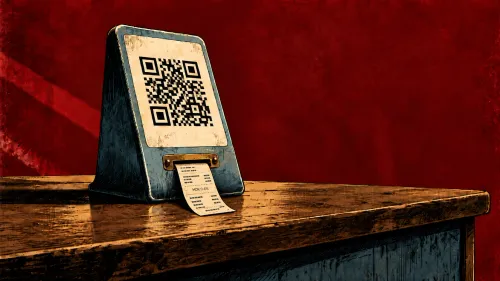
Now, there is usually a QR code near the meter.
You just have to scan, pay ₹180, and walk away.
No coins, no awkward exchange, and no “Khulle hain? Nahin hain” discussions.
India had been moving towards a less-cash economy for years.
Demonetisation in 2016 accelerated the shift.
UPI, the Unified Payments Interface that lets any bank account pay another instantly through a phone, then did something more consequential.
It made paying so simple that the act itself almost disappeared.
Digital India, Jan Dhan Yojana, electronic-payment mandates, UPI, BHIM (Bharat Interface for Money), RuPay, FASTags and Quick Response (QR) payments gradually turned digital transactions from something relatively new into something almost mundane.
KPMG was already describing India’s digital-payments ecosystem in 2020 as more evolved than those of 25 other countries, including the UK, China and Japan.
The unusual part was what happened next.
India did not just encourage digital payments. It made one of the most important rails effectively free.
By August 2026, UPI was processing about 24.5 billion transactions worth ₹29.82 lakh crore in a single month, and charging most merchants nothing to accept them.
Now someone has to pay for the pipes.
Most of us have never given a thought to what sits behind a QR code.
The question of ₹8
Under a framework announced by NPCI on 15 September, specified person-to-merchant (P2M) UPI payments above ₹2,000 will attract a 0.4% Merchant Discount Rate, or MDR, from 15 October 2026.
MDR is the small fee a merchant pays, through its bank, for accepting a digital payment.
On a payment just over ₹2,000, the fee works out to about ₹8.
This fee is also capped at ₹300, a ceiling reached at ₹75,000.
The merchant pays, not the customer.
Person-to-person transfers remain free, while merchant payments up to ₹2,000 remain outside the standard MDR framework.
The government estimates that around 96% of P2M transactions will remain unaffected. Small merchants get another shield.
Businesses receiving up to ₹1 lakh a month through UPI QR codes remain exempt, even if an individual payment exceeds ₹2,000.
There are separate rates for certain categories.
Payments above ₹2,000 for essential services such as railways, fuel, telecom and insurance attract a flat ₹5 MDR.
So this is not a universal charge on UPI.
The kirana shop is largely protected.
The larger restaurant, electronics retailer, e-commerce transaction or other high-value merchant payment is where the economics change.
Free was never really free
The zero-MDR policy began in January 2020, when government rules prohibited MDR on prescribed electronic payment modes, including BHIM-UPI and UPI QR payments.
It removed a direct cost for merchants, but not the cost of operating the network.
Technology still had to run. Transactions still had to settle.
Fraud still had to be managed. Cybersecurity still had to be maintained.
Government incentives helped bridge the gap.
Between FY2021-22 and FY2024-25, budgetary support under the relevant digital-payment incentive schemes totalled ₹8,276 crore.
But UPI did not stay small.
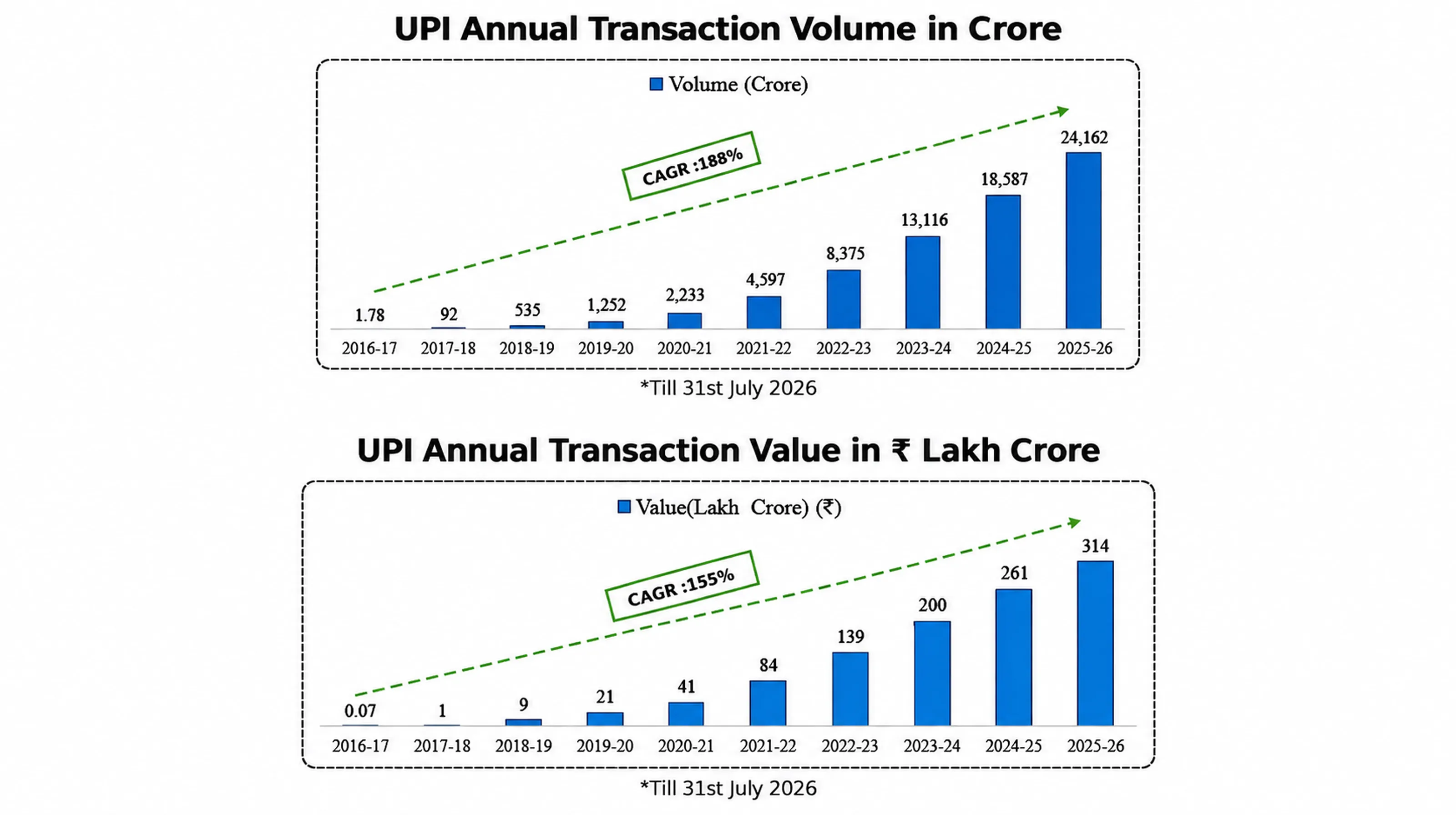
It processed just 1.78 crore transactions in FY2016-17.
By FY2025-26, annual volume had reached 24,162 crore, with an annual transaction value of about ₹314 lakh crore. Banks live on the platform increased from 21 at launch to 752 by August 2026.
Source: Press Information Bureau
Industry estimates put the annual cost of maintaining the UPI ecosystem at roughly ₹20,000–20,700 crore, covering technology infrastructure, cybersecurity, fraud prevention, settlement and technical support.
These are industry estimates, not an audited figure from the National Payments Corporation of India (NPCI), the body that runs UPI.
By March 2026, a Standing Committee on Finance had recorded the Department of Financial Services’ assessment that the absence of MDR made the UPI ecosystem financially unsustainable and argued for a viable revenue mechanism.
The question was no longer whether India could make digital payments free.
It was who should fund them at this scale.
When 0.4% meets 24 billion transactions
The scale explains why the change matters.
In July 2026, UPI processed about 23.66 billion transactions worth ₹29.88 lakh crore.
August added nearly a billion more transactions, at a broadly similar value.
Month | No. of Banks live on UPI | Volume (In Mn.) | Value (In Cr.) |
|---|---|---|---|
August-2026 | 752 | 24,508.96 | 29,82,355.95 |
July-2026 | 741 | 23,658.35 | 29,87,880.49 |
June-2026 | 731 | 22,716.07 | 28,92,138.67 |
May-2026 | 720 | 23,201.93 | 29,90,424.21 |
April-2026 | 713 | 22,346.80 | 29,02,988.05 |
*This data excludes transactions having debit/credit to the same account for the month of August 2018 onwards.
Source: National Payments Corporation of India (NPCI)
Across FY2025-26, UPI accounted for 84% of India’s digital-payment volume.
UPI accounted for nearly 49% of global real-time payment volume in 2025.
At this scale, 0.4% is no longer just a small decimal.
It creates a meaningful economic layer, even though most everyday transactions remain outside it.
And that is where the investor story begins.
MDR is not a tax.
The Finance Minister has described it as neither a tax nor a cess, and none of it goes to the government.
The fee is, however, taxed: GST at 18% applies to the MDR amount, not to the payment itself, and registered merchants can generally claim it back as input tax credit (a set-off against the GST they themselves owe).
It is distributed among participants in the payment ecosystem, including banks and payment application providers.
Follow the money
The final framework divides the 0.4% (40 basis points, where one basis point is one-hundredth of a percentage point) four ways:
• 40% to the issuing bank that holds the customer's account,
• 30% to the acquiring bank that handles the merchant's side,
• 20% to the UPI app the customer pays through, and
• 10% to that app's partner bank.
The exact distribution matters because it determines where the new revenue layer lands.
Banks, payment apps and merchant acquirers sit on the receiving side of this new fee.
Payment aggregators are also seeking a direct share rather than relying entirely on acquiring banks to pass through their allocation.
For investors, this is a structural change in payment economics.
UPI has spent years being primarily a scale and user-acquisition story.
A direct MDR stream gives that scale a transaction-linked revenue stream.
That does not transform the economics of every payment company overnight.
It does, however, put a price on part of the transaction itself.
There is a quieter consequence too.
A handful of apps handle the vast majority of UPI payments, and NPCI's long-delayed 30% cap on any single app's share has been hard to enforce, partly because smaller apps had no way to earn from payments.
The government has itself argued that MDR gives them one.
A fee introduced to fund the pipes may also reshape who competes on them.
Then the stock market walks in
Capital markets have a different problem.
UPI payments connected with mutual funds, securities, stockbrokers, dealers and investment platforms attract 0.02% MDR, capped at ₹300.
That places brokers and investment platforms on the cost side of this particular flow.
A customer can transfer money into a broking account without actually placing a trade.
Regulation adds a twist.
Brokers must periodically return unused client money, and much of it comes back through UPI.
The same rupees can therefore attract the fee more than once without a single trade.
Brokers have asked for a much lower cap on such payments, and SEBI has said it will examine their concerns.
It is a useful reminder that UPI is no longer simply a way to pay for groceries.
It is embedded in the plumbing of India’s financial markets too.
The American subplot
There is a trade-policy dimension as well.
The US Trade Representative’s (USTR) 2026 National Trade Estimate report, an annual American list of what Washington sees as foreign trade barriers, raised concerns about India’s electronic-payment policies, arguing that the framework appeared to favour domestic suppliers and created difficulties for US payment-service providers seeking a level playing field with RuPay, India's domestic card network, within UPI.
That prompted debate over whether US concerns around Visa and Mastercard influenced the MDR decision.
The public record supports a narrower reading.
The USTR raised the issue, but the Indian government rejected the suggestion that external pressure drove the decision and pointed instead to the domestic sustainability problem.
The March 2026 parliamentary report had already identified the funding problem before the final framework was announced.
So the trade dispute is part of the backdrop, but it is not evidence of causation.
The small merchant is largely protected. The larger one pays.
For the neighbourhood merchant, little changes directly.
The ₹1 lakh monthly QR threshold remains exempt, and payments below ₹2,000 remain outside the standard MDR.
The exposure is greater for larger retailers, restaurants, electronics stores, e-commerce businesses and other merchants handling high-value P2M payments.
Merchants are not permitted to pass MDR on to customers as a surcharge, and the government has said it will monitor merchant behaviour.
But a business does not need to add a line called “UPI fee” to recover a cost.
It can surface elsewhere: in slightly firmer prices, thinner discounts, or a gentle nudge towards whichever way of being paid costs the business least.
For now, UPI still sits low on that list; debit-card fees, for instance, can run up to 0.9%.
Customers may adjust too.
There is already talk of larger bills being split into payments below the ₹2,000 line, the kind of quiet workaround any new fee tends to invite.
That is the behavioural question worth watching.
India has spent six years making UPI feel like the default way to pay.
The question now is whether putting a price on part of the merchant side changes that behaviour.
The paradox is the point
The zero-cost model helped UPI scale because it removed friction.
Government incentives supported the ecosystem while that scale was being built.
Now the economics are moving in the opposite direction.
India is shifting from subsidising the adoption of digital payments to asking the infrastructure that adoption created to pay for itself, and some of the businesses using the pipes will fund it.
For investors, the interesting part is not simply the 0.4% headline.
It is what happens underneath: how the MDR pool is shared, how merchants and customers adjust, whether smaller apps finally find a business model, and how brokers and investment platforms absorb a cost they did not carry before.
The QR code on the taxi will still be there.
The passenger will still scan it. The fare will still be paid to the rupee.
The experience will remain almost boringly frictionless.
The change is happening underneath.
India spent years making the payment rail invisible.
Now, for the first time, part of the machinery behind that little square has a price.
Sources and References:
- KPMG
- NPCI
- ECONOMICTIMES
- PIB
- MONEYCONTROL
- FINANCIALEXPRESS
- BUSINESSSTANDARD
This article is for informational purposes only and does not constitute financial advice. It is not produced by the desk of the Kotak Securities Limited Research Team, nor is it a report published by the Kotak Securities Limited Research Team. The information presented is compiled from several secondary sources available on the internet and may change over time. Investors should conduct their own research and consult with financial professionals before making any investment decisions. The above images were generated using AI. Read the full disclaimer here.
Investments in securities market are subject to market risks, read all the related documents carefully before investing. Brokerage will not exceed SEBI prescribed limit. The securities are quoted as an example and not as a recommendation. Registered Office: 27 BKC, C 27, G Block, Bandra Kurla Complex, Bandra (E), Mumbai 400051. Kotak Securities Limited; SEBI Registration No. INZ000200137(Member of NSE, BSE, MSE, MCX & NCDEX), Member Id: NSE-08081; BSE-673; MSE-1024; MCX-56285; NCDEX-1262. For compliance T&C and disclaimers, Visit bitly link.
0 people liked this article.

Shreyas is a capital markets enthusiast and content strategist at Kotak Neo, driving content for Kotak Stockshaala and Kotak Insights. His work sits at the intersection of market analysis and financial literacy, turning what's moving the market into content people can actually act on.
Outside the 9-to-5, he's usually chasing his next sneaker drop, planning his next vacation, or elbow-deep in a crossword.