Cheap Data, Expensive Space: The Business of Connecting India
- Posted: 16 Oct 2026, 5:35 PM IST
- | 7 min read
- 5,195
 Add Preferred News Source

It is a Sunday evening in Pune, and a software engineer is on a video call with her parents.
Or trying to be.
Her mother's face freezes mid-sentence, then breaks into grey squares.
"Wait, let me go up to the terrace," her father says, and the call drops.
Her parents live in the family village in the Sahyadri hills, a couple of hours inland from Chiplun.
Ten minutes later, the phone rings again.
Her father is standing in the one corner of the terrace where a single bar holds steady, arm raised so she can see the house behind him.
In Pune, she has spent the afternoon streaming a series, paying bills and watching cricket highlights.
Her data costs roughly ₹8 a gigabyte (GB).
Her parents pay the same rate. They simply cannot use much of it.
India has achieved something remarkable by making mobile data so cheap that watching videos, attending classes and scrolling through the Internet have become ordinary habits.
But affordability has a boundary.
It ends wherever the signal does.
Now, the companies that helped build India’s Internet economy on the ground want to extend it into space.
And the timing is interesting: Jio Platforms, the company behind one of those ground networks, is preparing for its initial public offering (IPO).
The business that made connectivity affordable is also planning a satellite network that could take years to complete.
The two ambitions share a corporate roof, but they do not share a clock.
The race above a country that already has cheap data
Source: Best Broadband Deals
At the India Mobile Congress (IMC) in New Delhi last week, Reliance Jio showcased a proposal for around 1,600 low Earth orbit (LEO) satellites and 23 ground stations (the facilities on Earth that link satellites to the wider Internet), with the aim of reaching more than 600,000 villages.
LEO satellites circle a few hundred kilometres above Earth, which cuts the delay in communication compared with traditional geostationary satellites parked about 36,000 km away, fixed above one spot.
Meanwhile, Starlink said it had built 20 gateway sites (its own ground stations) in India and was waiting for final government clearance before launching commercial services.
Elon Musk said Starlink would have to price its service affordably to attract Indian customers.
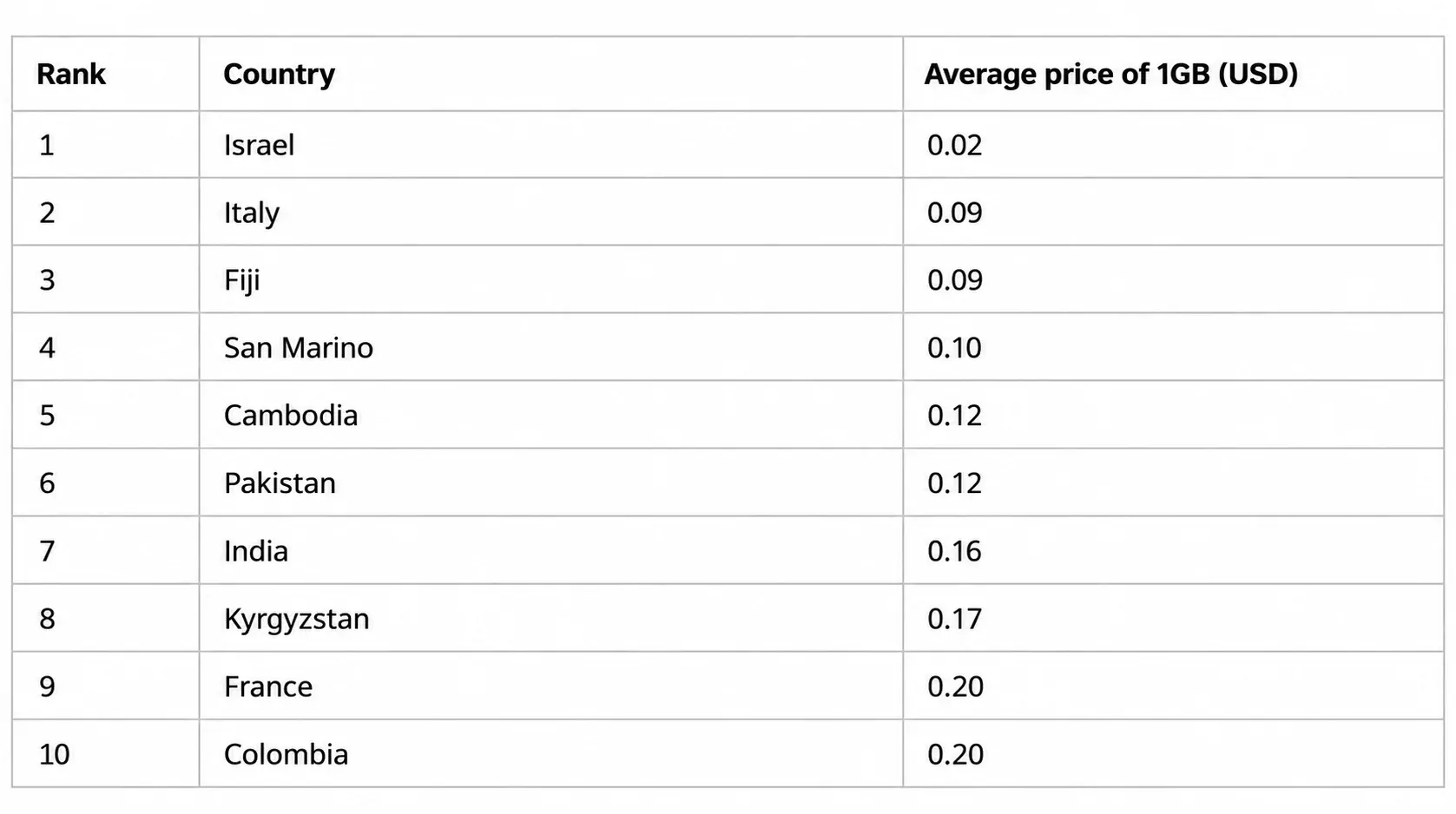
Reuters reported that mobile data here costs around eight US cents per GB, among the cheapest rates in the world.
Most coverage frames this as a contest between Jio and Musk’s SpaceX-backed Starlink.
But the more revealing contest is between the economics of satellite Internet and a price that India’s ground network has already established.
How ₹269 became ₹8
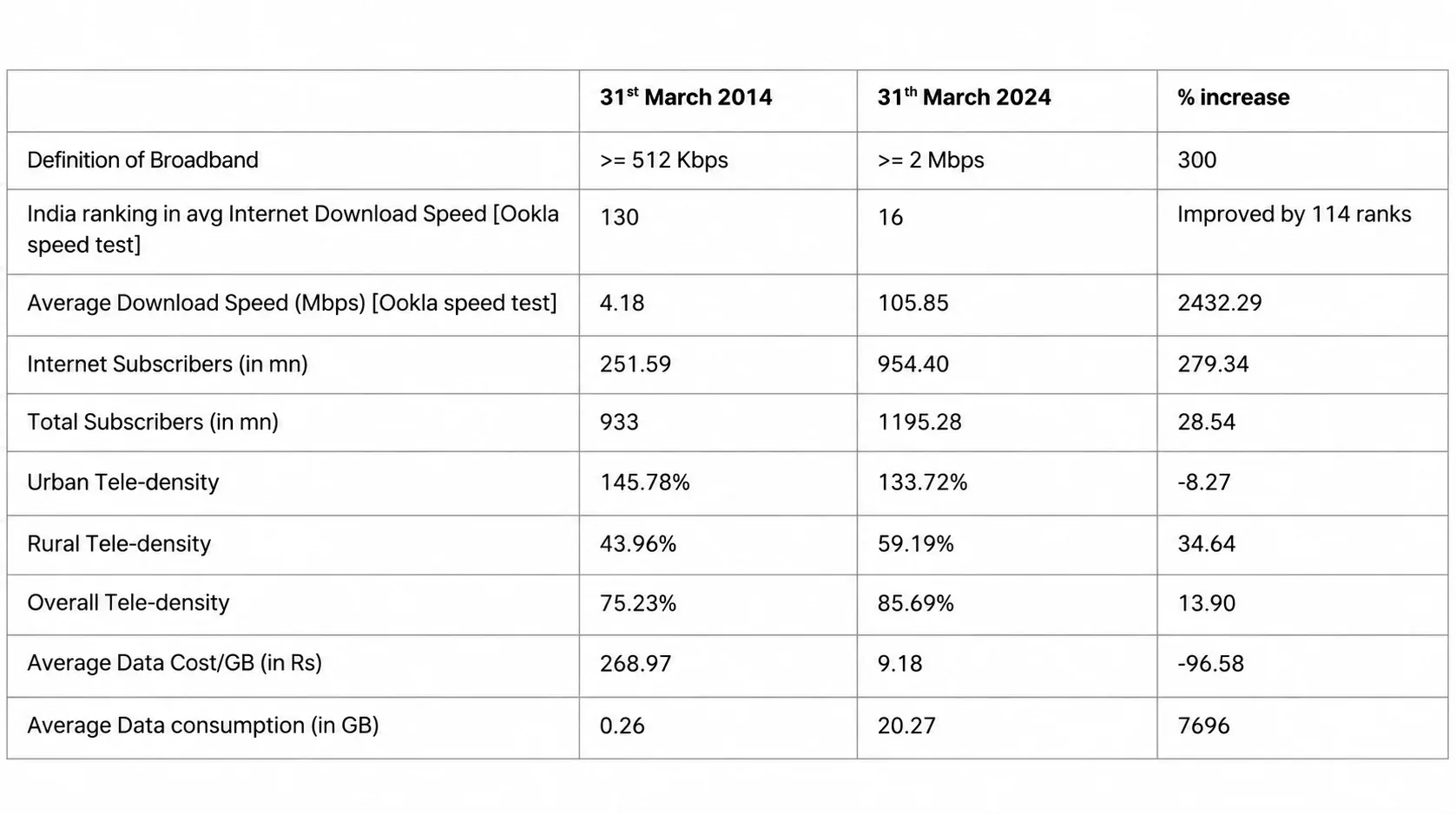
In March 2014, a GB of mobile data cost around ₹269 on average.
By June 2024, the price had fallen to ₹8.31, a reduction of approximately 96.9%.
More recent reporting puts it at about ₹7.74 to ₹8 per GB, while the communications minister has said India’s data costs are below 5% of international levels.
This was not simply a story of operators deciding to charge less.
The expansion of 4G networks, greater competition, rising network capacity and the shift towards data-led services all helped.
Jio’s entry in 2016, with free voice calls and inexpensive data, accelerated the change.
The economics of a mobile tower are straightforward.
The operator pays for equipment, electricity, fibre connections and maintenance, but can spread those costs across thousands of subscribers within range.
In densely populated settlements, each tower serves a large customer base, while the same infrastructure can carry more traffic as usage grows.
Source: Press Information Bureau
The scale of the transformation is visible in the numbers.
India had 251.59 million Internet subscribers in March 2014.
By March 2024, that had risen to 954.40 million, including 398.35 million rural subscribers.
Cheap data was built on shared infrastructure, a huge customer base and years of investment, not merely a generous tariff.
That is the price satellite operators must now compete with.
The sky has a capacity problem
A satellite can reach places a tower cannot, but it cannot offer unlimited bandwidth to everyone beneath it.
Capacity is finite, shared across users and locations, and expensive to expand.
Jio’s proposed constellation (a network of satellites working together) is expected to begin test flights in September 2027, with around 400 to 450 satellites targeted by 2030 and the full network by 2035.
When fully deployed, around 30 to 32 satellites are expected to be positioned over India at a time, delivering a projected combined capacity of up to 4.8 terabits per second, shared by everyone below.
More satellites can improve coverage and increase capacity, but each also adds to the capital and operating costs.
Consider the price of getting connected. Starlink has not announced Indian tariffs.
A residential plan of ₹8,600 a month, with a ₹34,000 hardware kit, briefly appeared on its India website in December 2025, but the company later called those figures test data.
Subsequent media reports suggested a retail plan nearer ₹2,500 to ₹3,000 a month.
Even at that level, the subscription would be more than ten times the average mobile bill of a little over ₹200, and the dish and router would still need to be bought upfront.
The two are not like for like: one is a home broadband connection, the other a phone plan.
But the comparison shows the household arithmetic satellite operators are walking into.
Musk’s promise of affordability will have to contend with a market used to paying very little for data.
For a city resident with a reliable mobile signal, satellite Internet is not a cheaper version of the same thing.
It is a different product, built for different circumstances.
In 2025, a government estimate suggested Starlink could serve around 50,000 to 60,000 connections in Delhi at most, while its capacity across India may be limited to about 20 lakh connections.
That makes satellite broadband a potential solution for underserved areas, rather than a mass-market substitute for India’s existing telecom networks.
The villages are not all waiting for satellites
The plan to connect more than 600,000 villages sounds like an enormous untapped market.
But it is worth looking at what has already been built.
By April 2024, 612,952 of India’s 644,131 villages, or 95.15%, had 3G or 4G mobile connectivity.
The government’s 4G Saturation Project, approved at a cost of ₹26,316 crore, is extending services to 24,680 previously uncovered villages, with another 6,279 villages earmarked for upgrades from 2G or 3G to 4G.
The remaining market is not one enormous blank space.
It is a collection of difficult places: fishing vessels far offshore, border posts in mountainous terrain, remote islands, disaster-hit areas and industrial sites beyond fibre networks.
Satellite links can also connect mobile towers to the wider Internet where laying fibre is too expensive or physically difficult.
For a shipping company trying to maintain connectivity at sea, the alternative may be no broadband at all.
For a household already using inexpensive mobile data, paying thousands of rupees each month is a different proposition.
The regulatory details will influence how quickly these markets develop.
In September, the Department of Telecommunications’ top decision-making body cleared a spectrum usage charge (the fee operators pay for the airwaves they use) of 5% of adjusted gross revenue, reduced to 4% in government-notified remote areas, on top of an annual licence fee of 8% of AGR.
The proposal still awaits Union Cabinet approval.
The department also set aside the regulator’s suggested ₹500 annual levy on each urban satellite subscriber.
Even after pricing is settled, each operator needs security clearance from the Ministry of Home Affairs before it can switch on service.
So price and capacity, rather than the headline ambition to connect every village, will help determine which customers get served first.
There is also a little irony in the competitive landscape.
In 2025, both Bharti Airtel and Reliance Jio signed agreements to distribute Starlink equipment through their retail networks.
Rivals can still become partners when the commercial logic makes sense.
Two businesses, two clocks
This brings us to Jio Platforms and its forthcoming IPO, scheduled to open for subscription on 21 October and close on 23 October 2026, with listing expected on 28 October.
Investors should refer to the offer document for the final terms.
Jio’s satellite ambitions sit within the Jio Platforms group, alongside its telecom and digital businesses.
At the top of its price band, the issue values the company at about ₹10.3 lakh crore.
The proposed IPO is structured as a fresh issue, meaning the money raised goes to the company rather than existing shareholders selling their stakes.
The offer document (the formal prospectus filed with regulators) earmarks up to ₹27,500 crore for repaying borrowings at Reliance Jio Infocomm, the telecom arm, with the rest for general corporate purposes.
None of it is set aside specifically for the satellite programme.
The ground business already serves around 53 crore customers.
The satellite programme, by contrast, remains a long-term infrastructure project.
Analyst estimates cited in media reports put the investment needed for a network of this scale at $10 billion to $15 billion, roughly ₹95,000 crore to ₹1.4 lakh crore.
For anyone trying to understand the company, the distinction matters.
One part of the business has already built a customer base and helped establish the price of data across India.
The other must prove that it can serve customers in places where conventional networks cannot economically reach, while managing the cost of satellites, ground infrastructure and user equipment.
That is not a judgement on the share sale.
It is a way to separate an established operation from a long-dated infrastructure plan.
Their commercial prospects will unfold on different timelines, and the satellite network’s proposed reach should not be confused with a completed nationwide service.
In Pune, the call has ended, a little shorter than either side wanted.
In the hills, her father walks back down from the terrace, the one place in the house where the network reaches him.
Next Sunday, he will climb the stairs again, carrying a connection that costs his daughter almost nothing and still cannot quite reach him.
India has made connectivity affordable across much of the country.
The next challenge is reaching the places where affordability alone cannot buy a signal.
Sources and References:
- BESTBROADBANDDEALS
- MONEYCONTROL
- FINANCIALEXPRESS
- REUTERS
- NEWSONAIR
- PIB
- STORYBOARD18
- ECONOMICTIMES
- OUTLOOKBUSINESS
- INDIATIMES
- DBN
- THEHINDUBUSINESSLINE
- FIERCENETWORK
- MEDIANAMA
_This article is for informational purposes only and does not constitute financial advice. It is not produced by the desk of the Kotak Securities Limited Research Team, nor is it a report published by the Kotak Securities Limited Research Team. The information presented is compiled from several secondary sources available on the internet and may change over time. Investors should conduct their own research and consult with financial professionals before making any investment decisions. The above images were generated using AI. _
Investments in securities market are subject to market risks, read all the related documents carefully before investing. Brokerage will not exceed SEBI prescribed limit. The securities are quoted as an example and not as a recommendation. Registered Office: 27 BKC, C 27, G Block, Bandra Kurla Complex, Bandra (E), Mumbai 400051. Kotak Securities Limited; SEBI Registration No. INZ000200137(Member of NSE, BSE, MSE, MCX & NCDEX), Member Id: NSE-08081; BSE-673; MSE-1024; MCX-56285; NCDEX-1262. For compliance T&C and disclaimers, Visit https://www.kotakneo.com/disclaimer/
0 people liked this article.

Shreyas is a capital markets enthusiast and content strategist at Kotak Neo, driving content for Kotak Stockshaala and Kotak Insights. His work sits at the intersection of market analysis and financial literacy, turning what's moving the market into content people can actually act on.
Outside the 9-to-5, he's usually chasing his next sneaker drop, planning his next vacation, or elbow-deep in a crossword.