India's Fastest-Growing Loan Has No New Borrowers
- Updated: 26 Aug 2026, 12:53 PM IST
- | 4 min read
- 7,795
 Add Preferred News Source
Owning a home may be every Indian family's dream, but owning gold is often its first financial safety net.
Long before mutual funds, credit cards or instant personal loans became commonplace, families relied on jewellery when life demanded cash without warning.
Gold was never just an ornament. It was emergency savings, waiting inside a locker.
A bride's necklace from a wedding two decades ago.
A mother's bangles, bought one at a time during Dhanteras sales.
A set of coins gifted at a naming ceremony.
Most of it has never been worn since the occasion it was bought for, but none of it was ever meant to be sold.
For years, pledging that jewellery carried an emotional weight.
Today, it has become one of India's most widely used borrowing tools.
Which is why the latest numbers from India's gold lenders seem perfectly logical.
Muthoot Finance reported a record quarter. Consolidated loan AUM grew 43% year-on-year to ₹1.91 lakh crore, while its core gold loan book rose 44% to ₹1.63 lakh crore.
Standalone net earnings increased 25%, and the company added 86 branches during the quarter.
Across the industry, the story appears equally compelling.
Gold loans have overtaken personal loans to become India's second-largest retail credit product after home loans.
Banks, NBFCs and fintechs continue expanding into the segment, while ICRA expects NBFC gold loan portfolios to grow around 35% through FY27 and FY28.
The obvious conclusion is that Indians are borrowing against gold like never before.
The data suggests something subtler.
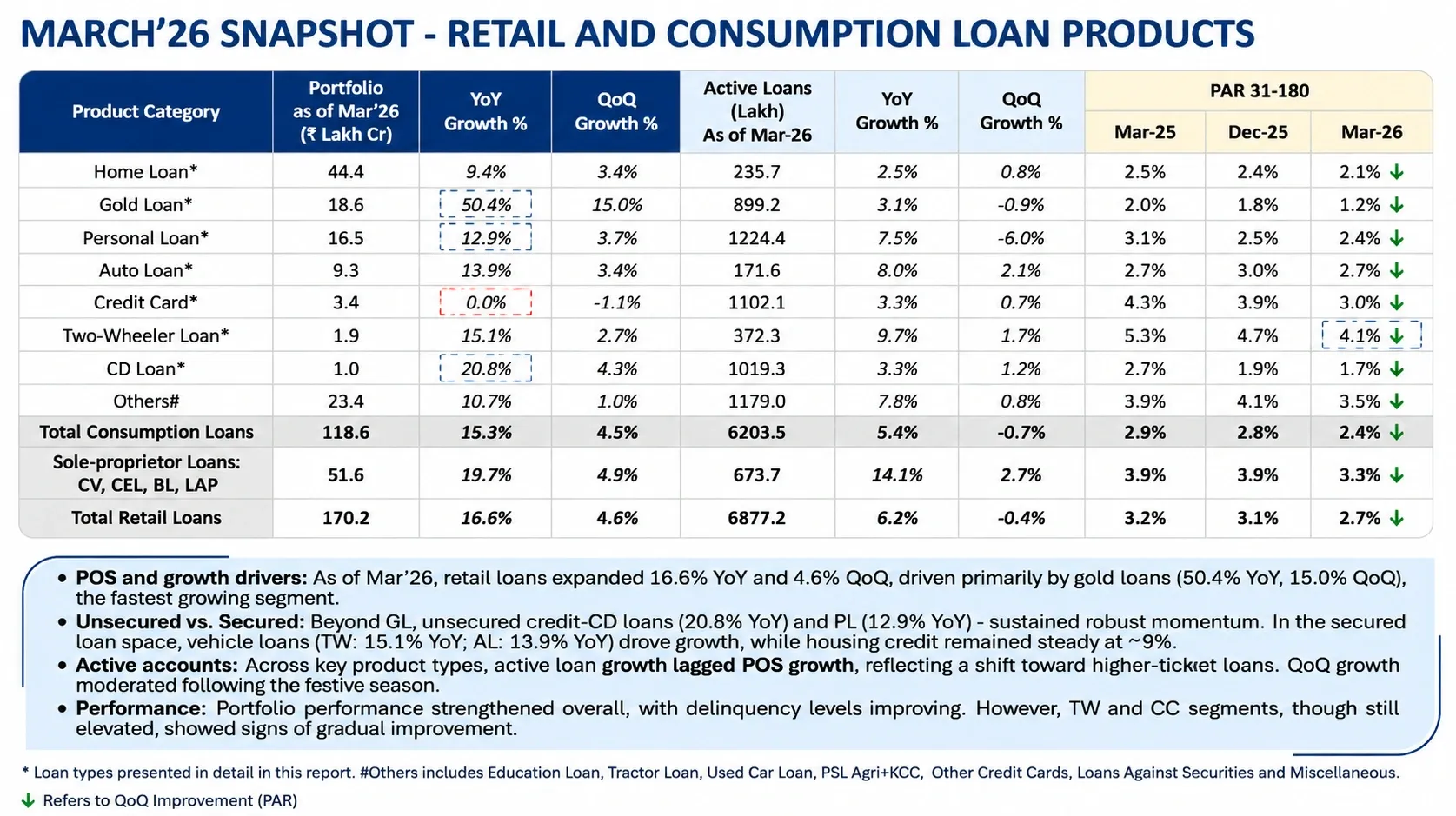
Source: CRIF High Mark
Growth Without More Gold
Between FY22 and FY26, the quantity of gold jewellery pledged with large lenders increased by just 3% to 4%, according to ICRA.
Loan books, meanwhile, expanded by around 24%.
The missing piece is gold prices.
Between March 2024 and March 2026, the gold price index rose 144%.
As the value of pledged jewellery climbed, so did the amount lenders could extend against it.
The average gold loan ticket almost doubled, rising from ₹98,000 in FY23 to ₹1.96 lakh in FY26.
The jewellery barely changed; its valuation did, and regulation amplified the effect.
From 1 April 2026, the RBI replaced the earlier flat 75% loan-to-value cap with a tiered framework, allowing up to 85% LTV for smaller loans while also tightening rules around bullet repayments, release timelines and auction pricing.
The same ornament could now support a materially larger loan than it could just a couple of years earlier.
That changes how we should read the industry's headline growth.
Muthoot's own operating metrics make the point clearly.
In Q4 FY26, active customer count declined 2% sequentially, while the quantity of gold held as collateral fell 4%.
Yet reported AUM growth remained robust because the collateral itself had become more valuable.
The Household, Not Just the Loan
The most interesting story is not inside the lender's balance sheet.
It is inside the Indian household.
For decades, gold loans were seen as borrowing of last resort.
Today, they have become one of the quickest and simplest ways to access secured credit.
No lengthy credit assessment for smaller loans, no income proof, and no waiting for approvals.
The jewellery already sitting in a family's locker has quietly become a source of liquidity.
What has changed is not just access to credit, but borrowing capacity.
A family that pledged the same jewellery a few years ago can now borrow substantially more against it because its value has increased.
Yet borrowers are not stretching themselves to the limit.
Muthoot's average loan-to-value ratio stood at 58%, well below even the revised RBI ceiling.
Borrowers are choosing not to draw the maximum amount available.
That suggests households are treating higher gold valuations as a larger emergency reserve rather than an invitation to borrow more.
It is neither a borrowing frenzy nor a distress story; it is a revaluation story.
Millions of Indian families became more creditworthy over the past two years without earning an extra rupee.
Rising gold prices quietly expanded household borrowing capacity across the country, not through higher incomes or better credit scores, but through an asset most families never planned to monetise.
The Numbers That Matter Next
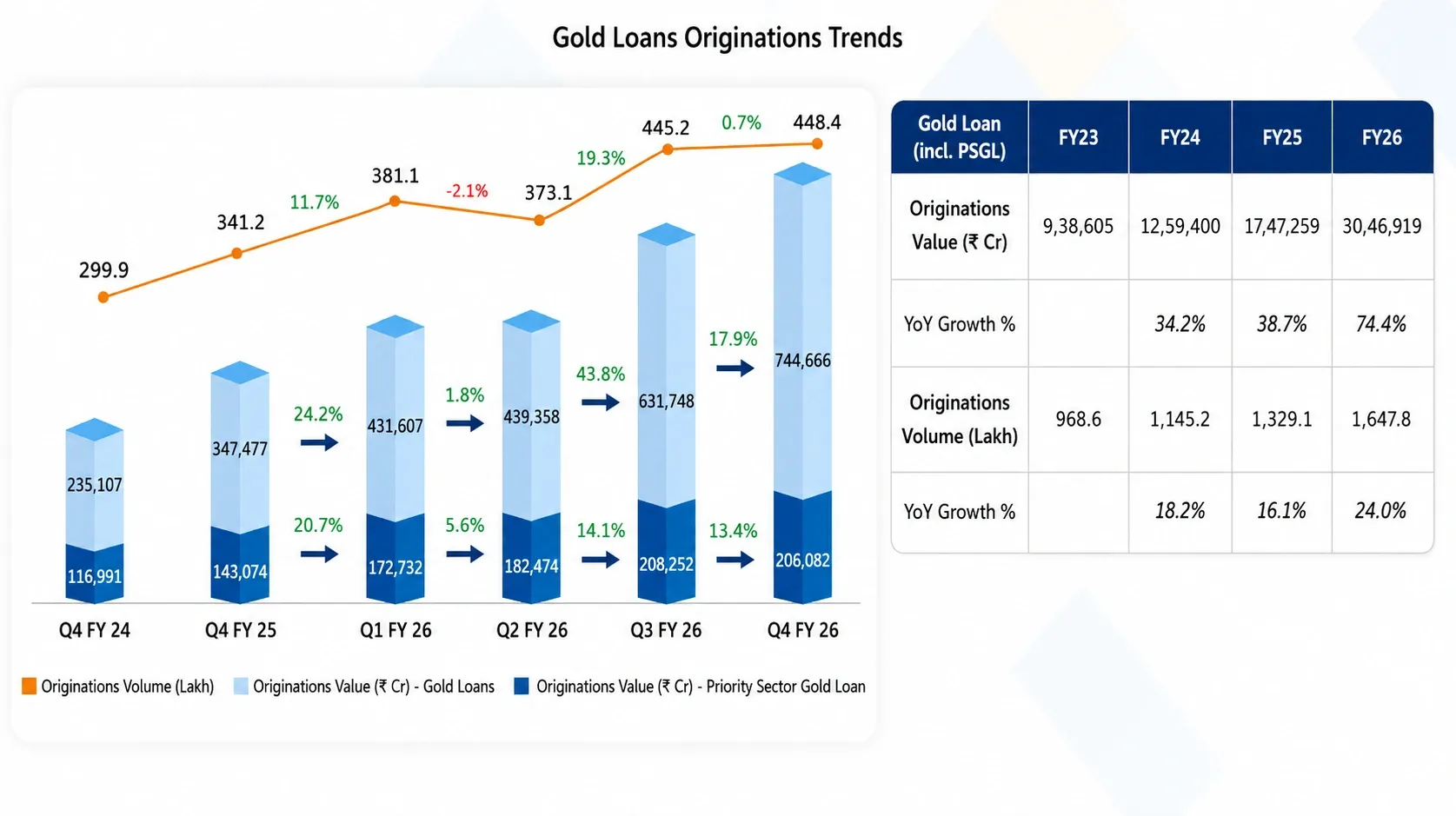
Source: CRIF High Mark
The past two years have been unusually favourable for gold lenders.
Rising collateral values helped drive reported AUM growth even when the quantity of pledged gold changed very little.
The next phase could look different.
If collateral values stop doing the heavy lifting, lenders will need growth from new customers and additional gold pledged.
That makes operating metrics far more important than headline AUM.
For investors, three operating metrics deserve closer attention than headline loan book growth: active customer additions, gold tonnage under pledge, and average ticket size.
Together, they reveal whether growth is being driven by fresh lending activity or simply by larger loans against existing collateral.
Gold loan portfolios also behave differently from most retail lending because they are short-tenure products, frequently renewed or repaid.
That allows portfolios to reprice relatively quickly, keeping credit risk low but making reported AUM unusually sensitive to shifts in collateral values.
The effects extend across the gold ecosystem.
Specialised lenders such as Muthoot Finance and Manappuram Finance, diversified lenders like IIFL Finance, and banks such as CSB Bank sit on the lending side.
Jewellery retailers such as Titan Company and Kalyan Jewellers operate on the demand side.
A meaningful rise in auctioned collateral can influence the supply of second-hand gold, linking both sides of the industry through a single commodity.
The Bigger Picture
Perhaps the most interesting observation is also the simplest.
Gold remains one of the safest forms of collateral because it is universally valued.
Yet that value is determined far beyond the households that pledge it, shaped by global bullion markets rather than local incomes.
That creates an unusual paradox.
The strength of India's gold loan industry rests on an asset whose value no Indian lender controls.
Every rise in gold prices changes not only what a family's jewellery is worth, but how much credit it can quietly unlock.
Sometimes, the biggest change in a lending business begins far away, in the global gold market and inside an Indian family's locker.
Sources and References:
- FINTECHBIZNEWS
- MINT
- CNBCTV18
- CRIFHIGHMARK
- FREEPRESSJOURNAL
- OUTLOOKBUSINESS
- LIVEMINT
- IIFL
- WHALESBOOK
This article is for informational purposes only and does not constitute financial advice. It is not produced by the desk of the Kotak Securities Research Team, nor is it a report published by the Kotak Securities Research Team. The information presented is compiled from several secondary sources available on the internet and may change over time. Investors should conduct their own research and consult with financial professionals before making any investment decisions. The above images were generated using AI. Read the full disclaimer here.
Investments in securities market are subject to market risks, read all the related documents carefully before investing. Brokerage will not exceed SEBI prescribed limit. The securities are quoted as an example and not as a recommendation. SEBI Registration No-INZ000200137 Member Id NSE-08081; BSE-673; MSE-1024, MCX-56285, NCDEX-1262.
0 people liked this article.