- Updated: 21 Aug 2026, 2:57 PM IST
- | 4 min read
- 1,003
 Add Preferred News Source
For anyone who has sat across a bank desk and watched an EMI being calculated, interest rates have never felt abstract.
A quarter-point can change the conversation. So can a few hundred rupees in the monthly budget.
That is how rate cuts are usually felt. Not in policy statements. In household arithmetic.
India saw plenty of that arithmetic change in 2025.
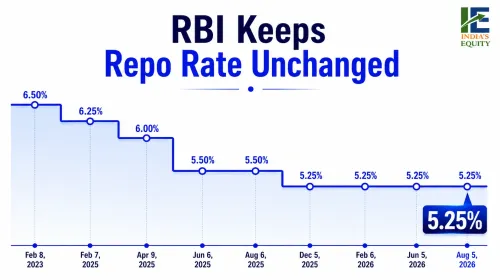
The RBI cut the repo rate four times. It fell from 6.50% to 5.25%.
Borrowing became cheaper. Credit demand picked up. Home-loan EMIs came down.
For a while, it looked like the start of a longer easing cycle.
But rate cycles rarely announce their turning points.
Sometimes, the first signs appear elsewhere. In food prices. In crude oil. In credit demand. Or in the bond market.
That is where India finds itself today.
The RBI has not raised rates. The repo rate remains at 5.25%.
But the conversation around rates has already started to change.
Source: India’s Equity
From 6.50% to 5.25%, rather quickly
The 2025 easing cycle was unusually decisive.
The RBI cut 25 basis points in February, another 25 in April, 50 in June and 25 in December.
6.50% → 6.25% → 6% → 5.50% → 5.25%
The June cut was the largest single reduction since the pandemic emergency cuts of 2020.
By December, with inflation at exceptionally benign levels, it was easy to believe the cycle had further to run.
Instead, the RBI has held at 5.25% through February, April, June and August 2026.
And now the market is looking in the opposite direction.
Morgan Stanley’s August forecast sees rate hikes beginning in December 2026, with cumulative tightening of 75 basis points and a terminal repo rate of 6%.
It expects headline inflation to remain above 5% through June 2027 and core CPI, excluding jewellery, to cross 4% from November 2026.
That is a forecast, not an RBI commitment.
But it is an important one because it changes the question from “How much lower can rates go?” to “How quickly could the cycle turn?”
Inflation has company
Source: The Times of India
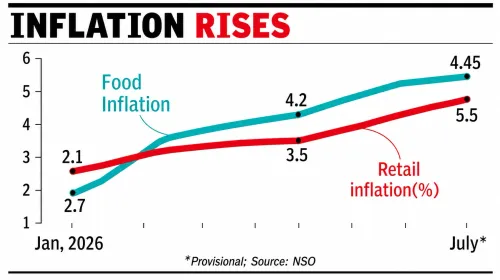
July's 4.45% CPI print was a 19-month high.
Food inflation reached 5.52%.
Vegetable prices have been particularly unruly, while June rainfall was 40% below its long-period average, and the cumulative monsoon deficit, though narrowing to around 11–12% by early August, has not completely disappeared.
Then there is oil.
Crude near $89 has pushed transport inflation to 4.43%, while the conflict involving the US and Iran has added another layer of uncertainty to energy costs.
But food and oil alone do not necessarily force the RBI into action.
The more important number for the rate outlook is core inflation.
Analyst estimates put core inflation at around 3.9% in July, still below 4%, which argues against assuming an immediate hike.
But if it crosses 4% as Morgan Stanley expects, while headline inflation is already above the RBI’s medium-term target, the policy conversation becomes considerably more difficult.
And the economy is hardly providing a reason to stimulate demand aggressively.
SBI Research estimates Q1 FY27 GDP growth at 8%, compared with the RBI’s 7% projection.
Of 50 leading indicators, 43, or 86%, showed acceleration.
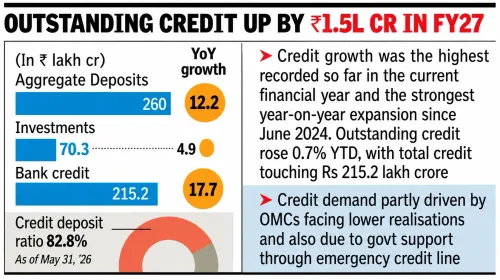
Credit growth is at 17.7%, while deposits are growing at 12.7%.
India is growing, credit is growing, and inflation is rising.
That is a rather different backdrop from the one in which the RBI began cutting rates.
The borrower feels all of this through one number
The EMI: Take a ₹50 lakh home loan over 20 years.
At an illustrative 9% interest rate, the EMI is about ₹44,986.
At 7.75%, reflecting the full 125-basis-point reduction, it falls to roughly ₹41,047.
This assumes the entire repo-rate reduction passes through to the loan rate, which not every borrower necessarily experienced.
That is a saving of around ₹3,939 a month, or ₹47,268 a year.
This explains why the 2025 cuts mattered; the relief was tangible.
Now consider the reverse.
If rates rise by 75 basis points, as Morgan Stanley forecasts, the illustrative loan rate moves from 7.75% to 8.50%.
The EMI rises from approximately ₹41,047 to ₹43,391.
Nearly ₹2,344 of the earlier monthly savings disappears.
There is another wrinkle.
External Benchmarks Lending Rate (EBLR)-linked floating-rate loans respond more directly to changes in the external benchmark, while older Marginal Cost of Funds-based Lending Rate (MCLR)-linked loans often saw slower and smaller transmission during the easing cycle.
EBLR-linked rates can reset within one to three months after a repo-rate change.
That creates a different kind of sensitivity.
EBLR-linked loans can transmit both rate cuts and hikes relatively quickly, while older MCLR-linked loans can take longer to reprice.
The borrower therefore feels the rate cycle with very different timing depending on when and how the loan was taken.
Which balance sheets can handle the turn?
Source: The Times of India
Banks enjoyed strong loan growth during the easing cycle.
Credit growth is now running at 17.7%.
But if borrowing costs rise, the market will have to look beyond loan growth and ask whether borrowers can continue servicing those loans comfortably.
For banks such as State Bank of India, HDFC Bank and ICICI Bank, the question for Q3 and Q4 FY27 is therefore two-sided.
Higher lending rates can support net interest margins, particularly after the margin compression created during the easing cycle.
But rising EMIs can test the quality of the retail loan book built when rates were lower.
The quality of growth becomes more important than the speed of growth.
NBFCs have a slightly different equation.
Those that locked in longer-term borrowing through bonds, NCDs or term loans at lower rates are better positioned if funding costs rise.
Those dependent more heavily on short-term wholesale funding face greater pressure.
That makes funding duration an important variable when looking at names such as Bajaj Finance and Shriram Finance.
The rate cycle does not make one category automatically attractive and another automatically unattractive.
It changes what investors need to look for.
Bonds have already started listening
The bond market tends to be less interested in waiting for the official announcement.
Government security yields reflect expectations around inflation, monetary policy, liquidity and borrowing.
RBI data showed the 6.94% government security maturing in 2036 yielding 6.7718% on 27 July, while the 364-day Treasury bill cut-off yield was 5.7650%.
If inflation expectations rise and markets begin pricing in a higher future repo rate, longer-duration bonds face pressure because yields and bond prices move in opposite directions.
Liquidity is another piece of the puzzle.
The special FCNR(B) swap facility had mobilised $52.3 billion by August 13, prompting the RBI to bring forward its closure to August 31.
That is a useful reminder that liquidity created through special measures is not necessarily permanent.
For bond investors, the important question is therefore not simply where the repo rate sits today, but what inflation, liquidity and future policy are being priced into yields.
The strange thing is how quickly the cycle could complete
This is perhaps the most interesting part of the entire story.
India started at a 6.50% repo rate in early 2025. It fell to 5.25%, and Morgan Stanley’s forecast takes it back to 6%.
So the potential path is:
6.50% → 5.25% → 6%
If that happens, India would move through a complete easing and partial tightening cycle in roughly two years.
The issue for investors is not whether rates eventually rise.
Rates rise and fall; that is what cycles do.
The issue is the shrinking window in which a particular rate regime can be treated as durable.
A borrower who took a floating-rate loan at the bottom of the cycle needs to think differently from one who locked in long-term funding.
A bank investor needs to watch both margins and asset quality.
An NBFC investor needs to understand how the company funds itself.
A bond investor needs to watch duration, yields, inflation expectations and liquidity.
The same repo rate is telling each of them a different story.
The market does not wait for the RBI
As things stand, there is no rate hike.
The RBI remains at 5.25%, its stance is neutral, and core inflation at 3.9% means the case for an immediate move is far from settled.
But the ingredients for a reversal are becoming harder to ignore.
Inflation has risen from 0.25% to 4.45%. Food inflation is above 5%.
Credit is expanding at nearly 18%. Q1 FY27 GDP growth is estimated at 8%.
And a major investment bank is forecasting 75 basis points of tightening from December.
That does not tell us exactly what the RBI will do, but it does tell us what investors should be watching.
The next inflation prints: core inflation, credit growth, borrower repayment behaviour, bank margins, NBFC funding costs, bond yields, and liquidity.
Because the real story is not that India is about to enter a rate-hike cycle.
Not yet.
It is that the gap between one rate regime and the next may be getting shorter.
And if the cycle really does run from 6.50% to 5.25% and back towards 6% in roughly two years, the most valuable financial skill may not be predicting the next rate move.
It may be recognising when the market has stopped behaving as though the current one will last.
Sources and References:
- SHRIRAMFINANCE
- INDIASEQUITY
- FORBESINDIA
- REUTERS
- BUSINESSSTANDARD
- BAJAJFINSERV
- FINANCIALEXPRESS
- INDIATIMES
- CNBCTV18
- FXSTREET
- FIRSTPOST
- LIVEMINT
- VENTURASECURITIES
- RBI
This article is for informational purposes only and does not constitute financial advice. It is not produced by the desk of the Kotak Securities Research Team, nor is it a report published by the Kotak Securities Research Team. The information presented is compiled from several secondary sources available on the internet and may change over time. Investors should conduct their own research and consult with financial professionals before making any investment decisions. The above images were generated using AI. Read the full disclaimer here.
Investments in securities market are subject to market risks, read all the related documents carefully before investing. Brokerage will not exceed SEBI prescribed limit. The securities are quoted as an example and not as a recommendation. SEBI Registration No-INZ000200137 Member Id NSE-08081; BSE-673; MSE-1024, MCX-56285, NCDEX-1262.
0 people liked this article.