The Viksit Bharat Arithmetic Nobody Is Discussing
- Posted: 14 Aug 2026, 4:43 PM IST
- | 4 min read
- 6,674
 Add Preferred News Source
There is a particular kind of optimism that comes with watching a country build itself.
A new road appears where there was once a bottleneck. A metro line changes the shape of a city.
A new factory, flyover, port: for a moment, the concrete walls feel like proof that the country is moving forward too.
India enters its 80th year with plenty of such evidence.
The economy continues to grow faster than most major economies.
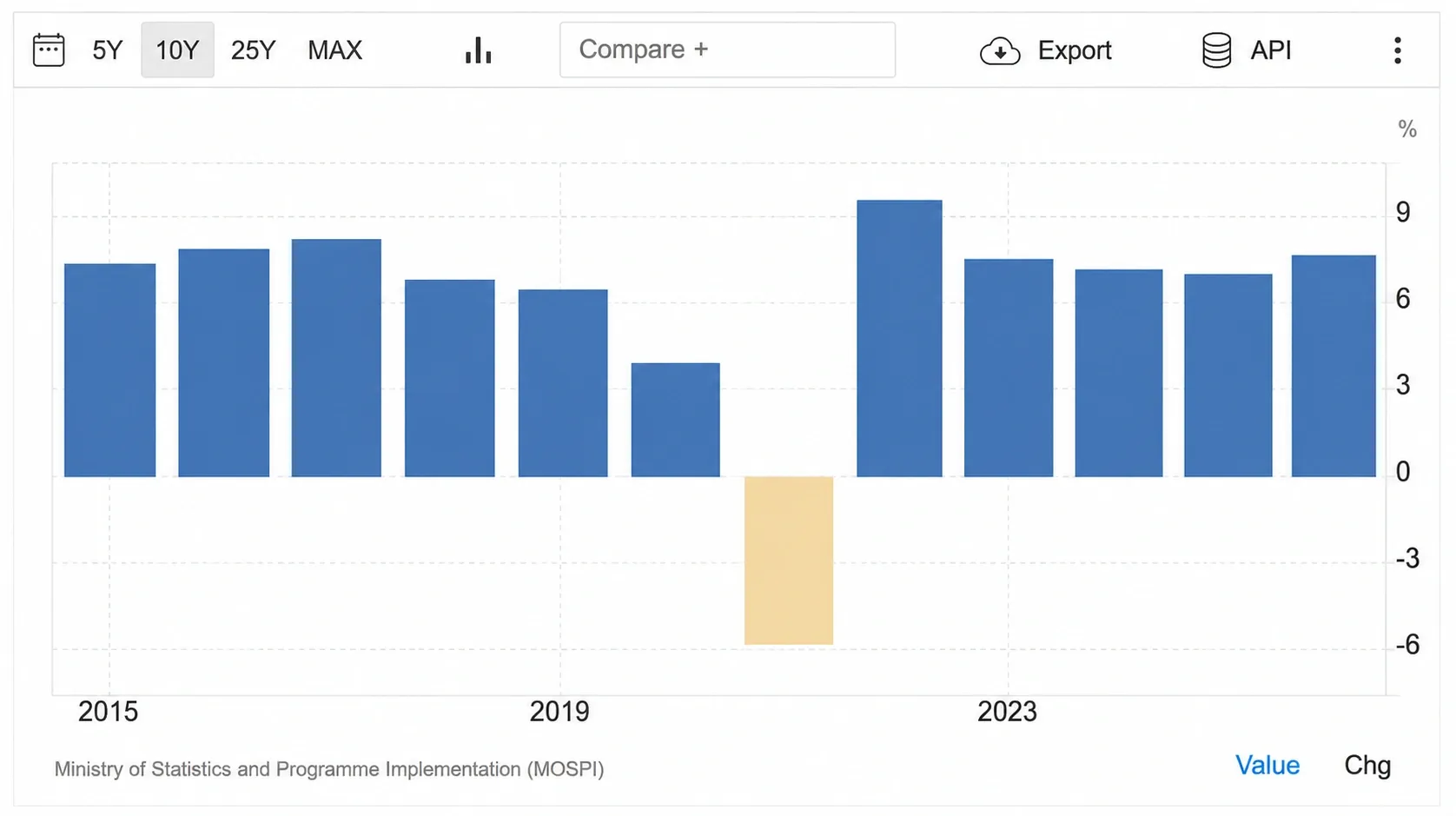
FY2025-26 real GDP growth reached 7.7%, the strongest expansion since the post-pandemic rebound in FY22.
Real GDP for the full year reached ₹323.12 lakh crore, while nominal GDP stood at ₹346.36 lakh crore.
All of that is real. And then comes the slightly less comfortable number.
Source: Trading Economics
Just over a week before Independence Day, NITI Aayog Vice-Chairman Ashok Lahiri put the arithmetic behind Viksit Bharat@2047 rather neatly: India’s per capita income, estimated at $2,813 in 2026, needs to reach about $18,000 by 2047.
That is a 6.4-fold increase in 21 years.
To get there, per-capita income needs to compound at roughly 9.25% in dollar terms every year for two decades.
No dramatic pause, no long detour, and no convenient decade in which the maths takes a holiday.
The target is not merely about making the economy bigger.
The broader Viksit Bharat vision includes better living standards, human capital, infrastructure, technology, governance and more inclusive growth.
But income is where the arithmetic becomes impossible to ignore.
India has 21 years.
One strong year is useful. Twenty-one years is the assignment.
India has already shown it can grow quickly.
The real test is whether it can sustain that pace long enough to turn headline growth into a meaningful rise in income for every Indian.
Richer, but not rich
Source: The World Bank
The past two years have been unusually favourable for gold lenders.
Rising collateral values helped drive reported AUM growth even when the quantity of pledged gold changed very little.
The next phase could look different.
If collateral values stop doing the heavy lifting, lenders will need growth from new customers and additional gold pledged.
That makes operating metrics far more important than headline AUM.
For investors, three operating metrics deserve closer attention than headline loan book growth: active customer additions, gold tonnage under pledge, and average ticket size.
Together, they reveal whether growth is being driven by fresh lending activity or simply by larger loans against existing collateral.
Gold loan portfolios also behave differently from most retail lending because they are short-tenure products, frequently renewed or repaid.
That allows portfolios to reprice relatively quickly, keeping credit risk low but making reported AUM unusually sensitive to shifts in collateral values.
The effects extend across the gold ecosystem.
Specialised lenders such as Muthoot Finance and Manappuram Finance, diversified lenders like IIFL Finance, and banks such as CSB Bank sit on the lending side.
Jewellery retailers such as Titan Company and Kalyan Jewellers operate on the demand side.
A meaningful rise in auctioned collateral can influence the supply of second-hand gold, linking both sides of the industry through a single commodity.
The World Bank offers an interesting reality check.
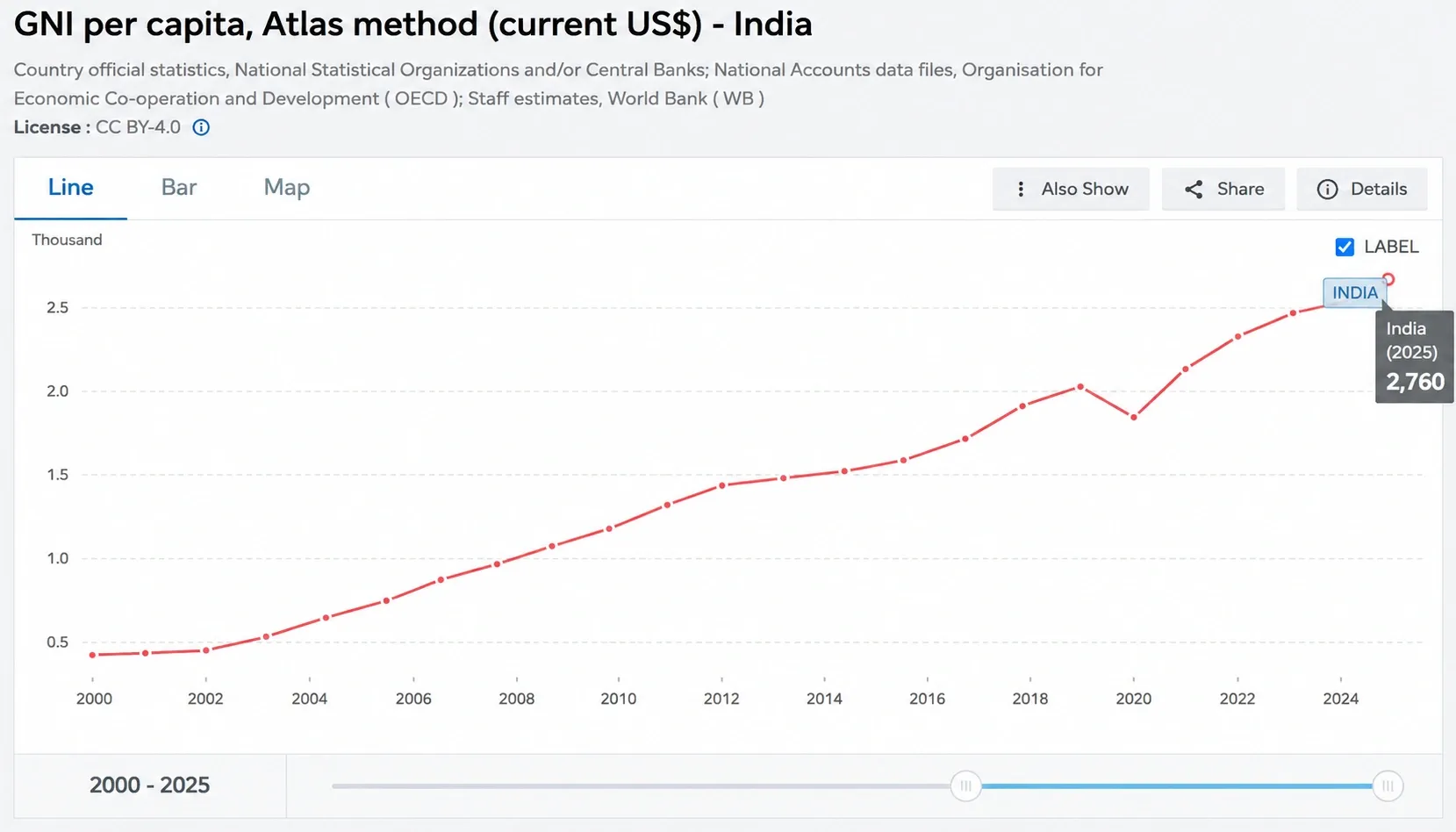
For FY2027, based on 2025 GNI per capita, India remains a lower-middle-income economy at $2,760 per person.
The lower-middle-income band extends to $4,635.
The upper-middle-income range runs from $4,636 to $14,375.
Above that sits the current high-income threshold.
So the journey to $18,000 has a few gates along the way.
India first has to cross into upper-middle-income territory, then cross today’s high-income threshold, and then go beyond it.
The $18,000 target is about 25% above the current high-income threshold.
There is a small but important footnote here.
The World Bank revises these thresholds every year, so today’s classifications will not necessarily be the ones India encounters in 2047.
Still, the broad point survives the accounting changes.
India’s aggregate economy is already enormous; its income per person is not.
That explains the strange feeling of watching an economy modernise at speed while the country remains officially lower-middle income.
One household may be discussing a home loan, investing through the markets and using digital financial services.
At the same time, the national average is still a long way from the income levels associated with developed economies.
Both realities can exist at the same time.
Fast is not the same as enough
The RBI’s August 2026 policy review makes the distinction even sharper.
The central bank kept the repo rate at 5.25% and projected FY2026-27 real GDP growth at 6.7%, with inflation forecast at 5%.
That is a substantial rate of growth. It is also not the same thing as 9.25%.
The distinction matters. Lahiri's 9.25% is the annual nominal compounding rate required for per-capita income to move from $2,813 to about $18,000 over 21 years.
The RBI's 6.7% is real GDP growth, which measures aggregate output after stripping out price changes, not income per person.
India does not need to grow at 9.25% in real terms every year.
But it does need per-capita income, measured in dollars, to compound at roughly that pace for 21 consecutive years.
Because the target is denominated in dollars, exchange-rate movements matter too.
The missing ingredient is capital
This is where the arithmetic starts to matter for investors.
Lahiri’s argument points towards investment, and particularly the amount of capital India puts into expanding its productive capacity.
India’s gross fixed capital formation (GFCF) remained below 30% of GDP for much of the period under discussion.
GFCF is broadly the amount invested in fixed assets such as buildings, machinery and infrastructure.
Several East Asian economies, including Japan, South Korea, Taiwan, Hong Kong, Singapore and China, sustained investment levels of 35% or more during their high-growth transitions.
But the latest national accounts change the comparison slightly.
Under the revised GDP series, GFCF was about 32% of GDP in FY2025-26.
The gap has narrowed, but it has not closed.
Smaller, certainly; still important.
Because three percentage points of GDP invested differently over a long period can become a rather large number.
And this is not simply a question of how much gets invested.
It is about what gets built with the money, how productive it becomes and who ultimately earns from it.
Public capex cannot do it alone
India’s public investment push has been substantial.
The Union Budget has provided for ₹12.2 lakh crore of central government capital expenditure in FY2026-27.
SBI Research estimates that when grants for asset creation and CPSE capital spending are included, effective public-sector capex could approach ₹20 lakh crore, or around 5.5% of GDP.
Roads, railways, ports, power networks, urban infrastructure and logistics are not particularly glamorous things to discuss over dinner.
They are, however, the plumbing of economic growth.
They reduce the cost of doing business and create the conditions in which private capital can move.
But there is a limit to how far the government can carry the investment cycle.
At some point, companies have to put their own money behind factories, machinery and technology because they believe the demand will be there and the returns will justify it.
That handover is still incomplete.
Private corporate investment has remained around 12% of GDP for more than a decade.
Its share of total GFCF fell to 34.4% in FY2023-24, the lowest since 2011-12.
There are encouraging signs.
Nearly 2,000 listed non-financial companies increased capex by 11% to ₹9.4 lakh crore in FY2024-25.
Capacity utilisation reached 74.3% in Q2 FY2025-26, although that was below the 77.7% recorded in Q4 FY2024-25. So, corporate investment is moving.
The question is whether it is moving broadly enough.
The savings sitting in the room
There is another piece of the arithmetic that is easy to miss when everyone is busy discussing factories. Savings.
Lahiri noted that India’s savings rate had fallen to 29% in 2020 before recovering to around 35% in 2025. It still remained 10-15 percentage points below China’s.
That creates a rather simple equation. India needs to save more.
Those savings need to find productive investment.
That investment needs to generate productivity.
And productivity needs to translate into better incomes and more jobs.
Break any link in that chain and the arithmetic becomes less impressive.
A country can accumulate financial assets without creating enough productive capacity.
It can invest heavily without generating adequate productivity.
It can grow GDP without creating enough employment for the benefits to spread widely.
Which is why Viksit Bharat is ultimately less about one spectacular GDP number and more about the quality of the compounding underneath it.
The young country problem
There is a useful advantage sitting in India’s demographics.
Nearly 65% of the population is below 35, according to government estimates.
Lahiri’s long-term priorities include education, health, infrastructure and entrepreneurship, alongside administrative reform, law and order and faster justice.
That list may look less exciting than a new GDP forecast.
For the 2047 arithmetic, it may be considerably more important.
A young population becomes an economic advantage only when enough people have the skills, health and opportunities to participate productively.
Otherwise, demographics are simply a very large number of people.
Where the next rupee matters
This is where the Viksit Bharat agenda starts to matter for investors.
The target is not a 2047 stock-market forecast.
It is a way of asking where India’s capital has to go if the arithmetic is going to work.
Infrastructure still needs roads, railways, ports, logistics and urban systems.
Manufacturing needs deeper domestic supply chains, not merely final assembly.
Energy needs generation, transmission, storage and reliable distribution.
Digital infrastructure needs to move beyond inclusion towards productivity.
Education and healthcare need investment that improves the quality of the workforce.
These are not five-year themes neatly packaged into a quarterly trade.
They are the physical and human infrastructure of a much larger economy.
For equity investors, that distinction matters.
The investment cycle runs through capital goods, engineering, infrastructure, power, banks and increasingly deeper manufacturing supply chains.
These are not necessarily sectors that must outperform.
They are simply close to the physical and financial infrastructure India needs to build if the arithmetic is to work.
The point is that they become increasingly relevant if the economy is actually going to close the distance between today’s income and Lahiri’s target.
Where the numbers meet
The most useful number to watch may therefore not be GDP growth; it may be the investment rate.
The Viksit Bharat arithmetic currently looks something like this:
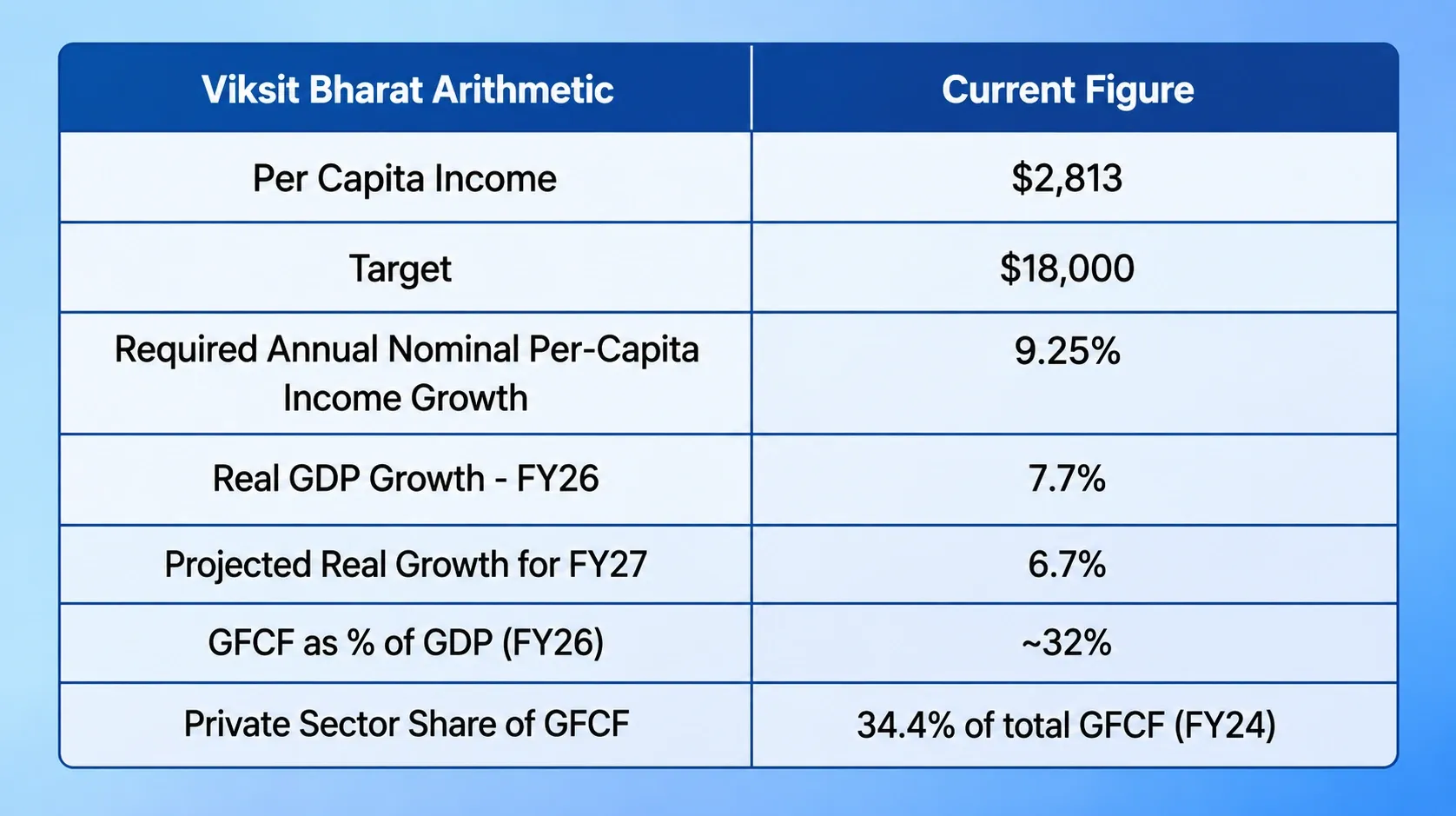
Each number tells part of the story; together they ask a much harder question.
Can India turn today’s 7-8% real growth into a sufficiently high and stable nominal growth path while simultaneously increasing investment, productivity, employment and incomes across more than 1.4 billion people?
That is one way to look at Viksit Bharat through an investor’s lens.
Not which stock wins next quarter, or whether the market celebrates Independence Day at a new high.
It is on whether India is building enough productive capacity to sustain growth and keep compounding for the next two decades.
India enters this stretch with several conditions in its favour.
Corporate balance sheets are healthier, investment is picking up, public capex remains substantial, and the demographic window is still open.
The distance, however, remains enormous.
Both realities can exist at once.
India has never looked more capable of making the journey, yet the arithmetic has never made the distance more visible.
And perhaps that is the defining tension of India’s 80th year: the country has the capacity to attempt the leap, but 21 years leaves little room for the arithmetic to go wrong.
Sources and References:
-
MOSPI -
THEPRINT -
TRADINGECONOMICS -
BUSINESSSTANDARD -
WORLDBANK -
OURWORLDINDATA -
REUTERS -
EY -
ECONOMICTIMES - INDIANEXPRESS
- FINANCIALEXPRESS
- PIB
This article is for informational purposes only and does not constitute financial advice. It is not produced by the desk of the Kotak Securities Research Team, nor is it a report published by the Kotak Securities Research Team. The information presented is compiled from several secondary sources available on the internet and may change over time. Investors should conduct their own research and consult with financial professionals before making any investment decisions. The above images were generated using AI. Read the full disclaimer here.
Investments in securities market are subject to market risks, read all the related documents carefully before investing. Brokerage will not exceed SEBI prescribed limit. The securities are quoted as an example and not as a recommendation. SEBI Registration No-INZ000200137 Member Id NSE-08081; BSE-673; MSE-1024, MCX-56285, NCDEX-1262.
0 people liked this article.