India Built a Stock Index on Ahimsa
- Updated: 17 Jul 2026, 1:28 PM IST
- | 6 min read
- 9,044
 Add Preferred News Source
Turn over almost any packet in an Indian kitchen, and there is a small square in the corner.
A green dot, or a brown one.
Nobody taught us to read it. We simply do.
It sits below the price, below the ingredients, and for a great many households it is the first thing the eye finds and the last word on whether the packet goes into the trolley.
It is a strange little piece of infrastructure.
A regulator specified the size of the dot and the colour of the dot.
They did not decide what the household does about it.
Something similar has just arrived on the stock exchange.
For years, global investing has quietly asked companies questions that have nothing to do with earnings.
How much carbon do you emit? How diverse is your board? How do you treat employees? How transparent is your governance?
ESG investing made ethics part of finance long ago, packaging those questions inside globally recognised frameworks and ratings produced by firms such as MSCI and Sustainalytics.
India has now decided to ask an entirely different question.
Not whether a company emits carbon or whether it has independent directors.
But whether its business aligns with the principle of Ahimsa.
Somewhere between philosophy and portfolio construction, that is quite a leap.
NSE Indices has launched the Nifty500 Ahimsa Index, developed with the Ahimsagain Foundation using its proprietary Ahimsa Investment Movement (AIM) framework.
Launched on 10 July, it classifies companies from the Nifty 500 universe into Green, Orange and Red bands according to whether their businesses involve harm to animals.
Only Green-band companies qualify for inclusion.
Almost simultaneously, BSE Index Services introduced the BSE Saatvik 100, another values-based benchmark inspired by principles of purity.
Two exchanges, two indices, two Indian philosophical ideas, launched within weeks of each other, feel less like a coincidence and more like the beginning of a new investing conversation.
India’s New Investing Vocabulary
India is not inventing values-based investing; it is giving it a distinctly Indian vocabulary.
Islamic finance has existed for decades, with Shariah-compliant indices excluding businesses involved in alcohol, gambling, conventional banking and other prohibited activities.
Catholic investment funds apply their own ethical filters.
Across the world, a substantial pool of capital already tracks indices screened using religious or moral principles. India has had one for years: the Nifty Shariah 25 sits quietly in the same index family as the Nifty 50.
Instead of importing another global ESG framework, India’s exchanges are building benchmarks rooted in Ahimsa and Saatvik philosophy.
That changes what an index represents.
It is no longer merely about measuring financial performance.
It is expressing a cultural view of which businesses deserve representation.
Today’s niche benchmark could become tomorrow’s ETF.
Most thematic investing trends have followed exactly that path, with the index arriving long before meaningful capital does.
Who Gets to Define ‘Ethical’?
The more intriguing question is not which companies made the index.
It is: Who decides the rules?
Most ESG benchmarks rely on methodologies developed by globally recognised rating agencies.
Investors may disagree with the scores, but they broadly understand who is doing the scoring and the factors being assessed.
The Nifty500 Ahimsa Index works differently.
The NSE has not developed its own ethical framework.
It has partnered with the Ahimsagain Foundation, whose proprietary AIM methodology classifies companies into Green, Orange and Red categories.
The exchange provides the infrastructure, index calculation, free-float market-cap weighting, semi-annual rebalancing and investable framework.
The ethical classification itself comes from a private foundation.
Today, that distinction feels academic because, at the time of writing, no ETF tracks the Nifty500 Ahimsa Index.
But if asset management companies eventually launch passive products linked to it, those classifications could begin influencing where fresh capital flows.
That is a significant responsibility for a framework whose detailed methodology remains proprietary.
SEBI Regulates the Index. Not the Philosophy.
The distinction becomes even more interesting when regulation enters the picture.
India’s index providers operate within SEBI’s framework governing benchmark administration, transparency, governance, periodic reviews and index dissemination.
The mechanics of how an index is built and maintained are regulated.
The philosophy behind the screening is not.
SEBI does not define concepts such as Ahimsa and Saatvik.
In the case of the Nifty500 Ahimsa Index, the exchange has partnered with an external organisation that applies its own proprietary screening methodology before the index construction process begins.
In other words, the benchmark operates under regulatory oversight, while the ethical framework determining eligibility remains privately developed.
It is an unusual separation.
The rules governing the index are regulated, but the values governing who enters it are not.
As values-based investing expands and passive products eventually emerge, that distinction could become just as important as the index methodology itself.
When an Index Starts Moving Money
One misconception about stock indices is that they merely describe markets.
Increasingly, they shape them.
Passive investing has changed the relationship between a benchmark and the money that follows it.
Once an ETF tracks an index, every included company picks up a steady source of buying demand.
Every excluded one loses it.
The index effectively makes the investment decision before the investor does.
Mechanically, the Nifty500 Ahimsa Index looks like any other benchmark.
It has a base date of 1 April 2016, a base value of 1,000, 326 constituents.
It follows free-float market capitalisation weighting and undergoes semi-annual review.
Philosophically, it asks a different first question.
Not whether a company is larger, more liquid or financially stronger.
But whether the business belongs inside a particular moral framework.
Everything else follows from there.
Consider a dairy company, a leather exporter or a pharmaceutical business that relies on animal testing during parts of its research.
None of them suddenly earns less because a new benchmark exists.
Factories keep operating, customers keep buying, earnings keep arriving.
Yet they could find themselves outside an expanding pool of passive capital.
Because the Ahimsa framework does not measure financial performance.
It classifies businesses by whether their activities involve harm to animals, and only Green-band companies qualify.
The methodology behind those classifications remains proprietary.
Investors understand the broad philosophy.
But not every factor used to evaluate companies, or the precise thresholds that decide where they land.
Nor has a public appeals process been described in the material released so far.
At the time of writing, none of this directs a single rupee, because no ETF tracks the index yet.
But history suggests indices rarely remain "just indices" for long.
Every investable benchmark carries the possibility of becoming an investment product.
If one is launched here, every rupee entering that fund would flow into Green-band companies alone.
Orange and Red would not signal weak businesses or weak financial performance.
They would simply sit outside one particular stream of passive money.
At that point the framework moves beyond philosophy and becomes a mechanism for capital allocation.
Which is why index methodologies deserve almost as much attention as company fundamentals.
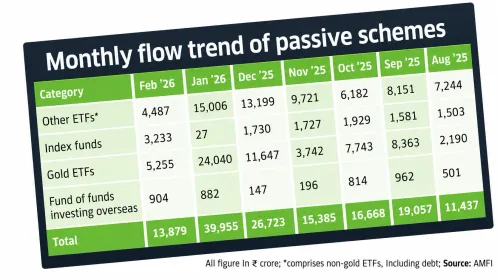
Source: AMFI (via The Economic Times)
Where the Screen Bites
The launch of the index is unlikely to have any immediate impact on listed companies.
The longer-term implications are more interesting.
The classifications are most consequential where a business model sits close to the line: dairy, poultry, leather, meat-adjacent consumer products, research that involves animal testing. Not because those businesses change, but because the band they land in does the deciding for them.
The exercise is not about predicting winners or losers.
It is about understanding how a new screening philosophy interacts with existing business models.
Whether future versions of these indices expand their coverage, refine their methodologies or disclose more about their classification process is the thread worth following.
Alongside ESG benchmarks and the recently introduced BSE Saatvik 100, the Nifty500 Ahimsa Index suggests India’s exchanges are increasingly competing through specialised investment themes rather than only broad market benchmarks.
The Structural Shift
It would be easy to dismiss this as clever branding.
A philosophy-inspired index, an interesting launch, or perhaps even a niche product.
That would probably miss the bigger picture.
Markets have always reflected society’s priorities.
First came the balance sheet, then governance, then sustainability, and now values themselves are becoming investable themes.
Whether one agrees with these frameworks is almost beside the point.
The more important development is that index providers are becoming more than compilers of market data.
By deciding which companies qualify for specialised benchmarks, they are increasingly influencing how future passive capital may be distributed across sectors.
The Nifty500 Ahimsa Index is unlikely to move share prices tomorrow morning.
The more meaningful milestones lie ahead: whether ETFs emerge, how companies are ultimately classified, and whether values-based benchmarks become a larger part of India’s passive investing landscape.
The real shift is not that markets have discovered ethics.
It is that ethics may increasingly determine where capital goes.
Sources and References:
- FREEPRESSJOURNAL
- LIVEMINT
- LSEG
- EPWORTHIM
- 5PAISA
- LIVEMINT
- AIMOFINDIA
- MILLENNIUMPOST
- ECONOMICTIMES
This article is for informational purposes only and does not constitute financial advice. It is not produced by the desk of the Kotak Securities Research Team, nor is it a report published by the Kotak Securities Research Team. The information presented is compiled from several secondary sources available on the internet and may change over time. Investors should conduct their own research and consult with financial professionals before making any investment decisions. The banner image was generated using AI. Read the full disclaimer here.
Investments in securities market are subject to market risks, read all the related documents carefully before investing. Brokerage will not exceed SEBI prescribed limit. The securities are quoted as an example and not as a recommendation. SEBI Registration No-INZ000200137 Member Id NSE-08081; BSE-673; MSE-1024, MCX-56285, NCDEX-1262.
0 people liked this article.

Kotak Neo (Kotak Neo) is India's venerable stockbroking company with a rich legacy. It offers comprehensive investment services across asset classes, prioritising a technology-first approach for a seamless experience. Trusted by 5 million+ customers, it guides you toward financial success with ease of investment and speed of trade.
Note: The opinions expressed in this blog are personal viewpoints and should not be construed as recommendations.