The Peace That Hasn’t Reached Your Pump
- Posted: 25 Jun 2026, 2:06 PM IST
- | 9 min read
- 1,934
 Add Preferred News Source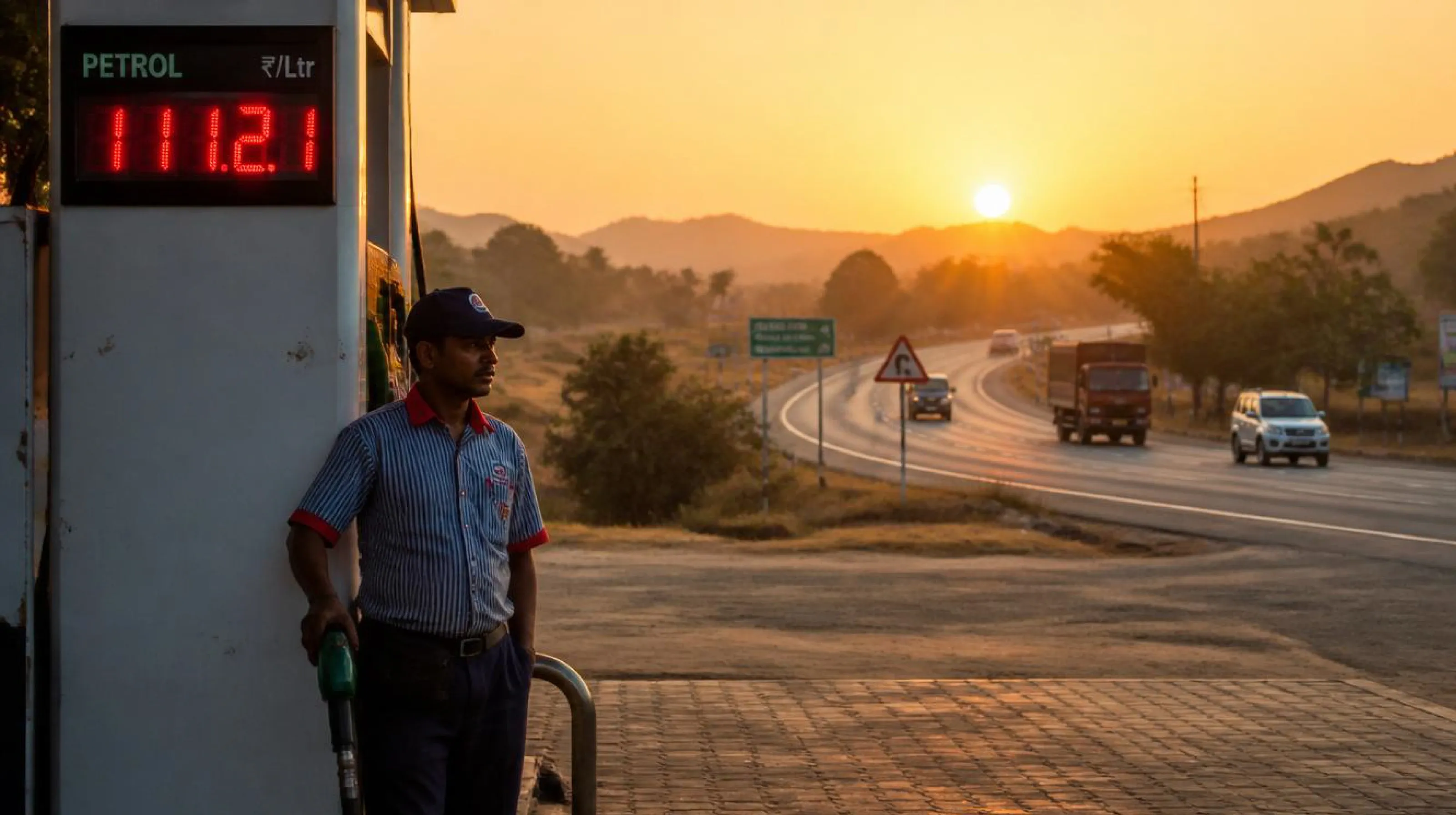
An oil barrel goes through a long journey.
It begins in a headline.
One day, Brent crude is climbing as tensions rise in the Middle East.
A few days later, a peace agreement brings prices down and markets breathe easier.
Then the barrel starts travelling through commodity markets, currency desks, refinery balance sheets, government calculations and central bank forecasts.
And it finally reaches the place where most people notice it.
The petrol pump.
The journey sounds straightforward. It rarely is.
India has just watched a major geopolitical risk evaporate almost overnight.
The US-Iran agreement signed in Switzerland has brought crude prices down, strengthened the rupee and eased some of the fears that had dominated financial markets for months.
Yet anyone expecting an instant reward at the fuel station may be disappointed.
Because in economics, bad news travels like a sports bike.
Good news prefers the scenic route.
The War Ended Faster Than The Bill
Markets reacted almost instantly.
Brent crude fell roughly 4% to around $83 per barrel.
West Texas Intermediate (WTI) slipped below $81, both reaching their lowest levels since
March as traders stripped away the geopolitical premium that had accumulated during months of uncertainty around the Strait of Hormuz.
Following the announcement of the US-Iran peace deal on 15 June 2026, the rupee extended its rally, touching an intra-day high of 94.95 against the US dollar and marking its fifth straight session of gains.
For a country that imports more than 85% of its crude oil requirements, those are not trivial moves.
Every meaningful decline in crude prices improves India’s arithmetic.
The current account looks healthier.
The pressure on the rupee eases.
Inflation forecasts become slightly less intimidating.
Government officials breathe a little easier.
The relief is real.
What’s fascinating is how quickly markets receive the benefit and how slowly households do.
The stock market gets the good news first. The fuel pump gets it later.
The EMI gets it even later.
That difference in timing is often overlooked.
Markets react to expectations. Households live with outcomes.
The distance between the two is sometimes measured in months.
Three Months Of Anxiety Don’t Disappear In Three Days
It is easy to forget how different the mood looked just a few months ago.
India entered 2026 in reasonably comfortable shape.
Inflation had moderated significantly from earlier peaks.
Growth remained resilient.
The RBI had already delivered 125 basis points of rate cuts across 2025 and into early 2026, and there was growing expectation that more easing would follow.
Then the conflict arrived, and the picture changed.
Energy costs surged. Supply concerns intensified, and forecasts for the balance of payments deteriorated.
Suddenly, a conflict thousands of kilometres away was dictating conversations inside
Indian boardrooms and policy meetings.
The impact showed up in places that consumers could actually feel.
Fuel prices told the same story.
State-owned oil marketing companies implemented four petrol and diesel price increases between mid-May and late May, the first such revisions in four years.
LPG prices were raised by another ₹29 per cylinder in early June.
By the time peace negotiations gained momentum, households had already absorbed a meaningful portion of the shock.
The war may have ended in Switzerland, but the bill had already arrived in India.
Why The Pump Hasn’t Got The Memo Yet
One of the most misunderstood aspects of oil markets is the assumption that lower crude automatically translates into lower petrol prices.
That is not how the system works.
As of 15 June, petrol under-recoveries for oil marketing companies had fallen to roughly ₹3 per litre.
A week earlier, the figure was around ₹6.
At the peak of the conflict in April, it had approached ₹24 per litre.
That is a remarkable improvement in a relatively short period.
Yet fuel prices remain where they are.
Part of the reason is inventory.
Think of it like a retailer holding old stock.
If a clothing store bought shirts at ₹1,000 each, it cannot suddenly sell them as though they were purchased at ₹700 simply because wholesale prices have fallen.
Refineries work in a similar way.
Much of today's fuel was refined from crude purchased weeks earlier at higher prices.
The benefit of lower crude reaches consumers only after that inventory gradually works its way through the system.
Refineries continue selling products produced from crude purchased weeks earlier at significantly higher prices.
Immediate price reductions would squeeze margins before lower-cost inventory has fully entered the distribution system.
Part of the reason is institutional memory.
Companies such as Indian Oil Corporation, Bharat Petroleum Corporation and Hindustan Petroleum Corporation spent months absorbing margin pressure while crude prices surged and retail price adjustments lagged.
When crude falls, there is naturally an incentive to rebuild profitability before rushing to pass the benefit on.
We have seen this before.
Oil prices rise quickly; retail prices eventually follow.
Oil prices fall, retail prices respond more slowly.
Not because anyone is breaking the rules, but because the architecture itself creates these delays.
The peace agreement reduced pressure. It did not eliminate it.
The RBI Is Still Waiting For Proof
Financial markets and central banks often respond to the same event on very different timelines.
Markets ask what could happen next. Central banks ask what has already happened. Investors can price future peace in a single afternoon.
Policymakers need inflation data, supply chain evidence and confirmation that lower oil prices are actually feeding through the economy before they change course.
That difference in clock speed matters enormously right now.
Markets may already have moved on from the peace agreement. The RBI has not.
The June Monetary Policy Committee meeting ended with the repo rate unchanged at 5.25%, marking the third consecutive policy review without a move.
The decision reflected a simple reality.
The RBI could see inflation risks emerging from higher energy costs and disrupted supply chains, even as domestic growth remained relatively resilient.
The next MPC meeting is scheduled for 3-5 August 2026.
That date matters more than many investors probably realise.
Between now and then, policymakers will receive additional inflation prints, fresh crude- price data, and evidence on whether the US-Iran peace framework actually holds together.
The agreement remains a memorandum rather than a final settlement, and critical questions surrounding Iran’s nuclear programme and regional security arrangements remain unresolved.
Central bankers do not cut rates because diplomats shake hands.
They cut rates when the data allows them to.
Which means the August meeting is becoming one of the most important dates on the macroeconomic calendar.
Not because of what happened in Switzerland, but because of what the data says about Switzerland’s aftermath.
The Peace Dividend Travels In Stages
Investors often talk about the “peace dividend” as though it arrives all at once. It does not.
It travels through the economy in layers.
The first beneficiaries are usually businesses closest to the commodity itself.
Oil marketing companies see under-recoveries shrink.
Refining margins improve; profitability stabilises.
The aviation sector often follows quickly because aviation turbine fuel accounts for roughly 35% to 45% of airline operating costs.
Sustained declines in oil prices can therefore have a meaningful impact on earnings. After that, the effects become slower and more dispersed.
Transportation costs begin easing.
This is where the story becomes harder to notice.
No single truck journey becomes dramatically cheaper.
No single grocery bill suddenly collapses.
Instead, small cost reductions begin appearing across thousands of individual transactions.
Over time, those incremental changes influence inflation far more than any single headline announcement.
And manufacturers eventually start seeing lower input costs.
Food logistics become less expensive, and inflation pressures gradually moderate.
Only after those things happen does the household begin noticing meaningful change.
The sequence matters because investors often assume that lower oil prices automatically create a consumer recovery.
In reality, there is a lag between cheaper crude and stronger consumption.
The chain runs through inflation first, then purchasing power, then spending, and then earnings.
Beneath the Relief Rally
The most interesting investment story here may not be oil at all; it may be interest rates.
The conflict interrupted an easing cycle that was already underway.
The RBI had delivered 125 basis points of cuts before geopolitical risks forced a pause.
If lower crude prices remain durable and inflation pressures continue to soften, August could become the meeting where that pause finally ends.
If that happens, the effects could ripple through housing finance, auto lending, MSME credit and banking far more quickly than many expect.
The reason is simple.
This would not be a brand-new easing cycle.
It would be the resumption of one that was already in motion.
Lower borrowing costs tend to influence decisions across housing, automobile purchases and small-business financing.
If the easing cycle resumes, those effects may gradually become visible across parts of the economy that have little direct connection to crude oil itself.
That possibility is still several steps away.
But markets tend to price possibilities before households experience them.
Which brings us back to the petrol pump.
The war is over. Oil prices are lower. The rupee is stronger. Markets have already reflected much of that relief.
Households are still waiting.
That is often how economic recoveries work. Pain tends to arrive all at once.
Relief travels through a chain of inventories, balance sheets, policy decisions and consumer behaviour before it becomes visible in everyday life.
The next time fuel prices remain unchanged despite falling crude, it is worth remembering that oil travels through a long system before it reaches the pump.
Markets react in minutes. Inflation responds in months. Households often wait the longest.
The peace dividend is real. It just hasn't completed its journey yet.
Sources and References:
- THEGUARDIAN
- FINANCIALEXPRESS
- THEHINDUBUSINESSLINE
- CNBC
- REUTERS
- THEHINDU
- BUSINESSSTANDARD
- LIVEMINT
- PIB
This article is for informational purposes only and does not constitute financial advice. It is not produced by the desk of the Kotak Securities Research Team, nor is it a report published by the Kotak Securities Research Team. The information presented is compiled from several secondary sources available on the internet and may change over time. Investors should conduct their own research and consult with financial professionals before making any investment decisions. The above images were generated using AI. Read the full disclaimer here.
Investments in securities market are subject to market risks, read all the related documents carefully before investing. Brokerage will not exceed SEBI prescribed limit. The securities are quoted as an example and not as a recommendation. SEBI Registration No-INZ000200137 Member Id NSE-08081; BSE-673; MSE-1024, MCX-56285, NCDEX-1262.
0 people liked this article.

Kotak Neo (Kotak Neo) is India's venerable stockbroking company with a rich legacy. It offers comprehensive investment services across asset classes, prioritising a technology-first approach for a seamless experience. Trusted by 5 million+ customers, it guides you toward financial success with ease of investment and speed of trade.
Note: The opinions expressed in this blog are personal viewpoints and should not be construed as recommendations.