The Cost Of A Shirt Beyond The Factory Gate
- Updated: 19 Jun 2026, 6:28 PM IST
- | 10 min read
- 11,036
 Add Preferred News Source
Pick up a cotton shirt this weekend and it is easy to think of it as a finished product.
In reality, it is the final stop in a remarkably long journey.
The cotton may have been bought months earlier.
The yarn spun weeks before that.
Export orders may have been negotiated long before the shirt was stitched.
By the time it reaches a store shelf, dozens of decisions across farms, factories, ports and governments have already shaped its price.
Which is what makes the past fortnight so interesting for India's textile industry.
Within three days, two developments arrived from opposite directions.
One made cotton cheaper for Indian manufacturers.
The other threatened to make finished garments more expensive for buyers in India's largest export market.
Together, they reveal an uncomfortable reality about modern manufacturing.
Making a product competitive is one challenge.
Selling it in a changing global market is another.
On 30 May, the government announced that cotton imports would enter India duty-free between 1 June and 31 October 2026.
The decision removed the full 11% levy comprising basic customs duty and the Agriculture Infrastructure and Development Cess.
For an industry that had just watched domestic cotton prices rise by 11-15%, the move was welcomed almost immediately.
Then, just three days later, the United States Trade Representative released its Section 301 findings and proposed an additional 12.5% tariff on imports from 60 economies, including India, over concerns related to forced-labour enforcement.
Most headlines treated these as unrelated developments.
One was framed as good news for manufacturers.
The other was presented as a potential challenge for exporters.
India has become increasingly effective at fixing problems inside the factory gate.
It can reduce input costs, remove duties and improve domestic competitiveness with relative speed.
What it cannot control is what happens when those products reach foreign borders.
The gap between those two realities may ultimately determine whether India’s textile ambitions reach their destination.
Cotton duty removed | Additional US tariff proposed |
Input costs may fall | Export costs may rise |
Policy action was immediate | Outcome remains uncertain |
India controls this | India cannot fully control this |
India Solved A Cotton Problem
Cotton remains the foundation of India’s textile value chain.
It moves through yarn manufacturers, fabric producers, garment makers and exporters before eventually finding its way into wardrobes around the world.
When cotton becomes expensive, the pressure spreads quickly through the entire ecosystem.
That pressure had become increasingly visible.
The Cotton Association of India estimated that domestic cotton prices rose between 11% and 15% in the period leading up to the waiver.
Mills were facing rising input costs while competing against manufacturers in countries such as Bangladesh and Vietnam, both of which enjoy easier access to imported cotton.
The government’s response was straightforward: remove the duty.
The logic behind the decision becomes clearer when one looks at the production numbers.
According to the USDA’s 2026 cotton outlook, India’s cotton production for 2026-27 is expected to reach around 25.2 million 480-pound bales.
Mill consumption, meanwhile, is expected to be roughly 25.8 million bales.
Domestic demand therefore exceeds domestic supply, meaning imports are not merely useful.
They are structurally necessary.
Taxing imported cotton under those circumstances is effectively taxing the competitiveness of the textile sector itself.
The waiver addresses that problem directly.
It lowers costs for spinning mills, improves access to raw materials and provides immediate relief to a value chain that had been feeling squeezed.
If the story had ended there, the industry would have had little reason to complain, but global trade rarely allows stories to end so neatly.
The Market That India Cannot Control
Just as the industry was digesting cheaper cotton, another development arrived from Washington.
The USTR’s Section 301 findings covered 60 economies and concluded that 54 had failed to adequately prohibit or enforce restrictions on imports produced through forced labour.
India falls within the group facing a proposed additional tariff of 12.5%.
The proposal remains exactly that, a proposal.
Public comments are open until 6 July 2026, and hearings are scheduled for 7 July.
There is also a textile-specific mechanism within the proposal that could potentially reduce the impact on certain apparel categories and volumes.
India’s final position under that framework remains uncertain.
Yet uncertainty itself carries consequences.
The United States accounts for 28.97% of India’s textile and apparel exports, making it by far the country’s most important export destination.
When nearly one-third of export demand comes from a single market, any discussion about tariffs quickly becomes more than a trade-policy issue.
It becomes an earnings issue; it becomes an investment issue.
And it becomes a question about whether domestic competitiveness alone is enough.
The arithmetic is particularly revealing. India removed an 11% burden on imported cotton.
The United States proposed a 12.5% burden on finished exports.
The two are not directly comparable because cotton represents only one component of a garment’s total cost structure, whereas a tariff applies to the value of the finished product itself.
A reduction in raw-material costs helps.
A border tariff affects the final selling price.
The industry saved money on the thread; it may end up paying more on the shirt.
A shirt's economics are increasingly determined in multiple places at once.
Part of the story unfolds in cotton markets.
Another part unfolds at customs desks thousands of kilometres away.
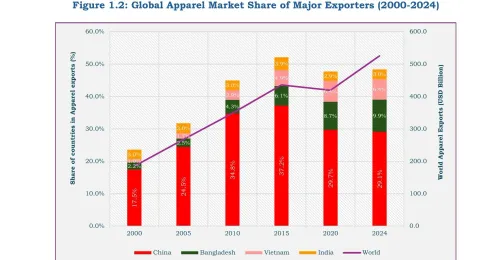
Source: Indian Council for Research on International Economic Relations
One observation offers partial reassurance: India is not being singled out.
Bangladesh, Vietnam and China appear on the same USTR list.
The competitive hierarchy among major apparel exporters may not shift dramatically.
But relative stability is not the same as immunity.
Buyers respond to absolute pricing conditions, not just relative ones.
A tariff that raises the overall cost of importing apparel into the United States influences order decisions across the supply chain.
Some buyers absorb it, some delay, some diversify until there is clarity.
Textile supply chains are particularly sensitive to that kind of uncertainty, because production decisions are made months before products reach consumers.
The Gap Between Ambition And Reality
Perhaps the most revealing statistic in this entire discussion has nothing to do with cotton or tariffs.
It concerns exports.
India’s textile and apparel exports declined 2.2% year-on-year to $35.79 billion in FY26.
That figure sits alongside an official ambition of reaching $100 billion in exports by 2030.
The gap is substantial, and it becomes even more striking when compared with regional competitors.
India’s apparel exports in 2025 were valued at approximately $15.7 billion.
Bangladesh exported around $51 billion. Vietnam exported roughly $39.4 billion.
These numbers raise an uncomfortable but important question.
If cotton availability were the primary constraint, would the gap really be this large?
India has spent years discussing manufacturing competitiveness, and rightly so.
Yet the challenge increasingly appears to lie beyond production itself.
Market access, supply-chain integration, trade relationships and speed-to-market often matter just as much as input costs.
The cotton waiver improves competitiveness inside India.
The tariff proposal highlights the realities waiting outside it.
If Market Access Becomes The Bigger Question
The textile industry has spent years discussing costs, productivity and manufacturing scale.
But if trade barriers become more common, the conversation may gradually shift.
Exporters may diversify towards newer markets.
Policymakers may place greater emphasis on trade agreements.
Manufacturers may invest more heavily in integrated supply chains that reduce delivery times.
In other words, the challenge stops being simply about producing garments efficiently.
It becomes about reaching customers reliably.
That distinction may matter far more over the next decade than any single cotton season.
Two Forces, One Value Chain
For investors, the most useful exercise is not predicting tariff outcomes.
It is understanding where the benefits and risks travel.
The cotton waiver benefits spinning mills first because they purchase raw cotton directly.
Lower input costs improve economics almost immediately.
Fabric manufacturers and integrated textile players benefit next, while garment exporters experience the gains with a lag as cheaper yarn and fabric move through the production cycle.
The tariff risk travels in precisely the opposite direction; it begins with exporters.
If export orders slow, garment manufacturers feel the impact first.
That weakness then moves backwards through fabric demand, yarn demand and eventually cotton consumption itself.
What makes the current situation particularly interesting is that both forces could arrive during the same earnings cycle.
An exporter may receive lower-cost inputs while simultaneously facing uncertainty around demand.
A spinning mill may enjoy cheaper cotton while discovering that downstream orders are becoming less predictable.
The two developments do not necessarily cancel each other out, but they do create a far more complicated earnings environment than either headline suggests.
Q3 FY27, which corresponds broadly to the October-December period, may provide some of the earliest evidence of how these opposing forces interact.
Two Clocks Moving In Opposite Directions
What stays with us is not the cotton waiver itself, nor is it the tariff proposal.
It is the contrast between them.
The cotton duty waiver demonstrates how quickly domestic policy can respond when an industry faces a competitiveness challenge.
The government identified a problem and acted within days.
Market access, however, operates on a completely different timetable.
Trade negotiations, diplomatic discussions and regulatory reviews move far more slowly.
The Section 301 proposal remains under consultation.
Industry groups will make representations.
Governments will negotiate. Outcomes will emerge gradually.
The cotton waiver and the tariff proposal are, on the surface, separate developments.
One side of competitiveness is built at home through lower costs, better infrastructure and supportive policy.
The other depends on access to markets beyond India's borders.
India has become steadily better at managing the first.
The second remains harder to predict.
Which leaves the textile industry with an unusual reality.
The shirt costs less to make today.
Whether it becomes easier to sell tomorrow is the question that matters.
Sources and References:
- INDIANTEXTILEJOURNAL
- PIB
- BUSINESSSTANDARD
- ECONOMICTIMES
- TIMESOFINDIA
- FAS
- USTR
- ICRIER
- THEHINDU
The content in this blog is intended purely for educational purposes. Any securities or mutual funds referenced are illustrative in nature and do not constitute a recommendation or endorsement by Kotak Neo. Investors are encouraged to assess their own financial situation and seek professional advice before making any investment decisions. For compliance T&C and disclaimers, Visit https://www.kotakneo.com/disclaimer
0 people liked this article.

Kotak Neo (Kotak Neo) is India's venerable stockbroking company with a rich legacy. It offers comprehensive investment services across asset classes, prioritising a technology-first approach for a seamless experience. Trusted by 5 million+ customers, it guides you toward financial success with ease of investment and speed of trade.
Note: The opinions expressed in this blog are personal viewpoints and should not be construed as recommendations.