India's Gulf Connection Is Bigger Than Oil
- 5 min read
- 7,016
- Published 13 Mar 2026

There are few global relationships as layered as India’s with the United States and the Gulf.
One is built on software engineers, Wall Street listings, and endless debate about trade deficits.
The other smells faintly of airport lounges in Dubai, construction dust in Doha, and long phone calls home to Kerala or Bihar after a 12-hour shift.
One relationship shows up in export statistics and trade negotiations.
The other shows up quietly in bank accounts in small Indian towns.
And yet, when you look at the numbers closely, something unexpected appears.
India earns almost as much from its workers in the Gulf as it does from its entire trade surplus with the United States.
Pause there for a moment.
Because that single observation rearranges the way one looks at West Asia, the Indian household economy, and perhaps even a few stock market sectors that nobody has connected to geopolitics yet.
The quiet river of money coming home
India has held the crown of the world’s largest remittance recipient for more than a decade.
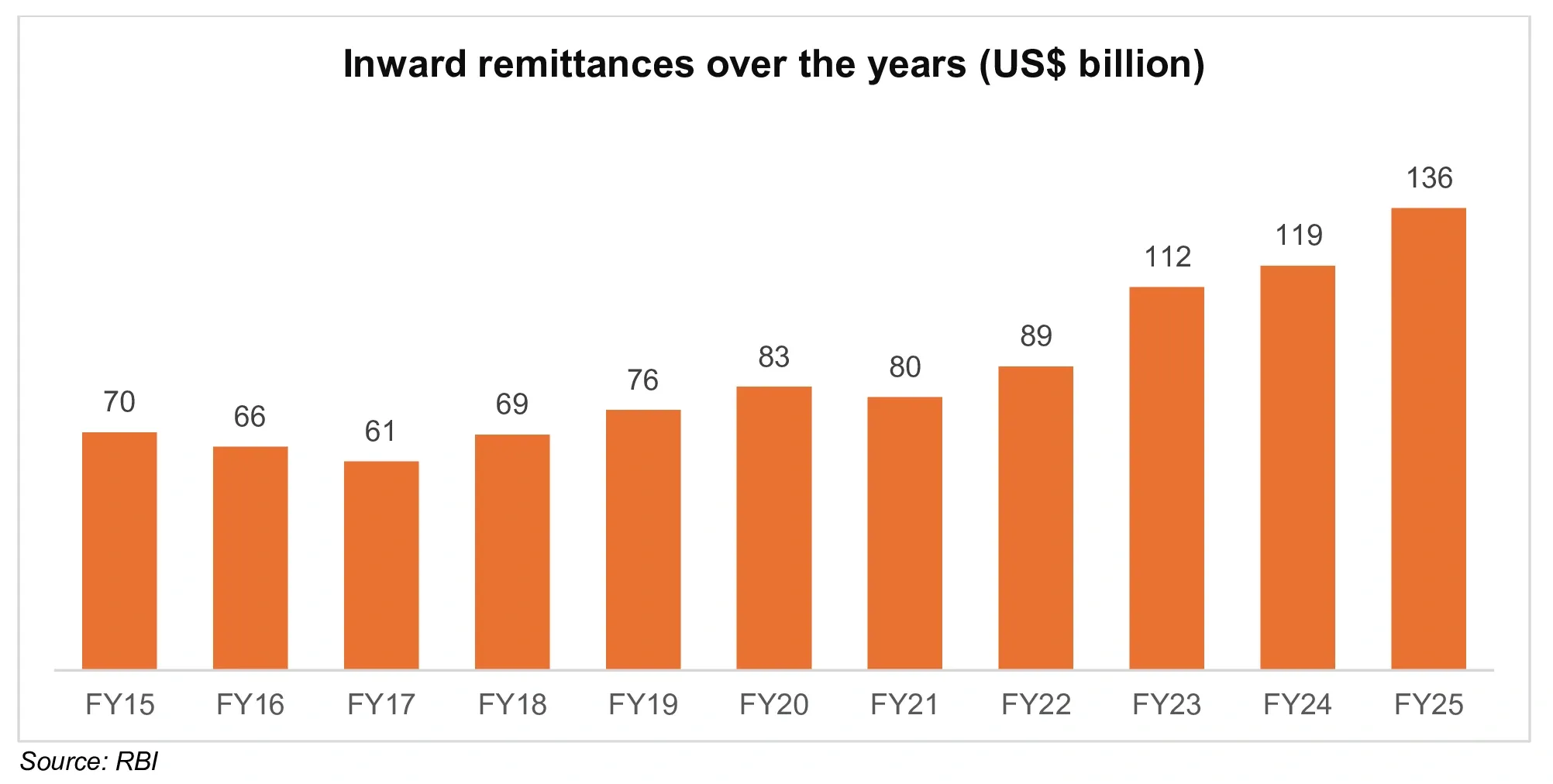
In FY2025, Indians working abroad sent home a record $135.46 billion.
RBI data and the Economic Survey 2025–26 reveal that remittance inflows into India rose 14% year-on-year to $135.4 billion in FY2024–25, up from roughly $129 billion in FY2023–24.
That is not small change drifting through remittance apps.
That is a macroeconomic current powerful enough to move consumption patterns across states and districts.
What is even more interesting is that this rise has not been a one-off spike tied to a good global year.
It has been structural.
Over the past decade, remittances flowing into India have almost doubled from around $69 billion in FY2014–15.
In other words, the money Indians send home from abroad has quietly become one of the most reliable financial streams supporting the domestic economy.
It is a macroeconomic force capable of shaping consumption patterns across states.
Today, remittances account for roughly 3–3.5% of India’s GDP.
Few cross-border income flows carry that kind of weight in an economy of India’s size.
For perspective, countries like China, Mexico, and the Philippines also receive large remittance flows.
Yet India sits comfortably at the top of the global table.
Souce IBEF
What tends to surprise people is where much of that money originates.
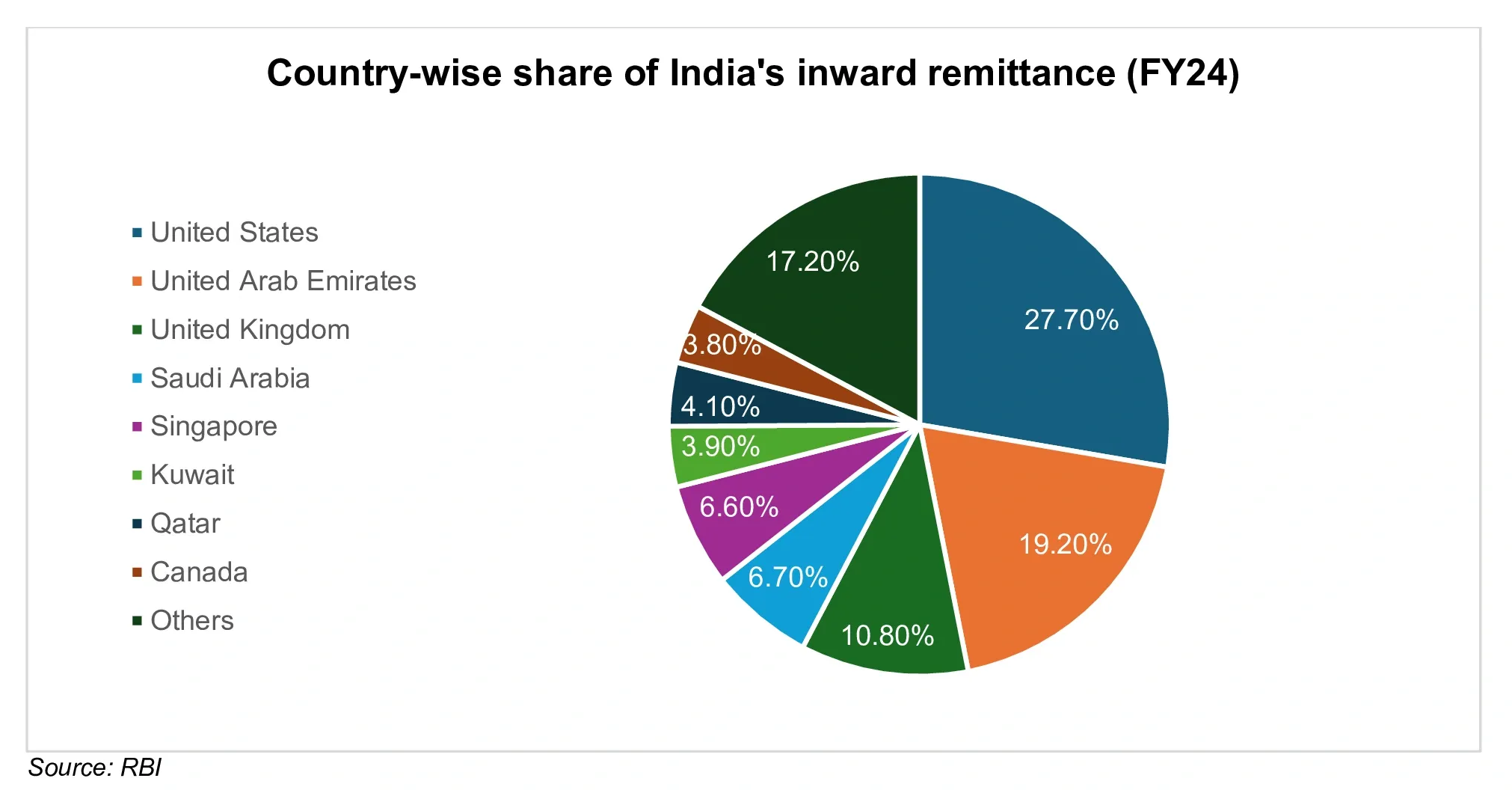
The Gulf Cooperation Council countries remain one of the most important corridors of remittance flows into India.
Roughly 38% of total remittances, about $51.4 billion, come from the Gulf region.
At roughly the same time, India’s entire trade surplus with the United States stood at $58.2 billion.
In other words, the money migrant workers send home from the Gulf nearly matches the net earnings India makes from its trade surplus with the United States.
That comparison is not often made in macro debates.
But once you see it, it becomes difficult to unsee.
Souce IBEF
Oil gets the headlines, but workers move the money
Whenever tensions flare in West Asia, the first headline in India is almost always about oil.
How much crude does India import?
What will happen to the oil bill?
Will inflation spike?
All valid questions.
India imports more than half its crude oil from the region, which makes energy security a permanent policy conversation.
But oil is only half the story; possibly the noisier half.
The quieter half is labour.
Millions of Indian workers across construction sites, hospitality chains, oil service companies, transport networks, and retail establishments across the Gulf send money home every month. Not occasionally or only during festivals, but month after month.
This steady stream of transfers does something unusual in macroeconomics.
It directly supports household income rather than corporate earnings or government revenue.
Which means it travels a very specific route through the economy.
From a worker in Doha or Dubai to a family in Kozhikode, Gorakhpur, or Darbhanga, to the local grocery store, gold shop, housing contractor, or school fee counter.
Remittances are not abstract financial flows.
They are consumption engines disguised as overseas salaries.
The strange stabiliser in India’s external accounts
Another detail that often receives less attention is how important remittances are to India’s balance of payments.
According to economic data and policy analysis, remittances finance roughly half of India’s merchandise trade deficit.
That means the money coming from overseas workers helps offset the gap between what India imports and what it exports.
India imports energy, electronics, and machinery in large quantities.
The trade deficit naturally widens as the economy grows.
But remittances act like a stabilising counterweight.
Unlike volatile capital flows, remittances tend to be remarkably stable and counter-cyclical.
When global economies wobble, migrant workers often keep sending money home because family obligations do not disappear during recessions.
It is one of the few international cash flows that behaves like household duty rather than speculative capital.
At least that is how it works in normal times.
War has a way of interrupting the normal
That stability can be tested when geopolitical tensions rise in regions where large numbers of migrant workers are employed.
That is where the current regional tensions begin to creep in.
As of March 2026, more than 9 million Indian workers are located across Gulf countries experiencing heightened geopolitical tensions, according to policy estimates and international reporting.
Some precautionary evacuations have already taken place.
More than 52,000 Indian nationals have been evacuated as tensions escalated across parts of West Asia.
For financial analysts tracking remittance flows, that number matters less as a humanitarian statistic and more as an economic signal.
Because the sectors where many migrant workers are employed are the first to slow down when geopolitical risk rises, construction pauses, hospitality weakens, oil service projects stall, and transport and retail activity cools.
Exactly the industries where a large portion of migrant labour operates.
That is why analysts have begun flagging potential disruption in the remittance pipeline.
Not necessarily a collapse, but even a moderate disruption can ripple across India’s consumption landscape.
A $10 billion tremor nobody will see immediately
Here is where things become interesting for investors.
If remittances were to fall by $10 to $15 billion, the effect would not show up dramatically in the next GDP release.
Macroeconomic aggregates are blunt instruments.
A few billion dollars shift inside a multi-trillion-dollar economy can easily hide in quarterly numbers.
But the real economy tends to feel the shift earlier.
Remittances are household cash flows, which means the impact shows up in spending behaviour first.
Families postpone home construction, gold purchases get delayed, two-wheeler upgrades wait another year, and small business inventory orders shrink slightly.
Each decision may seem small on its own.
But when millions of households make them simultaneously, consumption patterns change. And the lag is often about two quarters.
Which means the shock travels slowly like a delayed echo.
Follow the remittance map, and the stock market clues appear
Remittance flows into India are not evenly distributed.
Certain states receive disproportionately large inflows from migrant workers abroad.
Maharashtra, Kerala, Tamil Nadu, Uttar Pradesh, and Bihar consistently rank among the largest recipients of remittances.
Kerala’s connection to the Gulf is almost cultural at this point.
Entire local economies in parts of the state are built around Gulf employment cycles.
Large numbers of workers from UP and Bihar are also present across the construction and service sectors in the Gulf region.
This means any disruption in remittance flows eventually becomes visible in rural and semi-urban consumption patterns in these regions.
When viewed through an economic lens, the connection becomes clearer.
Companies that generate a meaningful portion of revenue from rural demand tend to react when household cash flows change.
Consumer staples firms selling packaged foods, personal care products, and everyday essentials often track these shifts closely.
FMCG companies with deep distribution networks in remittance-heavy states could see subtle changes in demand if overseas inflows weaken.
Not overnight, but gradually.
Another corner of the market worth watching
There is also a quieter corner of the financial system where remittances matter.
Certain NBFCs and financial institutions serve communities heavily linked to Gulf employment.
Their lending patterns often intersect with housing loans, gold loans, and small business financing tied to remittance income.
If a migrant worker’s salary stream slows or stops temporarily, repayment cycles can shift.
This does not automatically translate into stress.
But it is a variable investors rarely model when thinking about geopolitical events.
Most market commentary during a West Asia crisis focuses on crude prices and energy stocks.
Very few analysts map the ripple effect through remittance-dependent household economies; yet the connection exists.
A macro story disguised as a family story
Perhaps the most fascinating thing about remittances is how human they are.
Trade data measures containers and cargo, remittance data measures phone calls home. Multiply that story by millions, and it becomes a macroeconomic force large enough to rival global trade balances.
Which is why the current West Asia tensions deserve attention beyond oil markets.
India’s Gulf connection is not just about energy imports or diplomatic relations.
It is about a massive pipeline of household income flowing quietly into the country every month.
And when a pipeline that large runs through a conflict zone, investors might want to keep one eye on the oil chart and the other on rural consumption data six months from now.
Trade statistics capture containers and cargo.
Remittance data captures something far more personal.
Often, it is simply a monthly transfer home.
And when you multiply that story by millions of workers across the Gulf, it becomes one of the quiet forces supporting India’s household economy.
Sometimes the most important economic current is not the one dominating policy debates.
It is the one quietly funding kitchens, school fees, and small-town consumption across the country.
Sources and References:
NEWSONAIR
IBEF
INDIATODAY
ECONOMICTIMES
CNBC
USTR
FRONTLINE
THEHINDU
0 people liked this article.