20% of the World's Data. 3% of the Storage
- 5 min read
- 1,020
- Published 06 Mar 2026
There is something typically Indian about generating noise at scale.
Whether they are wedding videos that run longer than movies or never-ending cricket commentaries.
UPI delivery notifications that ping every second or reels that travel faster than small-town gossip.
Somewhere inside this digital carnival sits a statistic that feels almost mischievous.
India generates roughly 20% of the world’s data.
Yet we host only about 3% of global data centre capacity.
It is a bit like cooking the feast and asking someone else to plate it.
And now, quietly, Budget 2026 has decided that this imbalance deserves attention.
The 21-Year Signal
When the government announced a 21-year tax holiday, running till 2047, for foreign companies delivering global cloud services from Indian data centres, most coverage treated it as another Big Tech love story.
Incentives are offered, global giants nod, and headlines celebrate investment.
But a 21-year window is not a quarterly tweak, but generational.
It is the most ambitious attempt to make India a data processing hub since the IT parks of the 1990s reshaped the services economy.
Back then, the bet was on talent.
This time, the bet is on infrastructure: steel, concrete, cooling systems, substations, and fibre.
Within days of the policy signal, the announcements began stacking up in ways that felt almost choreographed.
On the week of 27 February, OpenAI signed with TCS as its first Indian data centre customer.
The commitment was for 100 MW, with an option to scale to 1 GW.
“ONE GW”. This number carries a certain theatre, the sort that is usually associated with power plants rather than rows of humming servers.
Google has committed $15 billion for a 1 GW AI campus in Visakhapatnam.
Microsoft has pledged $17.5 billion.
At India’s AI Summit, total investment announcements touched $277 billion over 5-7 years, with the majority directed at data centre infrastructure.
At first glance, it may look like foreign technology companies are choosing India.
The deeper story is that India is finally attempting to process what it produces.
The Gap That Is the Opportunity
An industry voice recently said India needs 20% of global data centre capacity to match its data generation.
Today the number sits near 3%, and that difference is not just a statistical gap.
It is the opportunity.
For years, Indian data has travelled abroad to be processed, stored and monetised.
The raw material is created here; the refinement often happens elsewhere.
The tax holiday till 2047 is an attempt to pull that value chain home.
Deloitte estimates that India is poised to capture a significant share of the $800 billion Asia data centre boom.
Now, $800 billion is not a marginal theme; it is continental-scale infrastructure.
And, infrastructure is where markets quietly build wealth.
Hyperscale Is Not Just a Buzzword
The term hyperscale tends to float around in conference rooms, but the numbers now attached to it are heavy.
Several companies are setting up hyperscale data centres of more than 1 GW in India.
Data centre investments are expected to peak in 2026 after what has already been described as a landmark 2025.
Yotta has spoken about AI GPU demand driving capacity expansion, with appetite for advanced chips shaping data centre scale.
When GPU demand starts dictating real estate and power planning, you know the conversation has moved beyond coding.
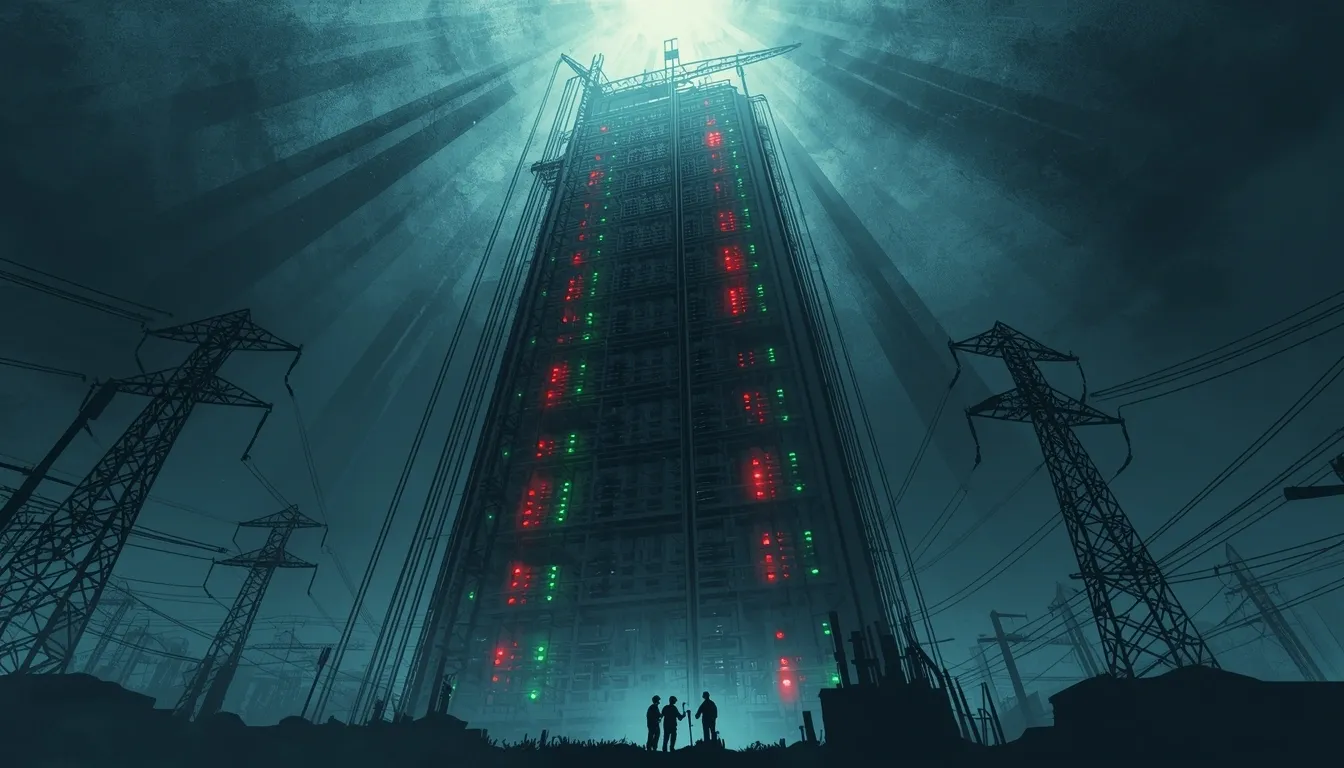
These facilities are among the most power-intensive assets in the economy.
They cannot tolerate patchy supply or romantic notions of intermittent electricity.
They require stable base-load power, serious cooling infrastructure, and land parcels large enough to look like industrial estates rather than office parks.
Suddenly, the AI story begins to look suspiciously like a power story.
Layer One: Building the Physical Backbone
For investors, it helps to separate the opportunity into layers rather than chasing the flashiest logo.
Layer one is the direct infrastructure build, colocation operators and EPC contractors laying down the physical backbone.
Companies like TCS and L&T design and execute these data centre projects.
When OpenAI partners with TCS for 100 MW with optional scaling to 1 GW, the scale is not symbolic.
Instead, it is an order book.
The $15 billion AI campus from Google and the $17.5 billion commitment from Microsoft will not materialise through press releases alone.
They will translate into contracts, cables, transformers, cooling systems and thousands of construction hours.
Yet here lies the twist.
Most pure-play operators, such as Yotta and Sify, are unlisted.
The direct exposure is not neatly packaged for retail investors.
That forces a slightly more imaginative approach.
Layer Two: The Quiet Beneficiaries
Layer two is where the more interesting trades may sit.
Data centres consume enormous amounts of electricity.
Power transmission companies become critical.
Transformer makers move from peripheral suppliers to essential partners.
Cable manufacturers supplying high-capacity lines and fibre connectivity find themselves in the middle of the story.
Real estate companies with large land parcels near cities such as Mumbai, Chennai or Hyderabad may suddenly find these locations acquiring a different strategic value.
The 2026 Budget also exempted customs duty on nuclear power components.
On the surface, this looks like energy policy housekeeping.
Underneath, it aligns neatly with the needs of hyperscale data centres that require clean, stable base-load power.
Nuclear power does not flicker with cloud cover or calm winds; it hums steadily.
When energy policy starts echoing digital policy, you know the coordination is intentional.
The Industrial Face of AI
In the 1990s, India built IT parks that became symbols of aspiration.
Engineers walked into glass towers and wrote code for the world.
Today, the ambition feels heavier.
There is a temptation to view the AI boom purely through software companies and semiconductor shortages.
In India’s case, the listed leverage may lie in industrial companies that manufacture transformers, cooling systems and heavy-duty cables.
If India is serious about narrowing the 20% versus 3% imbalance, thousands of megawatts of new capacity will need to be built.
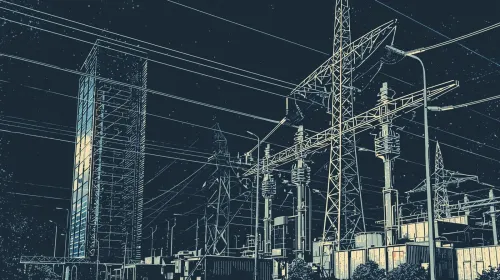
That means substations, transmission corridors, backup systems, water for cooling, and land development.
These are not glamorous themes.
They are predictable, capital-intensive and often overlooked until the order inflow spikes.
For traders, volatility will sit in announcements and execution timelines.
For long-term investors, the opportunity may lie in identifying which companies become indispensable to this build-out, rather than which global tech giant cuts the next ribbon.
Watching the Unlisted, Positioning in the Listed
An IPO from Yotta within the next 12 months would offer a more direct entry point into the data centre theme.
The company has already indicated a preference for a domestic listing in FY27 after shelving earlier overseas plans.
This signals that the Indian capital markets are now deep enough to host serious AI infrastructure stories.
Until that happens, most investors are positioned just outside the core asset.
That is not a disadvantage.
Yotta’s own trajectory hints at the scale building beneath the surface.
Revenues have grown significantly in recent years due to increased demand for AI and GPUs.
The Panvel campus near Navi Mumbai has expanded from about 20 acres to 70 acres.
It can now support up to 22 data centre buildings and has the potential to provide up to 2 gigawatts of power when fully built out.
Meanwhile, other players are lining up.
Sify Infinit Spaces has secured regulatory approval for a ₹3,700 crore IPO, and additional operators are exploring public listings.
The pipeline itself is a signal that data infrastructure is graduating from niche to a mainstream capital markets category.
For listed investors today, the exposure remains layered.
TCS and L&T as builders, power infrastructure companies as enablers, real estate firms with strategic land banks, and cable and transformer manufacturers riding the capacity expansion are the lines worth tracing closely.
The Real Question
India generates about 20% of the world’s data and stores barely 3% of it.
For years, that imbalance was treated as a by-product of globalisation.
Budget 2026 reframes it as a missed economic opportunity.
This is not simply about foreign companies building campuses in India.
It is about whether India can convert digital activity into domestic processing power, and processing power into long-term economic capture.
Data that is stored, analysed and monetised locally anchors jobs, contracts, energy demand and tax flows within the system.
When a country stops exporting raw output and starts refining it at home, the value chain thickens.
Suppliers gain visibility.
Infrastructure companies gain order books.
Power assets gain long-duration demand.
Capital allocation shifts quietly but decisively.
The noise of Indian data is already loud.
The more important signal may be the silent construction of the physical backbone that keeps that data within its borders.
For investors, that backbone is not just policy ambition.
It is a long infrastructure story unfolding quietly, one power line, server rack and cooling plant at a time.
Sources and References:
- PRESSINSIDER
- REUTERS
- BUSINESSSTANDARD
- TIMESOFINDIA
- THEHINDU
- MONEYCONTROL
- DELOITTE
- TRADEBRAINS
- LIVEMINT
- ECONOMICTIMES
0 people liked this article.