The Cigarette Tax Nobody Panics Over Anymore
- 5 min read
- 7,822
- Published 27 Feb 2026

Ever stood at a pan shop on Budget day?
There’s usually a ritual.
Someone mentions a tax hike in passing.
Someone else asks the new price.
There is a brief pause. It feels almost theatrical.
And then, the notes change hands anyway.
On 1 February 2026, that pause cost about ₹25 to ₹55 more per pack for many smokers.
The shrug that followed was priceless.
It was not a rebellion. It was not outrage. It was an adjustment.
And for those watching the markets, it meant something else entirely.
It was a signal.
When a Tax Hike Becomes Routine
The Union Budget 2026 did not whisper when it came to tobacco.
The earlier GST plus compensation cess structure was replaced.
In its place came a new length-based excise duty system on cigarettes.
This now sits alongside the highest GST rate of 40% on sin goods such as tobacco products.
Under the Central Excise Amendment Act, 2025, cigarettes are now taxed per stick based on physical length.
Short non-filter sticks attract roughly ₹2.05 per stick. Short filter sticks around ₹2.10.
Medium lengths sit in the ₹3.60 to ₹4 range.
Longer or specialised designs can go up to ₹8.50 per stick.
The older tariff structure is gone.
It charged basic duty per thousand sticks.
The new one taxes each individual stick.
Add to that the 40% GST, and the overall tax burden on many cigarette categories now climbs to an estimated 53% or more of the retail price.
Still below the 75% tax share recommended by the World Health Organisation, but substantial enough to make headlines.
And yet, on the street, it felt almost procedural.
The Price Moves, The Buyer Adjusts
Standard 10-stick packs like Wills Navy Cut, 76 mm, moved from around ₹95 to nearly ₹120.
Longer premium variants such as Gold Flake and Wills Classic now retail at approximately ₹220 to ₹225 or more.
Some categories have seen prices rise by ₹50 to ₹55 per pack.
In most sectors, that kind of price revision would invite consumer pushback, maybe even volume collapse.
Here, it was absorbed. Not celebrated, not protested. Just factored in.
That is where predictable disruption reveals itself.
The industry expects the hike.
The consumer expects the pass-through.
The government expects the revenue.
Nobody is shocked because everyone saw it coming.
The Government’s Quiet Dependence
Tobacco taxes accounted for about 2.2% of India’s Gross Tax Revenue in FY 2023 to 2024.
With provisional Gross Tax Revenue at ₹34.37 lakh crore, that 2.2% translates to roughly ₹76,000 to ₹76,300 crore.
That is not trivial.
At the same time, the economic cost of tobacco use in 2017 to 2018 was estimated at about 1% of GDP.
For every ₹100 the government gained in tobacco excise in 2016 to 2017, society paid about ₹816.
That includes healthcare costs and lost productivity from tobacco-related illness and premature deaths.
It is an uncomfortable equation.
The fisc depends on it.
Public health pays for it.
And somewhere between those two numbers sits the investor, watching cash flows.
The Market Blinked. Then It Didn’t.
When the GST and excise changes were announced, major tobacco stocks such as ITC Ltd, Godfrey Phillips India Ltd and VST Industries Ltd reacted sharply.
Investors turned cautious, anticipating pressure on sales volumes and margins.
Share prices fell.
Market capitalisation eroded visibly in the first few trading sessions.
Then something familiar happened.
Companies moved quickly to protect profitability by announcing price increases of roughly 20 to 40%.
The market read that not as desperation, but as confidence.
Pricing power was intact.
Brand resilience was intact.
The assumption that a significant portion of the tax impact could be passed on without severely hurting demand began to look reasonable.
By mid-February, tobacco stocks had staged a notable recovery, gaining nearly 12 to 20% from their post-announcement lows.
Godfrey Phillips led the rebound.
ITC and VST Industries followed with steady upward momentum, even as some brokerages trimmed earnings estimates and flagged near-term margin risks.
The pattern was almost rehearsed.
Initial fear.
Swift pass-through.
Recovery rally.
A History of Gradual Tightening
This was not the first time regulations tightened around cigarettes.
After independence, policy steps were slow.
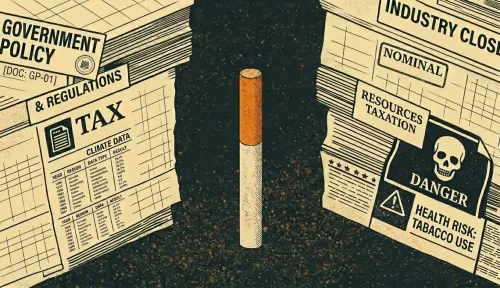
The Cigarettes Regulation of Production, Supply and Distribution Act of 1975 introduced statutory health warnings on packs.
Through the 1990s, measures accumulated.
Advertising restrictions.
Sales regulations.
Then came the Cigarettes and Other Tobacco Products Act in 2003, banning smoking in public places, prohibiting tobacco advertising and barring sales to minors and near schools.
Key rules came into force in 2004.
The National Tobacco Control Programme launched in 2007 to strengthen enforcement and awareness.
From around 2012, several states banned pre-packaged gutka and flavoured smokeless tobacco, with studies and WHO reviews noting reduced availability and, in many cases, reduced consumption.
In 2019, electronic nicotine delivery systems were banned nationwide.
Layer by layer, the net tightened.
Yet cigarettes remained.
Regulation as Margin Engineering
Here is the part investors quietly understand.
In tobacco, regulation is not an unpredictable shock.
It is a calendar event.
Excise hikes are priced in before they arrive.
Companies treat them as line items.
Consumers, even those price-sensitive in other categories, adjust almost mechanically.
The system behaves less like a battlefield and more like a choreography.
Excise here is not only about curbing demand.
It is about funding the fisc.
The state depends on reliable excise flows.
The industry depends on predictable pricing frameworks that avoid sudden volume shocks.
It is a stable, if silent, co-dependence.
In most industries, regulation is feared.
In this one, it is factored in.
The Bigger Question for Markets
The ₹2 shrug is not about smoking habits.
It is about how deeply predictable disruption has become.
When a tax burden of 53% or more of retail price does not materially break demand, something structural is at play.
When price hikes of ₹50 per pack are absorbed, it reinforces that idea.
And when stocks recover 12 to 20% after initial panic, the pattern becomes harder to ignore.
Pricing power is not just intact. It is embedded.
For investors and traders, this raises sharper questions.
Which other sectors are entering this phase?
Where regulation is no longer feared but modelled?
Where policy feels less like control and more like coordination?
Where margins are quietly engineered around predictable intervention?
The lesson from cigarettes is not moral. It is mechanical.
Predictable change rarely changes behaviour. It adjusts spreadsheets.
If disruption becomes a ritual, markets stop flinching.
And when markets stop flinching, the real volatility moves elsewhere.
Sources and References:
- CLEARTAX
- TIMESOFINDIA
- ANGELONE
- REUTERS
- WHO
- SUNDAYGUARDIANLIVE
- BUSINESSTODAY
- TAXGURU
- INDIABUDGET
- PUBMED
- FINOLOGY
- ECONOMICTIMES
- NCBI
- INDIACODE
- NHM
- MOHFW
0 people liked this article.