Elon Musk’s Starlink, and What Would Happen if it Comes to India?
- 3 min read
- 1,580
- Published 18 Dec 2025

The internet is like electricity - everyone needs it, but not everyone has it.
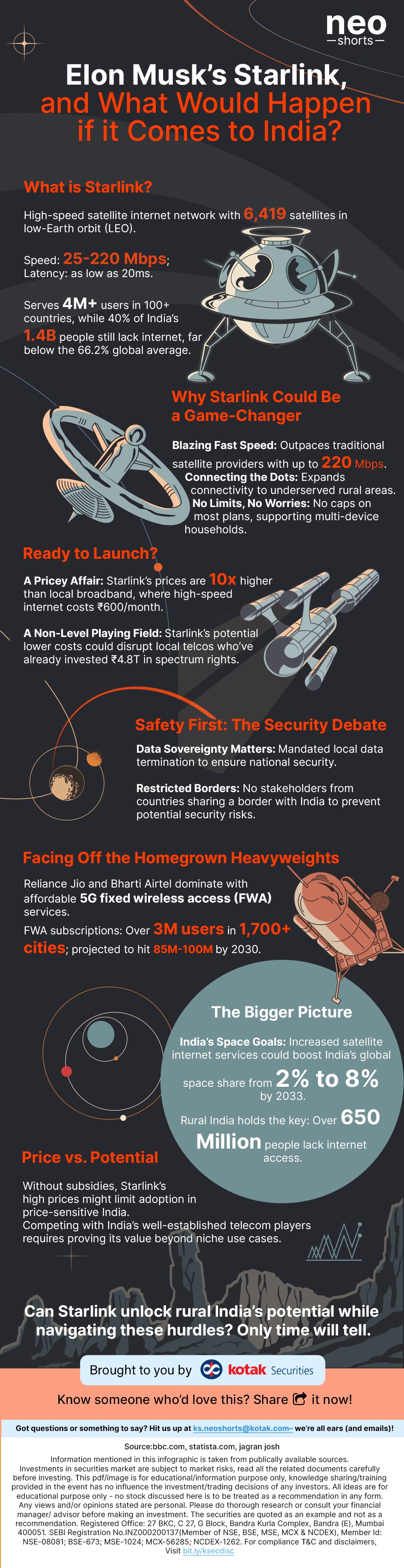
India, home to 1.4 billion people, still struggles with internet penetration. Over 40% of people lack access. That’s far below the global average of 66.2%.
Imagine streaming your favourite TV show live from a remote village, or attending an online class while camping in the mountains. Sounds impossible, right?
Not with Starlink.
What Is Starlink, anyway?
Think of Starlink as a web of satellites blanketing the Earth. With over 6,400 satellites in low-Earth orbit, it delivers high-speed internet at speeds between 25 to 220 Mbps.
Today, Starlink serves 4 million users across 100+ countries.
Sounds like a game-changer, right? Well yes - but let’s not get ahead of ourselves.
India’s internet scene is no cakewalk. Local giants like Reliance Jio and Bharti Airtel dominate with affordable 5G services, offering high-speed plans for as low as ₹600 per month.
Starlink? Its monthly fee could be ten times that. In a price-sensitive market, convincing users to switch won’t be easy.
Then, there’s the tech.
Starlink’s satellites offer extensive coverage, but India’s telecom companies have already invested billions in network infrastructure and spectrum rights, raising concerns about an uneven playing field.
See, over the past decade, telecom operators have collectively spent more than ₹4.8 trillion on spectrum rights, vital investments that have enabled the nationwide rollout of 5G services.
These operators argue that Starlink poses a potential threat to their revenue, particularly in urban markets where Jio and Airtel are banking on 5G-powered Fixed Wireless Access (FWA) for growth.
Fixed Wireless Access (FWA) services have already made inroads, with 3 million subscribers across 1,700+ cities. Projections suggest this number could skyrocket to 85-100 million by 2030.
A newcomer like Starlink could disrupt the market - but only if the price is right and regulations play fair.
Speaking of regulations, data security is a big deal.
India requires that data from its citizens be stored locally. Starlink will need to comply or risk being grounded before takeoff.
Additionally, the government frowns upon foreign stakeholders from neighbouring countries participating in key tech ventures - another potential hurdle.
Still, the possibilities remain enormous.
With over 650 million people lacking basic internet access, India’s internet penetration is far below the global average.
Expanding internet access could boost the country’s economy, elevate its tech industry, and even propel its space ambitions.
With the right approach, Starlink could help India increase its share in the global satellite internet market from 2% to 8% by 2033.
But the question remains: Can Starlink find its footing in India without breaking the bank or stepping on too many regulatory toes?
Without subsidies, its high prices might keep adoption limited.
To succeed, it must compete with established telecom giants and prove its value to millions of users beyond niche use cases.
It’s a race between promise and practicality, with rural India holding the key to unlocking an untapped digital future.
For now, the sky’s the limit - but reaching India’s billion-plus users might be the real ultimate challenge.
Sources:
0 people liked this article.