What Is ROCE? Understanding The Meaning, Formula, And Business Impact
- 5 min read
- 1,247
- Published 18 Dec 2025
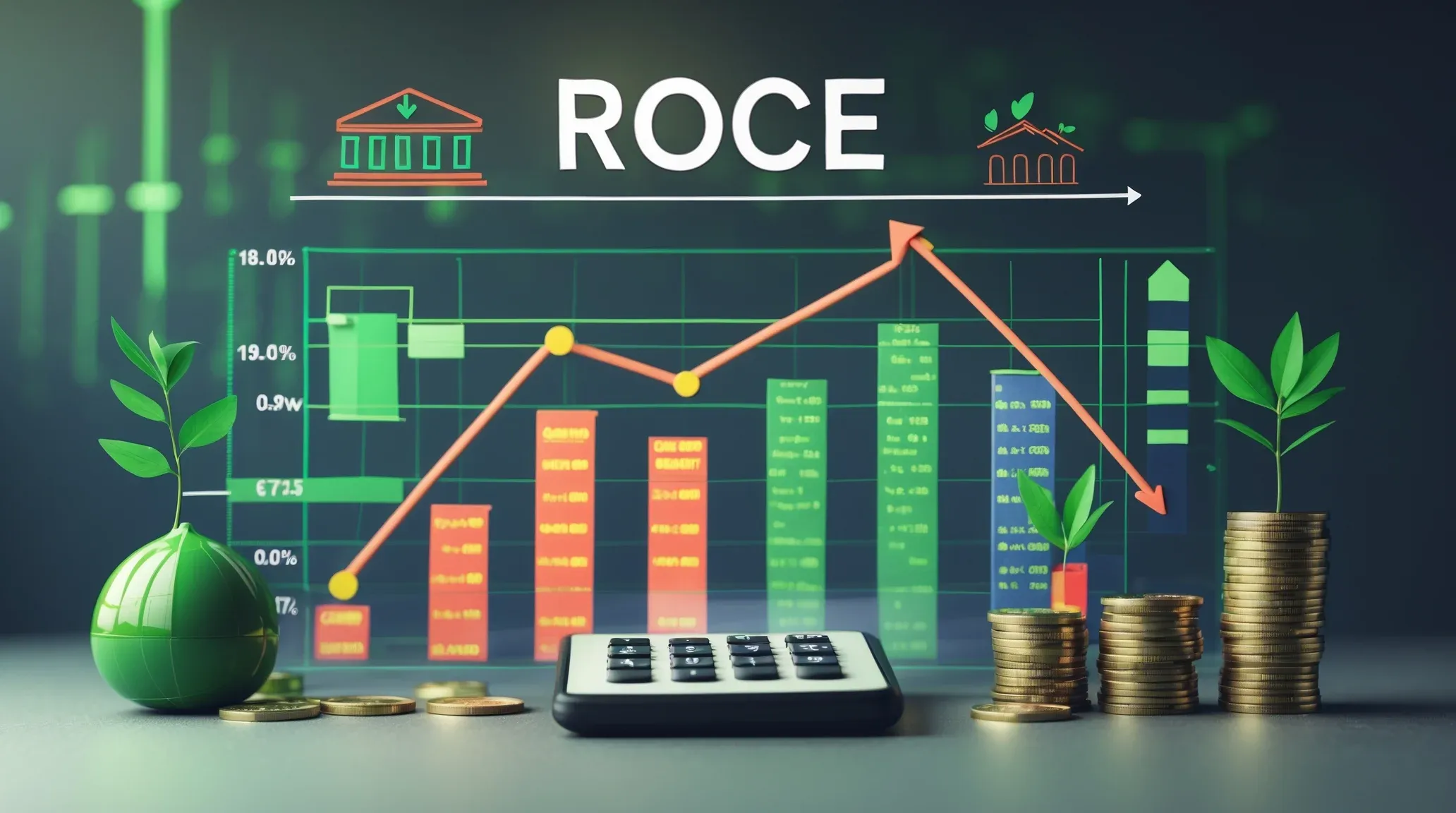
To assess a company's effectiveness in using its capital to generate profits, consider more than just sales or net income. A key metric in that regard is ROCE (Return on Capital Employed). Whether as an investor, owner of a business, or just trying to wrap your head around how companies function, being aware of ROCE allows you to evaluate how efficiently a company is using its capital. Let's dive into ROCE meaning, its formula, and why ROCE is so important for organisations.
What is ROCE?
ROCE stands for Return on Capital Employed, telling you how much profit the company generates from the funds you have invested in your business. If you invested Rs. 1 crore in your business and your profit before interest and taxes at the end of the year was Rs. 20 lakh, ROCE tells you how effective your investment is as a percentage.
Unlike some other profitability ratios, ROCE does not just look at the equity or the money directly put in by shareholders. Instead, it considers all the funds used in the business, including borrowed money. This makes it a broader and often more telling measure of performance.
ROCE Formula Explained
Calculating ROCE is straightforward, but you need to know where to look in a company’s financial statements. Here’s the formula:
ROCE = (Earnings Before Interest and Tax (EBIT)) / (Capital Employed) × 100
Let’s break down the two main parts:
1. Earnings Before Interest and Tax (EBIT): This is the profit a company makes from its operations before paying interest on loans and taxes to the government. You can usually find this number on the company’s profit and loss statement.
2. Capital Employed: This is the total amount of capital that has been used to generate profits. You can calculate it in two ways: ○ Total Assets minus Current Liabilities ○ Equity plus Non-Current (Long-Term) Debt
Both methods should give you the same number. Capital employed shows how much money is actually at work in the business, not just sitting as cash or inventory.
Example:
Suppose a company reports an EBIT of ₹50 lakh and has total assets of ₹4 crore, with current liabilities of ₹1 crore.
Capital Employed = ₹4 crore - ₹1 crore = ₹3 crore
ROCE = (₹50 lakh / ₹3 crore) x 100 = 16.67%
So, for every ₹1 invested in the business, the company earns a little less than 17 paise before interest and taxes.
Here’s Why ROCE Matters
You might wonder: why not just look at profits or net income? The answer lies in efficiency. ROCE doesn’t just show if a business is making money; it shows how well it is using its resources to do so.
-
Comparing companies: ROCE is especially useful when you want to compare companies in the same industry, no matter their size. A smaller company with a higher ROCE is often using its capital more wisely than a bigger company with a lower ROCE.
-
Investment decisions: As an investor, ROCE helps you spot businesses that are generating strong returns from their investments. Over time, companies with high and stable ROCE tend to create more value for shareholders.
-
Internal benchmarking: If you run a business, tracking your ROCE over time helps you see if you’re getting better at using your capital. A falling ROCE might be a warning sign that your investments are not paying off as well as before.
Limitations Of ROCE
For it to be completely objective, consider using ROCE with other financial ratios. For instance, if a company has made a substantial investment that has not yet produced profit, it could throw the ROCE figure off. Additionally, different industries have varying capital demands, so ROCE should be compared between companies in the same sector.
Another downside is ROCE is based off book values and not market values. Therefore, if a company's assets have been written down, or are significantly undervalued on the balance sheet, the ROCE value may not be accurate.
How You Can Use ROCE
If you’re investing in stocks, check the ROCE for at least the last five years. Look for companies with a consistently high ROCE, especially compared to their peers. If you’re running a business, set a target ROCE and review your investment decisions regularly to see if you’re hitting that mark. Even if you’re just trying to understand a company’s annual report, knowing ROCE helps you ask sharper questions about its use of capital.
Conclusion
ROCE goes a step further than just measuring if a business is profitable; it shows how efficiently the company is using its capital to generate that profit. It's no wonder ROCE is popular among seasoned investors and savvy business owners in India and around the globe. ROCE is the difference between seeing the top line of business performance and looking under the hood to see what is driving that performance.
FAQs
0 people liked this article.