Machine Learning in Trading: A Story
- 6 min read
- 1,062
- Published 27 Jan 2026
Machine Learning in Trading: A Story
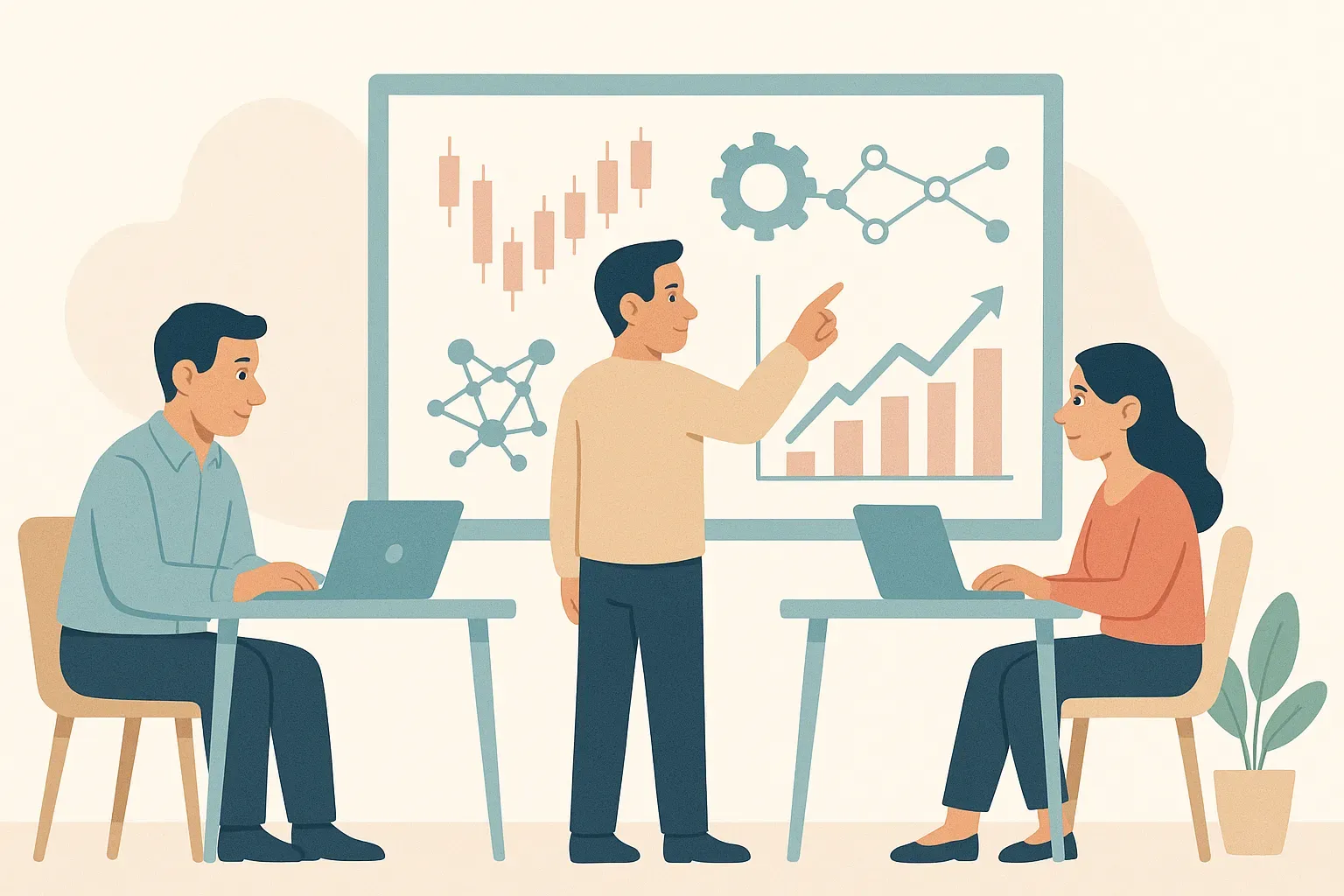
Imagine you’re at a crossroads in a bustling city of data, tickers flashing, numbers skating, and patterns hidden beneath what looks like chaos. That’s the world of markets. Now imagine a robot companion by your side, quietly absorbing the noise, spotting patterns you can’t see, and whispering suggestions in real time. That’s the promise of machine learning in trading.
In this blog, we’ll walk through how this companion works, how “trading and machine learning” are intertwining, and how “machine learning on trading” is shaping the future, while leaving you to draw your own conclusions.
From Gut Feeling to Data-Driven Moves
In the early days of trading, gut instincts, books, charts, and the experience of the trader were king. But as volumes rose, data exploded, news feeds, social chatter, real-time prices, and order flows.
Enter “trading and machine learning” as an idea: can machines sift through this flood, pick out signals, and help us trade smarter? In simple terms, you feed historic market data + other inputs to an algorithm, it learns patterns, then you deploy it live. That’s machine learning in trading in a nutshell.
Why the Buzz Now?
The environment has changed. Some numbers to ground this: the global AI trading platform market (which overlaps heavily with applying machine learning in trading) was estimated at about USD 11.23 billion in 2024, and is projected to hit roughly USD 33.45 billion by 2030.
These numbers suggest “machine learning on trading” isn’t a niche anymore; it’s becoming mainstream.
How It Works: The Four-Act Play
Think of this trading algorithm as a helper that works in the background. Here’s how it operates in simple terms:
-
It begins by gathering the information: The algorithm initially gathers such information as price, volume, order-book, news, and even social-media mood. This just implies that it attempts to know what is going on in the market at this particular moment.
-
Then it trains and learns on that data: It uses that data to determine what data, in fact, counts, and cleanses it before replacing it into a machine-learning model. In basic terms, it gets patterns, such as what signals tend to occur prior to either an increase or a decrease in price.
-
Its next stage is to put the model into practice: When the training is complete, the model begins to provide real-time recommendations like buying, selling, or holding. These aren’t random. They are founded on past market behaviour in terms of patterns.
-
Lastly, it studies its own mistakes: The system corrects itself in return. In the end, after learning the outcome of the trade, the system asks: Did I make the right prediction? If not, it adjusts itself. This is a feedback loop which makes it sharper with time.
In general, machine learning in trading does not strive to substitute humans.
It is aimed at helping traders to analyse and discern patterns more quickly, which a human may struggle to notice during live trading.
Real-Life Use Cases
-
Sentiment analysis
The system reads news and social-media posts to understand the overall mood around a stock, whether people seem positive, negative, or unsure. It then uses this mood as one of the inputs while deciding how to trade. -
Pattern recognition
The algorithm looks for groups of stocks that move in similar ways. When it finds these patterns, it can spot possible trading opportunities that may not be obvious to a human. -
Reinforcement learning
This method works like trial and error. The system tests different trading ideas in simulations, sees what works and what doesn’t, and improves its strategy over time. These techniques are what the term "machine learning on trading" is all about - converting data into decisions.
Where It Adds Value
- Speed: Markets change in seconds. A human trader can also take up 5-10 seconds to read the price change, consider it, and press a button, and during this period, the price might already reset. People are prone to errors, too, when they are in a hurry, such as typing the incorrect number or not replying at once.
However, a machine-learning model will respond in just a few milliseconds.
To give an example, when a stock suddenly jumps in volume, the model is able to identify the increase, compare it with previous trends, and send a signal almost immediately before even a human can notice the movement.
This acceleration benefit implies that the system is able to seize opportunities and prevent mistakes that human beings may overlook.
- Complexity: There are hundreds of things to consider when trading manually - price changes, volume spikes, news updates, technical indicators, order-book movements, global cues, and even sudden market rumours. No human can track all of these at the same time without getting overwhelmed.
Machine learning, however, handles this seamlessly.
It is trained on large datasets and models that can process many inputs at once, find patterns, and make decisions without getting confused. This allows it to analyse complex market information far more efficiently than a human ever could.
- Adaptation: Markets don’t behave the same way all the time. Sometimes they trend, sometimes they crash, sometimes they stay flat. A human trader may take weeks or months to realise that the market has changed.
A machine-learning model can be retrained to adjust quickly. For example:
If the market suddenly becomes very volatile, the model is retrained with new data. It learns, “Prices are moving faster now,” and changes how it reacts.
If the market becomes calm again, it learns that too and adjusts its signals.
But remember: speed, complexity, and adaptation aren’t guarantees of profit, just potential enablers.
The Other Side: What to Watch
Since we’re keeping things neutral, here are some caveats:
- Quality of data is important: When the system is fed with incorrect or incomplete data, the system can make incorrect decisions.
As an example, when price data is not available or the news data is not recent, the model might believe that a stock is safe when it is actually plunging. Good, clean data is what is needed to make good signals.
- The danger of over-fitting: the model can appear ideal when used to perform back testing due to the memorisation of old data rather than because it has overall learnt some real patterns.
However, it can be a disaster in live trading when market conditions vary by even the slightest margin. That is why models require proper validation and also frequent updates rather than simply good backtests.
- Dynamism in the market: A successful strategy yesterday might not be as successful today. Markets may change because of new regulations, international events or changes in the behaviour of traders.
Machine-learning systems need to continue learning and adapting; otherwise, they too will become obsolete and imprecise.
-
Interpretability: Other ML models are black boxes, i.e. buy/sell signals that do not provide the reasoning behind their decisions. This renders traders to question or seek the logic behind the decision, particularly under credit crunch conditions.
-
Cost/ infrastructure: ML-based trading systems are not inexpensive to run. They require high-speed computers, low-latency network, servers that are reliable, and continuous monitoring.
Without such an arrangement, there is also the likelihood of the system sluggishness, signal lapses, or total disconnection during volatile market situations.
What’s Next?
As the numbers show, the market of applying machine learning in trading is still expanding. What will likely shape the next phase:
-
More retail-friendly tools: As infrastructure costs drop, more small traders may access “machine learning on trading” capabilities.
-
Hybrid human-machine workflows: Where the model suggests, the human reviews, fine-tunes or overrides.
-
Regulation & risk control: With machines taking the driving seat, regulation and risk structure devolve.
-
Cross-asset models: More than stocks, into commodities, crypto, and FX. New niches are potentially found by machine learning
Final Thoughts
If you imagine the trading floor of tomorrow: desks not cluttered with tapecharts but with dashboards, alerts, model outputs, one thing is clear: machine learning in trading is not sci-fi anymore. It’s real, growing, and being experimented with.
Whether it becomes the dominant way to trade, or just one of many tools in a trader’s belt, remains to be seen. But if you’re curious about “trading and machine learning”, it’s worth understanding how “machine learning on trading” works, the value it adds, and the trade-offs it brings. Happy investing.
References
0 people liked this article.